

At least 5 dead in al-Shabab attack on Mogadishu hotel
Suicide bomber detonates car bomb outside and gunmen storm building, taking hostages in latest assault by al-Qaeda ally
 Add ToI as a Preferred Source on Google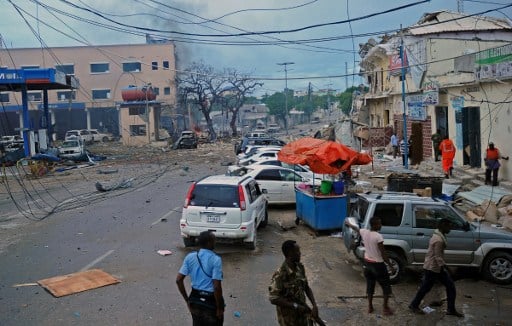
MOGADISHU, Somalia (AFP) — At least five people were killed Saturday in an attack on a hotel in the Somali capital Mogadishu that was swiftly claimed by Al-Qaeda-affiliated al-Shabab militants.
The assault, the latest by the al-Shabab group targeting hotels and restaurants in recent months, was led by a suicide attacker driving a car laden with explosives, the jihadists said in an online statement.
As night fell in Mogadishu, sporadic gunfire could still be heard coming from the Naasa Hablood hotel after it was stormed by the militants, witnesses said.
“What we know is that there were at least five victims, including three security guards, and that six others were injured,” police official Ibrahim Mohamed said.
“The security forces have managed to enter into the hotel and are in the process of restoring security,” Mohamed added.
The attack began at 4:30 p.m. (1330 GMT) with a powerful blast followed by two other explosions and then heavy gunfire, AFP journalists and a witness said.
The Naasa Hablood hotel in southern Mogadishu is often used by politicians and members of the Somali diaspora visiting the city.
Somali security forces cordoned off access to the neighborhood in which the hotel is located, an AFP photographer said.
Al-Shabab swiftly claimed responsibility for the attack, saying in a statement on the Telegram smartphone app that jihadist gunmen had forced their way into the hotel.
“The attack started with a heavy blast carried out by a brother who drove a car loaded with explosives. Gunmen fought their way into the hotel, and we believe that casualties were inflicted in the enemy’s ranks,” the group said.
Saturday’s attack came just three weeks after another assault quickly claimed by the al-Shabab group on the city’s Ambassador hotel left 10 dead including two lawmakers when a huge car bomb ripped the front off the six-story building.
Al-Shabab lost their foothold in the capital in 2011 but continue their battle to overthrow the Somali government and launch regular attacks on military, government and civilian targets like hotels and restaurants in Mogadishu and elsewhere.
In November last year, the Islamists carried out a similar attack on the Sahafi hotel in central Mogadishu, leaving at least 12 dead.
Across the border in Kenya, five policemen were killed on Monday when suspected al-Shabab fighters attacked their convoy.
Shabab insurgents have staged repeated attacks in Kenya, including the killing of at least 67 people at Nairobi’s Westgate Mall in 2013 and the massacre of 148 people at a university in Garissa in April 2015.
Al-Shabab earlier this month confirmed the death in a special forces raid of a commander named Mohamed Mohamud aka Dulyadin, who was suspected of organizing the Garissa University attack.
In recent months they have also claimed attacks on bases of the African Union peacekeeping mission in Somalia (AMISOM).
The authorities in Nairobi have vowed to send back 350,000 Somali refugees living in Dadaab camp in northeast Kenya.
The UN refugee agency however has called on Kenya to ensure the repatriation is carried out “in a humane, dignified manner, in line with international principles”.
The vast majority of residents of the sprawling Dadaab complex of camps close to the Kenya-Somalia border fled Somalia’s more than two-decades long conflict. Many remain fearful of returning to a country where insecurity remains rife and poverty is widespread.










The Times of Israel Community.