

Mr. Israel Advocacy
Neil Lazarus is one of the most popular speakers throughout the Jewish World, handling the hot-potato issues that create Israel with finesse. The secret of his success? Python, Monty Python
 Add ToI as a Preferred Source on Google
Deputy Editor Amanda Borschel-Dan is the host of The Times of Israel's Daily Briefing, What Matters Now and The Reel Schmooze podcasts, and heads up The Times of Israel's features.
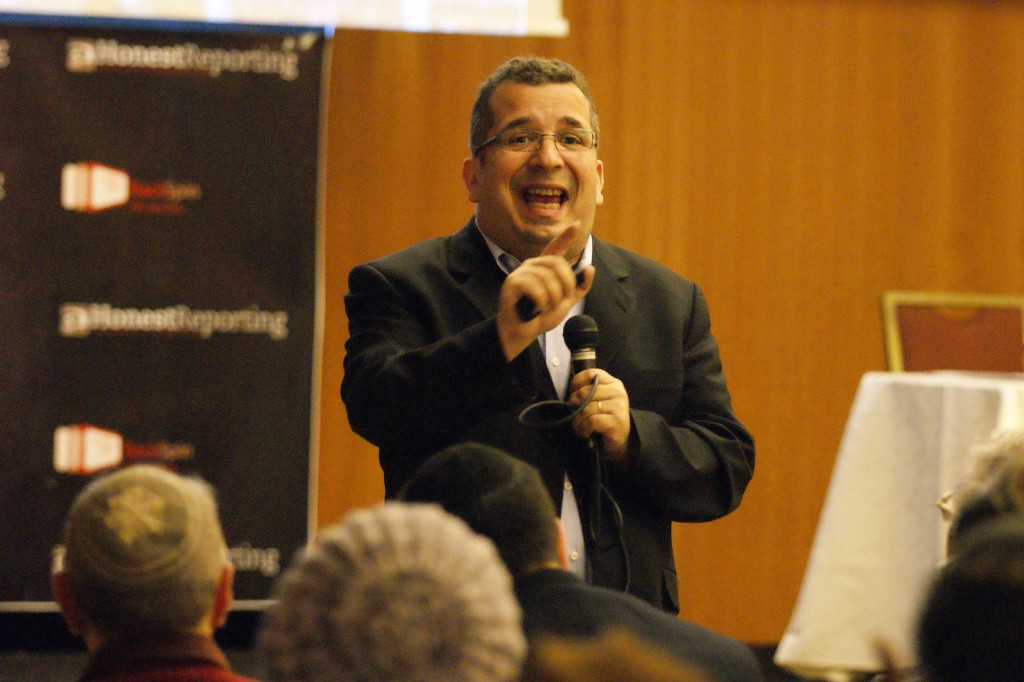
Jerusalem is the biggest small town in the Jewish world. Walking down its main drag, Jaffa Road, most residents are likely to run into a familiar face or two. But for Neil Lazarus, it’s more like six or seven. That’s what happens when you spend a couple of decades as Mr. Israel Advocacy, giving seminars to tens of thousands of people a year.
Lazarus comes by his profession honestly. At age 18 while studying political science in Wales, he was the only Jew attending the University of Swansea. “I was met with a barrage of anti-Semitism and was put in the strange situation of being the spokesman for Israel, a place I had barely visited,” he recalls.
After graduation in 1988, Lazarus decided to spend six months getting to know the country he’d been defending. “Twenty-three years later, I’m still on my year out,” he chuckles. Humor peppers our conversation, the unavoidable influence of Monty Python on his formative years, he claims.
After his aliya, Lazarus picked up a master’s in political science from the Hebrew University (“which qualifies me to be cynical”) and began working in the field of informal education. Now, in addition to the menu of hasbara (public diplomacy) seminars that he delivers to audiences all over the world, Lazarus is also hired to explain Israeli politics and train others to do political advocacy by sharpening their public speaking prowess. The latest addition to Lazarus’s skill set is training clients, ranging from the Ministry of Foreign Affairs to the Jewish Agency and to Christian friends of Israel, in what he calls digital advocacy.
‘Part of our problem today abroad is the assumption that if I’m liberal, I need to be against Israel.’ For far too many, says Lazarus, ‘To be a liberal supporting Israel is a bit like a feminist supporting the Taliban’
But for someone who makes his bread and butter from the concept of advocacy, Lazarus is shy when using the word. “I don’t like the word advocacy: I prefer saying ‘fighting the delegitimization of Israel.’ I teach people how to get a fair image of Israel. You don’t have to agree with everything Israel does; far from it. You can have a legitimate criticism, but still fight the campaign of delegitimization.”
The traditional hasbara one-liners, what he terms the “click and flick,” have to be replaced with something more nuanced, says Lazarus.
“The case for Israel can be presented in a way which reiterates the historic connection to the land and the right to live on the land and at peace, and at the same time does not delegitimize Palestinian rights to live in peace.”
What is most important, says Lazarus, is to communicate with people at their own level. If he’s speaking with one of the most caustic critics of Israel, the American ultra-liberal Jew, for example, he advises to “talk about the challenges in social justice here in Israel. Sometimes it can be more effective to agree with someone, tell them what they’re saying is partly right, and then bring them to a more mainstream argument.”Part of our problem today abroad is the assumption that if I’m liberal, I need to be against Israel.” For far too many, says Lazarus, “To be a liberal supporting Israel is a bit like a feminist supporting the Taliban.”
People need to be spoken to in their own terms. “If we could do for Israel what McDonald’s did for the hamburger, we’d be in a good place. They don’t do hasbara, but they do sell in the language of the people: In China the burger comes with rice; in Italy, pasta; in Germany, beer. But they’re all buying the burger.”
Part of teaching is educating, says Lazarus. But equally important is challenging the students’ preconceived notions. “When you ask questions about Israel, you’re asking questions about someone’s identity.”
“I come from a school of thought that believes learning should be interesting, challenging and fun.” To that end, Lazarus is a charter resident in cyberspace and makes full use of YouTube videos and other new media in his seminars. “It’s the teaching of 2012.”
Over the years, Lazarus has presented to, well, everyone, but always trying to maintain a fair position. “Left-wing groups think I’m right-wing and right-wing groups are convinced I’m left-wing. For religious groups I’m not religious enough; with secular groups I refer to things they may not have heard of.
“What is important is to deepen the connection between the Jewish people and Israel, to relate that it is a family relationship. I tell the participants, ‘If you find Israel annoying, it’s because we’re family. Also, the pride you feel is a family pride.’
“Sometimes Israel can be like the family member no one knows at the wedding, but if people buy into the family relationship, we’ve done our job.”









The Times of Israel Community.