

Mubarak: Israel tried to renege on part of ’79 peace deal
Ousted Egyptian president asserts Israel ‘deceptively’ laid claim to Taba, a small Sinai border town
 Add ToI as a Preferred Source on Google
Tamar Pileggi is a breaking news editor at The Times of Israel.
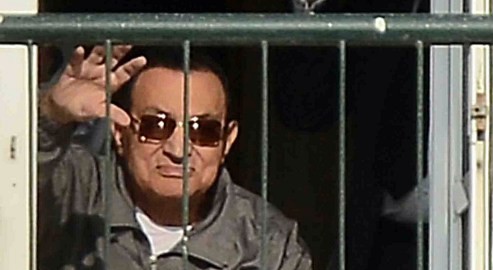
Former Egyptian president Hosni Mubarak recalled in a Monday phone interview that Israel tried to avoid returning part of the Sinai Peninsula to Egypt, contrary to what he said were the commitments outlined in the historic 1979 peace agreement between the two counties.
Mubarak said that shortly before the Sinai was to be returned, Israel “invented the story” that the city of Taba did not traditionally belong to Egypt and attempted to annex the border city.
He told Egypt’s Sada El Balad TV station: “Israel tried to deceive us in every way it could, just like it has done with the Golan Heights. Israel tried to keep Taba for itself with the excuse that it has a hotel there… it got to the point where in March 1982, a month before the withdrawal, the Israelis came and said that Taba was not part of Egypt’s historic borders.”
Israel returned control of Taba to Egypt in 1989.
The telephone interview, which coincided with the 33rd anniversary of the Sinai’s return, was conducted from Mubarak’s room at a Cairo military hospital, where he is being detained pending a retrial for embezzlement.
Mubarak added that concern that Israel would not commit to the terms of the 1979 peace treaty after the assassination of president Anwar Sadat was one of the biggest challenges of his tenure.
Mubarak went on to praise current President Abdel Fattah el-Sissi, despite the “difficult” period for the country. “Egypt is in the hands of a wise national leadership. The Egyptian nation needs to stand behind it because no president can operate on his own,” he said according to the report.
After ruling Egypt for nearly three decades, Mubarak was ousted after an 18-day popular uprising against his government in 2011. Following his removal, Mubarak was arrested and charged with complicity in the killing of protesters in the widespread demonstrations.
In November 2014, Mubarak was cleared of the charges, but is serving a separate three-year sentence for the embezzlement of public funds.








The Times of Israel Community.