

Plus ça change
The Paris story begins to fade from front pages to the ostensible delight of Israel Hayom, which is sick of seeing Netanyahu dogged by the ‘hateful’ press
 Add ToI as a Preferred Source on Google
Joshua Davidovich is The Times of Israel's Deputy Editor
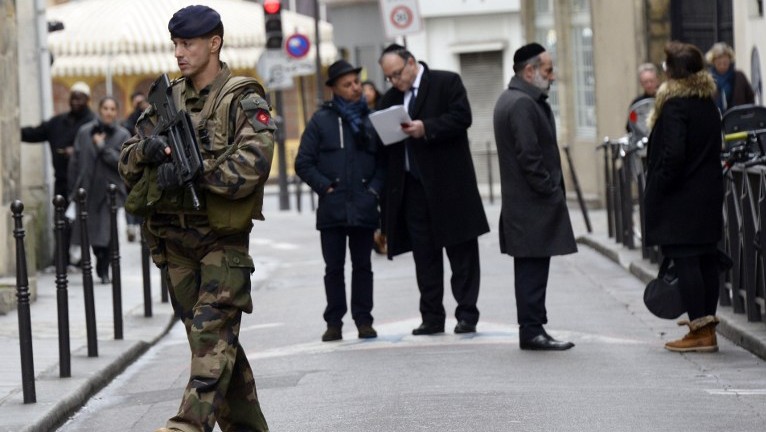
The Israeli press shows the first signs Tuesday morning of being able to move on from the tragic attacks in Paris, with newspapers no longer overwhelmingly dominated by last week’s killings and the ripple effect that has reverberated throughout the Jewish community and the world.
That’s not to say the story has completely ebbed away. Haaretz leads off with bolstered security for Jewish institutions in Paris and new laws being bruited to crack down on terror, Israel Hayom’s A1 is dominated with preview coverage of the Jerusalem funeral for the four victims of Friday’s HyperCacher attack, and Yedioth Ahronoth, the only major daily to not lead with Paris, still leaves room on its front page for pictures of people hiding in that supermarket’s freezer and the upcoming Charlie Hebdo cover, featuring a caricature of Muhammad holding a “Je suis Charlie” sign.
Much of the Paris coverage in all three papers is focused on the 5,000 troops who will be dispatched to protect Jewish sites in the wake of the attacks. On top of that, Haaretz reports, French lawmakers are looking into toughening anti-terror measures, comparing the new laws to the controversial Patriot Act passed in US Congress following the September 11 attacks.
Yedioth reports that while troops were fanning out, people continued to make their way to honor the dead outside the HyperCacher market. The paper quotes one Muslim woman who came to the scene shortly after Prime Minister Benjamin Netanyahu left, holding a sign that read “I am a Muslim, I came to share in your grief.”
“I came here to condemn what was done in my name,” she’s quoted saying.
Meanwhile, most of Israel Hayom’s coverage seems to focus on fighting back against the bon ton of Bibi-bashing and condemning those who would dare criticize the prime minister. A news piece reports that Netanyahu was supposed to be in the front row of world leaders marching and didn’t unjustly elbow his way in, and Mati Tuchfeld writes that those who weren’t at his speech at Paris’s Grande Synagogue can never understand the significance of his visit.
But even he is one-upped by editor Haim Shine, who launches a vociferous attack on Israeli media for reporting critically on Netanyahu’s trip there, accusing them of employing hatred and malice in the service of Labor head Isaac Herzog’s campaign to be prime minister.
“Just before the oxygen runs out of the ‘just not Bibi’ campaign, in the last breaths before their hope for a regime change runs out, they pull out a collection of obscenities, hallucinations, malice, cynicism and deep hatred. A collection that sounds like a requiem for a free and fair press that does not represent the economic interests of its owners.”
As they say in old Paree, plus ça change, plus c’est la même chose, and in that vein, Haaretz correspondent Yair Ettinger, chilling in the 19th arrondissement Parc du Buttes-Chaumont — which has become known as the terror park for its connection to the cell that carried out the attacks — notes that despite the massive display of unity, France is far from homogenizing, and Muslims don’t feel any better about their place there.
“You ask if I was at the march? Why would I go,” 24-year-old Imad tells the correspondent. “Everyone marched there with signs for unity and against violence, but don’t buy it. That’s just on the surface. Underneath the veneer this was a rally against French Muslims. Against us. Yesterday, I met, two streets from here, at the bus station, my neighbor. She’s a young Muslim, one that covers her hair in a hijab. I asked her if she was going. She laughed in my face. ‘Why would I go to a place where they want to cut off my head?’ She’s right.”
Sanctions, scandal and slogans
Yedioth’s lead story has nothing to do with Paris, unless you count the fact that France and the rest of Europe are set to begin leveling sanctions on Israel, according to the report. The paper doesn’t offer a number, but writes that the series of sanctions will leave a deep gash in the country’s economy, quoting a communiqué distributed to Israeli envoys around the world.
“The diplomatic erosion is expected to continue—and grow worse,” the paper quotes the document reading, noting that the effects will be felt with “damage to defense imports, a more harsh boycott on products from the settlements, shrinking of investment and joint projects and severing of business and academic ties.”
Israel Hayom covers the resignation of deputy minister Faina Kirschenbaum amid a growing graft scandal. The paper’s Dan Margalit, reading the tea leaves, sees the move as a possible harbinger of the end of the Yisrael Beytenu party, whose time, he says, “may have passed.”
“Considering the suspicions growing each day, it seems to be doubtful that fair people have what to do in Yisrael Beytenu. There are those who left against their will, and those who were asked to quit and did so with relief, and those who were asked to continue but haven’t yet found a place in the next Knesset, and after Uzi Landau and Yitzhak Aharonovitch and David Rotem, only Yair Shamir remains who is not tied to Liberman’s hard core,” he writes. “Shamir told me yesterday that after a series of conversations, he will return from his post in Asia in more than a week, and only then will he deal with the issue. His good name will force him to quit. There’s no other way, as I see it.”
While Yisrael Beytenu deals with its tumult, the rest of the parties are gearing up for elections, but Haaretz op-ed writer Merav Alush Levron decries the lack of actual content behind the catchphrases being bandied about by politicians.
“Whirling about … are slogans such as governance, corruption, monopolies, the high cost of living and the housing shortage, national unity, united Jerusalem, and peace and hope. To keep them from becoming ‘ghost content,’ the public needs to receive more,” she writes.
“Anyone who talks about peace must explain what his plan is, and how he intends to overcome the obstacle of Jerusalem and the problem of the right of return. Anyone who talks about fighting the monopolies must say clearly which of them he plans to deal with, and provide the timetable for breaking them up.”




The Times of Israel Community.