

Revving up their (tired) engines: 7 things to know for June 2
With election season back in swing, Hebrew dailies are abuzz with speculation over who will merge with whom and whether Netanyahu can pull off coalition without Liberman next time
 Add ToI as a Preferred Source on Google
Jacob Magid is The Times of Israel's US bureau chief
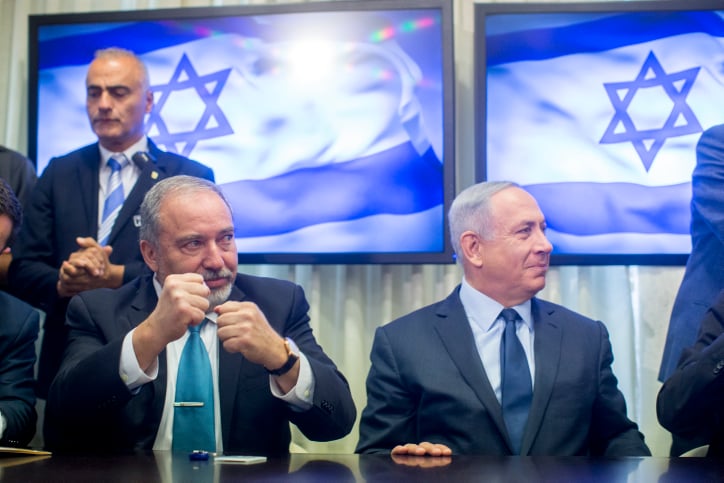
1. I can do coalition all by myself: Now that Yisrael Beytenu chairman Avigdor Liberman is dead to Prime Minister Benjamin Netanyahu, the premier is wasting no time in ensuring a post-September 17 electoral constellation that would allow him to form a coalition without his newest right-wing (aka “leftist”) rival.
- “The right’s challenge: A 61-MK coalition without Liberman,” reads the headline on the front page of the pro-PM Israel Hayom. The daily’s Mati Tuchfeld writes that Likud has already began investing considerably in its Russian-language campaigning, aimed at bringing over long-devout Liberman voters.
- Tuchfeld explains that the uphill battle that Netanyahu will face in the upcoming campaign will be getting the “leftist” label he pinned on Liberman last week to stick. The analyst acknowledges that it won’t be simple, given the Yisrael Beytenu leader’s actual views. Moreover, he claims that “the media” (not him, of course) will do everything in its power to push back on Netanyahu’s assertion that Liberman is in cahoots with the left. But in the current political environment, Tuchfeld argues, all it takes to be considered a leftist is to be against Netanyahu and Liberman checks that box.
- The Times of Israel’s David Horovitz points out that given Liberman’s rising popularity in the polls since he thumbed his nose at Netanyahu, the Yisrael Beytenu chairman could once again find himself in the position of kingmaker (or kingbreaker).
- Liberman “is doubtless dreaming of the monarchy himself, at the head of a wildly improbable unity coalition, without the ultra-Orthodox, post-Netanyahu… in an Israel where the wildly improbable cannot be so easily ruled out,” Horovitz writes.
- The ToI founding editor notes that there is another big-name right-wing politician who has a bone to pick with Netanyahu after the premier’s gevalt campaign left him outside of the short-lived 21st Knesset: Naftali Bennett.
2. New New Right: The Likud satellite parties are also looking into how they can best adapt to improve on the support that they gained in the April elections, with the growing conclusion being that additional alliances will be necessary.
- With parties having until the beginning of August to finalize their lists, Army Radio reports that New Right co-leaders Bennett and Ayelet Shaked are considering another run together. But this time, Shaked would be at the top of the party, in a change the two are hoping would ensure that they cross the electoral threshold this time around.
- Zehut chairman (and foot aficionado) Moshe Feiglin confirms that he met with Bennett to discuss a possible merger. However, he clarifies that his party is only willing to work with those who share the same values — a tough sell for a faction that supports reconquering all of Gaza and encouraging mass Palestinian emigration.
- Union of Right-Wing Parties No. 2 Bezalel Smotrich tells Army Radio that he’d be happy to see all of the parties to the right of Likud run on one slate (Yisrael Beytenu is apparently to the left of Likud as the hardline MK did not include Liberman’s party in the theoretical merger). However, he asserts that despite her popularity, Shaked should not be at the head of such an alliance.
- Dismissing the possibility of Shaked being reserved a spot on the Likud list, Amit Segal tweets, “Logic would dictate reserving spots for Bennett and Shaked in Likud, thereby garnering the majority of the national religious camp’s votes and comfortably reaching 40 seats. But a spot was not reserve for logic on the Likud slate for the upcoming elections.”
- But for all the merger talk, there are still some who are considering a breakaway or two. Israel Hayom reports that URWP officials close to chairman Rafi Peretz are considering giving far-right faction Otzma Yehudit the boot and returning to a Jewish Home-National Union alliance that has less of a chance of scaring away more moderate voters.
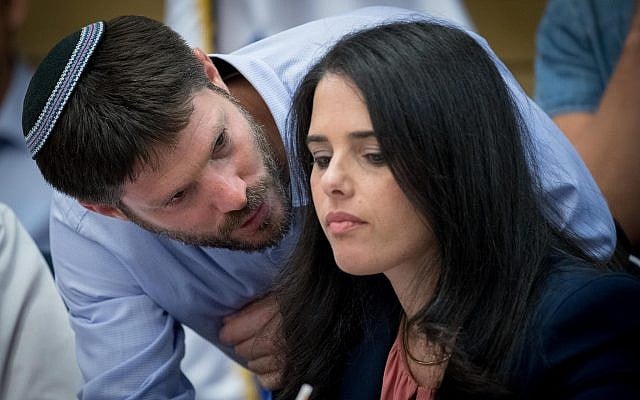
3. Please let me stay, I promise not to break anything else: Labor chairman Avi Gabbay’s place was cemented in the history books after leading the party to its worst-ever finish in the last elections, but after managing to further tarnish his name by intensely considering an offer to join Netanyahu’s coalition, he is now hinting that he might like to stick around at the helm.
- After long expressing opposition to the idea of any merger — and even breaking up Labor’s Zionist Union with Tzipi Livni’s Hatnua — Gabbay is now talking about having his party join forces with either Meretz to the left or Blue and White to the center, in a move that Yedioth Ahronoth reports the hapless leader hopes will allow him to remain relevant. Nonetheless, he announces this morning that leadership primaries will be held ASAP.
- Senior party MKs Itzik Shmuli, Stav Shaffir and Amir Peretz don’t want to hear anything about the idea until after the party votes on a chair so they never have to see Gabbay’s face again. “He wiped out the party. The man is not living in reality,” one lawmaker tells Yedioth.
- Don’t count out Livni, Yedioth points out. The Hatnua chair who has gotten closer than just about any politician to defeating Netanyahu — winning more seats than the Likud leader in 2009 — was filmed over the weekend executing a moving duet version of “A song for peace” with Blue and White chairman Benny Gantz.
She's running. pic.twitter.com/uVQ0SbduzZ
— Jacob Magid (@JacobMagid) June 2, 2019
4. Calling in the big guns: In the left-leaning Haaretz daily, Iris Leal writes that the Blue and White leadership does not have what it takes to defeat Netanyahu and that it’s time to call in a former IDF general who has experience in doing just that: Ehud Barak.
- Leal argues that as soon as Liberman began showing hesitation about joining Netanyahu’s government, Blue and White should have been springing into action to form a coalition of its own, apologizing to the Haredi parties for No. 2 Yair Lapid’s choice to build his political career by going after the ultra-Orthodox.
- Instead of hearing about the last-minute proposals Netanyahu was making to various parties in the would-have-been opposition, Israelis should have been hearing about offers Blue and White was making to its potential coalition partners, Leal writes, adding that Gantz’s party should have at least petitioned the High Court against Netanyahu’s effort to dissolve the Knesset.
- “The level of madness will certainly rise [in this next round], and only a real madman has a chance of bringing about a political big bang. Therefore, now is the time for Ehud Barak, who has been warming up on the sidelines since last election,” the columnist recommends.
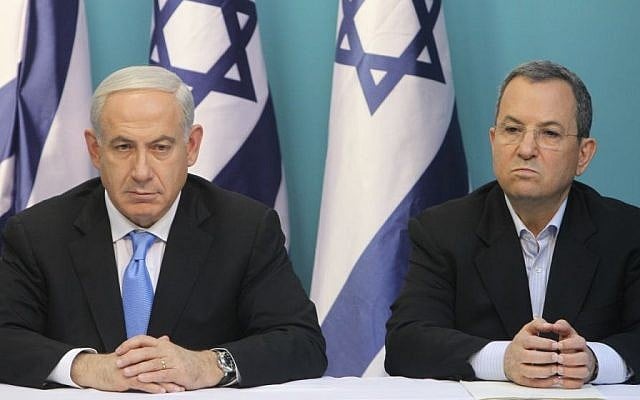
5. Stuck in the election mud: Yedioth leads its Sunday edition with a detailed report on how each industry in Israel will remain frozen for several additional months as government offices are unable to operate fully during campaign season.
- Health officials tell the daily that another round of elections risks the shelving of a government-commissioned report that the health budget be increased by NIS 5.5 billion ($1.5 million). The boost is aimed at partially addressing the hospital room shortage, which has left thousands of patients sleeping in beds in the hallways of the country’s medical centers.
- In the area of welfare, a special Knesset committee chaired by Netanyahu that was supposed to advance legislation to combat violence against women will not meet in the near future. Senior citizens will also begin seeing cuts to their pensions beginning this week in a move that Finance Minister Moshe Kahlon says he is unable to prevent while a permanent government is not in session.
- In the field of education, officials in the relevant ministry tell Yedioth that another round of elections will place proposals to build more classrooms and schools on the back burner. Moreover, since the Knesset’s Finance Committee cannot convene, it won’t be possible to grant funds for informal education programs such as those for at-risk youth.
- The government created as a result of the April election was slated to introduce a plan aimed at solving Israel’s severe traffic problem. Another round of elections means that presenting this plan will also be delayed, along with the prospect of any change easing the acute congestion clogging roads throughout the country.
- Interior Minister Aryeh Deri is also prohibited from signing an agreement that would allow the marketing of roughly 5,000 homes throughout the country while a permanent government is not in session.
6. Heating up the Hermon: The Times of Israel’s Avi Issacharoff says that the rockets fired at Mount Hermon yesterday are an indication as to what Iran is trying to push Syria to become: a testing ground for experiments in the battle against Israel and the US, with the help of the pro-Iranian militias it has established there.
- Issacharoff writes that Tehran is trying hard to establish a rocket force in Syria that will be operated by Shiite emissaries — Iraqi and Afghan militias and even Hezbollah — under the supervision of the Islamic Revolutionary Guard Corps.
- The question is the degree to which Hezbollah will be involved in that effort. Basing his conclusion on speeches made by the terror group’s leader in recent weeks, Issacharoff admits that the answer is not yet clear.
- “While this is definitely a difficult time for [Hezbollah] in light of recent US sanctions, Washington could be overestimating their effect. While they will affect Hezbollah’s budget, it is doubtful that the group is already going through a real crisis,” he explains.
- On a separate but related note, the Syrian Observatory for Human Rights reports that seven “foreign fighters” were among the 10 killed in IDF airstrikes on several military targets in Syria in the predawn hours of Sunday morning in response to the rocket fire at the Golan Heights.

7. Jerusalem Day charade: As authorities in the capital deal with celebrations that are slated to once again include far-right activists parading through the Muslim quarter, police allowed Jewish worshipers to visit the flashpoint Temple Mount/Haram al-Sharif compound, setting off clashes between Muslim occupants with security forces at the site.
- Footage shows hundreds of Muslim men and woman chanting “God is great” as police escort one of the two groups of several dozen Jews through the compound.
קבוצה נוספת עלתה pic.twitter.com/yeI8pkdLml
— Maya Horodniceanu (@mayahorodnicean) June 2, 2019
- It was the first time in three decades that non-Muslims were let into the site during the final days of the month of Ramadan. Police say that as a result, “a riot began that included the hurling of stones, chairs and various objects.”



The Times of Israel Community.