

Seeking stability, more East Jerusalemites become Israeli citizens
Applicants say that the security of official status outweighs fears of betraying their Palestinian heritage
 Add ToI as a Preferred Source on Google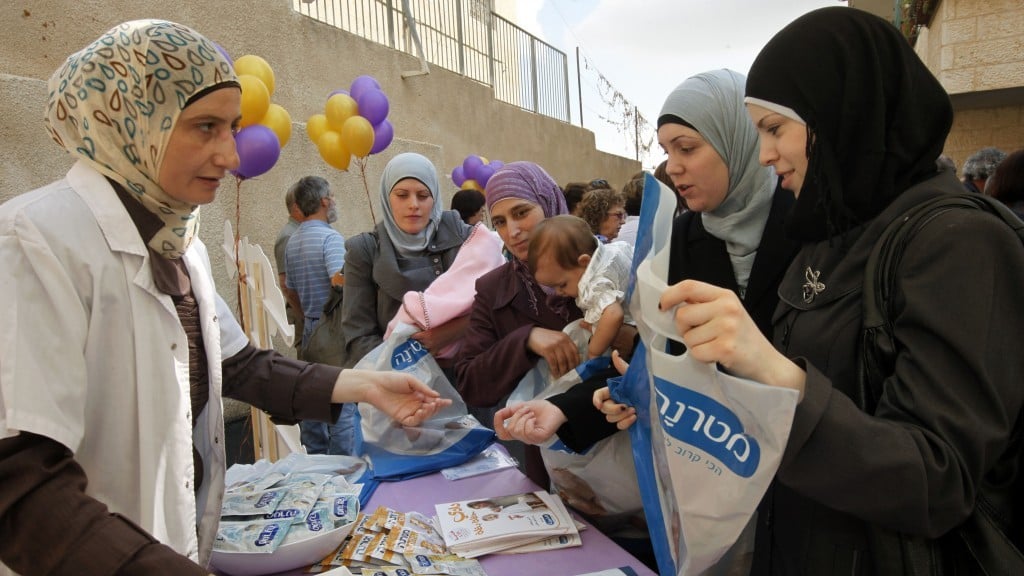
An increasing number of East Jerusalem Palestinians have been applying for and receiving Israeli citizenship, most citing practical reasons as the deciding factor in a decision that was nevertheless emotionally charged.
Figures obtained by the Jerusalem Institute for Israel Studies showed a dramatic increase in citizenship applications, from 114 applications in 2003 to between 800 and 1,000 current annual applications, Reuters reported this week. Approximately half of the applicants received citizenship, the report said.
Palestinians interviewed by the news agency cited practical reasons for the move: they believed that Israeli citizenship made it easier to get jobs and buy houses, and they wanted the stability that Israeli citizenship brought. At the same time, some expressed concerns that they were betraying their Palestinian identity.
Most Palestinians in East Jerusalem are official residents of the city, a status that allows them to work and receive healthcare and insurance benefits, but one that carries the threat of being revoked.
Unlike citizenship, which can only be revoked in extreme cases, such as becoming a citizen of an enemy state or committing treason, the residency status is contingent on the holder proving that his “center of life” is in the city. The right to live in Jerusalem can be lost by working in a different city or spending too much time outside of Israel.
“I wanted to strengthen myself in Jerusalem. It’s my homeland. I was born here, I live here and I want to stay here,” said a 46-year-old teacher who became an Israeli citizen in 2014.
For some applicants, the choice was a wrenching one, and some hid their decision from family and friends due to fear of negative reactions, reported Reuters.
“I was a bit ashamed because it feels like you’re giving up your identity,” a 26-year-old Palestinian ballet dancer, who began her application two months ago. “But if I get an Israeli passport I won’t be so weak, especially living in East Jerusalem — it’s so easy for us to get kicked out.”
Her family members accepted her decision, although they initially reacted with surprise.
Since Israel gained control of East Jerusalem in the 1967 Six Day War, approximately 24,000 Palestinians — close to 10 percent of East Jerusalem’s Palestinians — have received Israeli citizenship.
The trend is a welcome one for Israel’s government, according to geographer and former member of the Palestinian negotiating team Khalil Tafakji. He said that Israel was trying to reinforce its control of the city through increasing the percentage of Jerusalemites who are Israeli citizens.
Israeli Interior Minister Silvan Shalom dismissed Tafakji’s claim that Israel had a strategic interest in the matter.
“This will not affect negotiations with the Palestinians, which encompass far greater and wider issues,” said Shalom, who is also chief negotiator in peace talks with the Palestinians.
The status and control of Jerusalem is a highly contested issue in peace negotiations. Both Israel and the Palestinians claim Jerusalem as their capital.
A survey published by the Washington Institute for Near East Policy in November 2011 showed that East Jerusalem Palestinians were split when asked if they would prefer Israeli or Palestinian citizenship, if a Palestinian state were to be established.
The respondents leaned toward Palestinian over Israeli citizenship: 53 percent would rather obtain Palestinian citizenship while 39% favored Israeli citizenship. When asked if they would move in order to obtain their desired citizenship, 44% of respondents said they would likely do so to obtain Palestinian citizenship, and 40% for Israeli citizenship.
While the percentage of respondents favoring Israeli citizenship was constant from a 2010 survey, the number of respondents favoring Palestinian citizenship had increased, from 30 to 53%.







The Times of Israel Community.