

Senior cop quits, alleging government has politicized and neglected police force
Supt. Lee Pearl-Bahiri claims law enforcement has ‘changed its face’ under Ben Gvir and now lacks the resources and manpower to deal with serious crime
 Add ToI as a Preferred Source on Google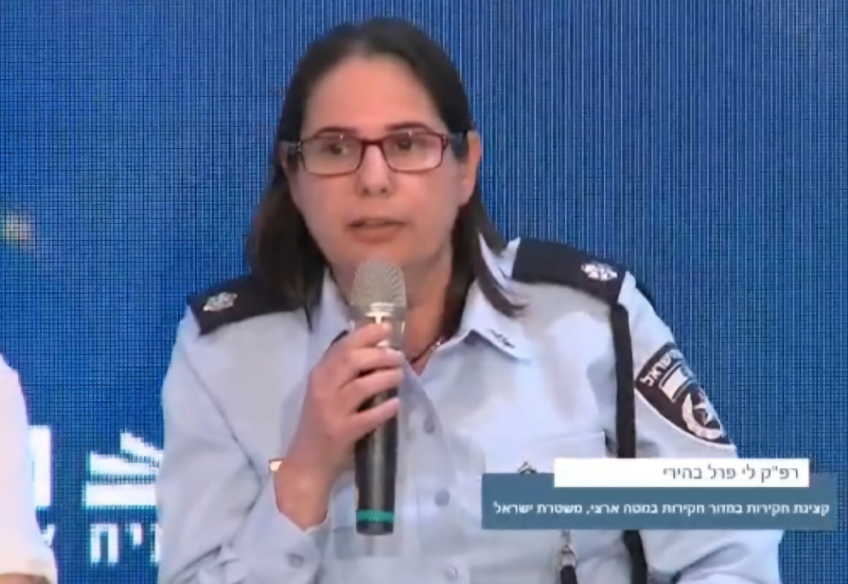
A senior officer in the Israel Police resigned her post on Tuesday over what she characterized as the politicization of the force under the current government.
Supt. Lee Pearl-Bahiri, a former officer in the police National Headquarters’ investigations division, claimed that law enforcement had shifted its priorities and become financially strained in recent years, leading her to quit after nearly three decades of service.
Pearl-Bahiri said that she had always acted as the law enforcement system’s “public defender” in conversations with her friends, but grew disillusioned since the accession of the current government under Prime Minister Benjamin Netanyahu.
“I found myself in a very sensitive position, being exposed to things incompatible with the values I’ve always held,” she said.
Since then, she claimed, a range of pressing issues have been placed on the back burner, including tackling organized crime, car and workplace accidents, sexual offenses, violence against women, and crime in the Arab sector.
“All of it was pushed aside. ‘That’s not important right now,’ they told me,” she recounted in a Facebook post published after her resignation.
Instead, she was instructed to focus on Jewish residents’ noise complaints about mosques broadcasting the call to prayer and online incitement of the “right type” — presumably referring to incitement by Arabs against Jews.
“Stations have been emptied out. Positions remain vacant. No one comes, and if they do — they leave,” she said, warning that the force stood to deteriorate even further as her generation approaches retirement age.
Since National Security Minister Itamar Ben Gvir took office at the end of 2022 — occupying a newly modified office with greatly expanded influence over the police — many legal experts have raised concerns about the politicization of the police force on his watch. Critics have accused him of trying to shape law enforcement to conform to his ideological agenda.

The far-right minister has himself boasted of offering promotions to officers only if they implement his policies, including “compassion for right-wing activists” and the destruction of “entire villages” illegally built by Bedouins on state land in the Negev.
Pearl-Bahiri described law enforcement’s decline as evident from just a glance out her window.
“I live above a playground. To the right of my building is a luxury construction project. At night, the playground is controlled by youth who, in my time as a youth officer, would have gone home with noise fines and never returned,” she said.
As for the construction project, Pearl-Bahiri said it came under the control of a Haredi gang that “extorts the contractor with threats, burns tractors, knocks down fences and causes property damage and noise for the entire neighborhood.”
Though the police have come for a “show of strength,” they never arrest any of the troublemakers, she claimed.
“I believe this is political, because if those same ultra-Orthodox had just changed shirts and headed toward Kaplan [Street], they would have been stopped with horses and smoke grenades,” she said, referring to the site where most Tel Aviv anti-government protests are held.
Alongside the police’s alleged politicization, she added that the force also suffers from chronic underfunding, another reason for her departure.
“There was never enough money… the perception was always that the money belonged with the Defense Ministry — they needed it more,” Pearl-Bahiri said. But her mind changed with the onslaught of October 7, 2023, “when police physically saved the south from Hamas’s invasion.”
“October 7 was the final straw, and [my] path to civilian life was paved earlier than expected and desired,” she wrote.









The Times of Israel Community.