

Trump seeks to explain Muslim ban in flurry of calls to world leaders
Amid global alarm, homegrown opposition, Hollande urges president to ‘respect’ principle of accepting refugees, as Trudeau tweets Canadian support for ‘those fleeing persecution’
 Add ToI as a Preferred Source on Google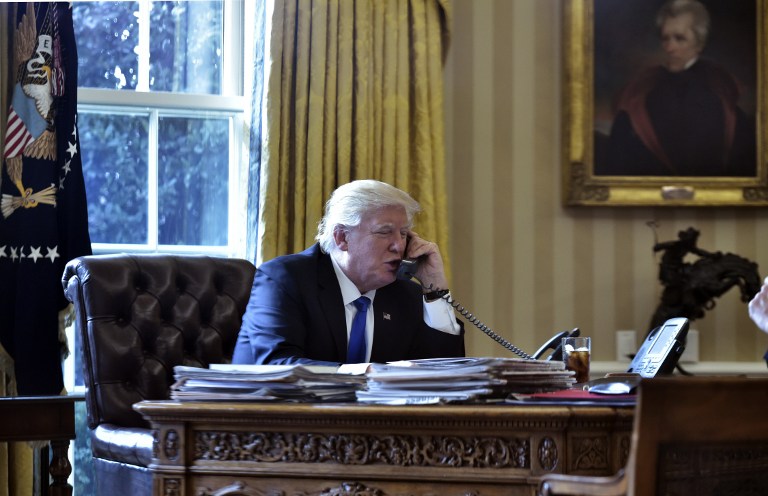
WASHINGTON, United States — US President Donald Trump spoke by phone on Saturday with various world leaders, amid growing international alarm and a legal challenge over his moves to drastically limit Muslim immigration to the United States.
In a flurry of calls that started early in the morning and rounded out an already frantically paced week, Trump spoke with Japanese Prime Minister Shinzo Abe, German Chancellor Angela Merkel, French President Francois Hollande and Russian President Vladimir Putin. He also had a call planned for later in the day with Australian Prime Minister Malcolm Turnbull.
The conversations gave the US president an early opportunity to explain new policies that have baffled and unnerved much of the rest of the world — particularly his order to temporarily halt all refugee arrivals and those of travelers from seven mainly Muslim countries including war-wracked Syria.
The calls also allow him to start developing ties with countries that have been close allies with the United States in recent history, as well as Russia — a perennial foe, but a country with which Trump has said he is keen to improve relations.
Hollande urged Trump to “respect” the principle of accepting refugees. Canadian Prime Minister Justin Trudeau, whose country has been open about welcoming refugees, wrote a Twitter message of support to “those fleeing persecution, terror and war.”
To those fleeing persecution, terror & war, Canadians will welcome you, regardless of your faith. Diversity is our strength #WelcomeToCanada
— Justin Trudeau (@JustinTrudeau) January 28, 2017
‘Extreme vetting’
Trump’s pronouncement on Muslim immigration makes good on one of his most controversial campaign promises to subject travelers from Islamic countries to “extreme vetting,” which he declared would make America safe from “radical Islamic terrorists.”
“This is big stuff,” the new US president declared at the Pentagon on Friday, after signing an executive order entitled “Protection of the nation from foreign terrorist entry into the United States.”
The decree suspends the entire US refugee resettlement program for at least 120 days while tough vetting rules are established.
The new protocols “ensure that those approved for refugee admission do not pose a threat to the security and welfare of the United States.”
In addition, they specifically bar Syrian refugees from the United States indefinitely, or until the president himself decides that they no longer pose a threat.
Meanwhile, no visas will be issued for 90 days to migrants or visitors from seven mainly Muslim countries: Iran, Iraq, Libya, Somalia, Sudan, Syria and Yemen.
Detentions already under way
US authorities wasted no time implementing Trump’s order, detaining travelers arriving at American airports within hours of the measures being signed, media reports said Saturday.
The New York Times reported that airport officials as early as Friday night began detaining travelers, some of whom were already aboard their flights when Trump announced his executive order.
The order also lays the groundwork for what Trump has pledged will be “extreme vetting” of visa applicants’ backgrounds — with some exceptions for members of “religious minorities,” a caveat many see as a way to apply favorable treatment to Christians from majority-Muslim states.
US rights groups filed a legal challenge Saturday after two Iraqi men were detained Friday night at John F. Kennedy Airport in New York.
The American Civil Liberties Union and other advocacy groups are seeking the men’s release on grounds that they are being held unlawfully, and asked that they be freed so they could at least request asylum and avoid being sent back to Iraq.
The groups asked for their suit to be considered a class action on behalf of all people held up in the same way. The two Iraqi men have valid visas, the documents stated.
‘Greatest nation’
One of them had worked for the US government in Iraq for 10 years and the other was coming to America to join his wife, who had worked for a US contractor, the lawsuit said.
The former, Hameed Khalid Darweesh, was released later in the day and spoke to reporters at the airport.
“America is the greatest nation, the greatest people in the world,” Darweesh said.
One of the refugees, Hameed Khalid Darweesh, has been released pic.twitter.com/U1XHr4DaTt
— Rep. Nydia Velazquez (@NydiaVelazquez) January 28, 2017
Asked what he would say to Trump, he added: “I like him. But I don’t know. This is a policy I don’t know. He’s a president. I’m a normal person.”
Mark Doss, a supervising attorney at the International Refugee Project at the Urban Justice Center, said Darweesh’s detention and release showed the new policy was being implemented “with no guidance.”
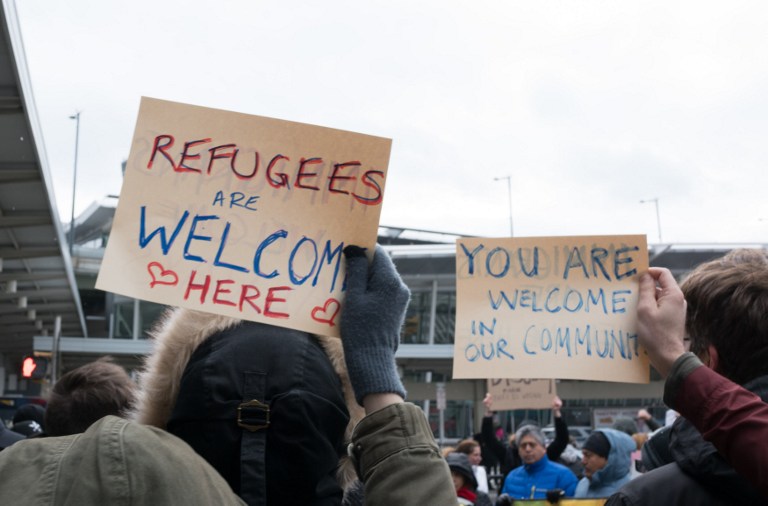
Immigration advocacy groups issued an appeal for demonstrations at JFK airport, which spread rapidly over social media.
According to Camille Mackler of the New York Immigration Coalition, two New York lawmakers went to the airport to try to gain access to the men.
International groups and civil liberties organizations have roundly condemned Trump’s orders.
“‘Extreme vetting’ is just a euphemism for discriminating against Muslims,” said Anthony Romero, executive director of the American Civil Liberties Union.
Romero said Trump’s order breached the US constitution’s ban on religious discrimination by choosing countries with Muslim majorities for tougher treatment.
Many foreign leaders said they were aghast over the new US policy.
Iran answered in kind by saying it would ban Americans from entering the country, calling Trump’s action insulting.
But the US leader did get backing from Czech President Milos Zeman, who praised him for being “concerned with the safety of his citizens.”
Times of Israel staff contributed to this report





The Times of Israel Community.