

US veteran who survived blast receives penis transplant
In most extensive operation of its kind, doctors rebuild entire pelvic region, including scrotum, of man injured in Afghanistan
 Add ToI as a Preferred Source on Google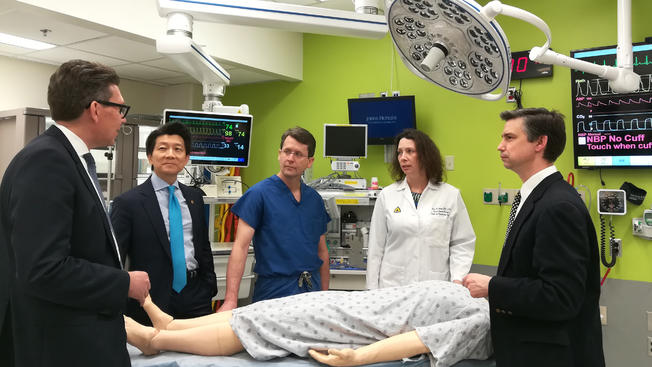
WASHINGTON (AP) — A US veteran who lost his genitals from a blast in Afghanistan has received the world’s most extensive penis transplant, and doctors said Monday he is recovering well and expected to leave the hospital this week.
Saying they wanted to address “an unspoken injury of war,” Johns Hopkins University surgeons rebuilt the man’s entire pelvic region — transplanting a penis, scrotum and part of the abdominal wall from a deceased donor — in a highly experimental 14-hour operation last month.
Such transplants “can help those warriors with missing genitalia just as hand and arm transplant transformed the lives of amputees,” Dr. W.P. Andrew Lee, Hopkins’ chairman of plastic and reconstructive surgery, told reporters Monday.
The patient, who asked to remain anonymous, is expected to recover urinary and, eventually, sexual function.
The scrotum transplant did not include the donor’s testicles, meaning reproduction won’t be possible. “We just felt there were too many unanswered ethical questions” with that extra step, said Hopkins’ Dr. Damon Cooney.
Three other successful penis transplants have been reported, two in South Africa and one in 2016 at Massachusetts General Hospital. Those transplants involved only the penis, not extensive surrounding tissue that made this transplant much more complex.
The loss of a penis, whether from cancer, accident or war injury, is emotionally traumatic, affecting urination, sexual intimacy and the ability to conceive a child. Many patients suffer in silence because of the stigma their injuries sometimes carry.
Doctors sometimes reconstruct the form of a penis from a patient’s own skin, usually to treat congenital abnormalities or during transgender surgery. That requires using implants to achieve erection.
For a functional penis transplant, surgeons must connect tiny nerves and blood vessels. Candidates face some serious risks, including rejection of the tissue and side effects from anti-rejection drugs that must be taken for life.
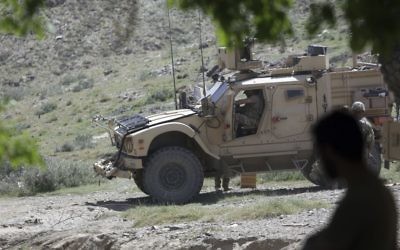
But penis transplants have generated intense interest among veterans from Iraq and Afghanistan, and a few years ago Hopkins surgeons began planning and rehearsing how to perform such a complex operation in patients with widespread tissue damage. The Department of Defense Trauma Registry has recorded 1,367 male service members who survived with genitourinary injuries between 2001 and 2013. It’s not clear how many victims lost all or part of the penis.
Hopkins is screening additional veterans to see if they are good candidates for this type of reconstructive transplant. Finding donors is an additional hurdle: In the U.S., people or their families who agree to donate organs such as the heart or lung must be asked separately about also donating a penis, hand, face or other body part.
The Hopkins patient received an extra experimental step, an infusion of bone marrow from his donor that research suggests may help a recipient’s immune system better tolerate a transplant. Surgeons said that is enabling the veteran to take one anti-rejection drug instead of several.
In a statement from Hopkins, the patient was quoted as saying: “When I first woke up, I felt finally more normal.”






The Times of Israel Community.