

Cutting to the chase
Twin stabbing attacks in the West Bank have the press once again in alarm mode
 Add ToI as a Preferred Source on Google
Joshua Davidovich is The Times of Israel's Deputy Editor
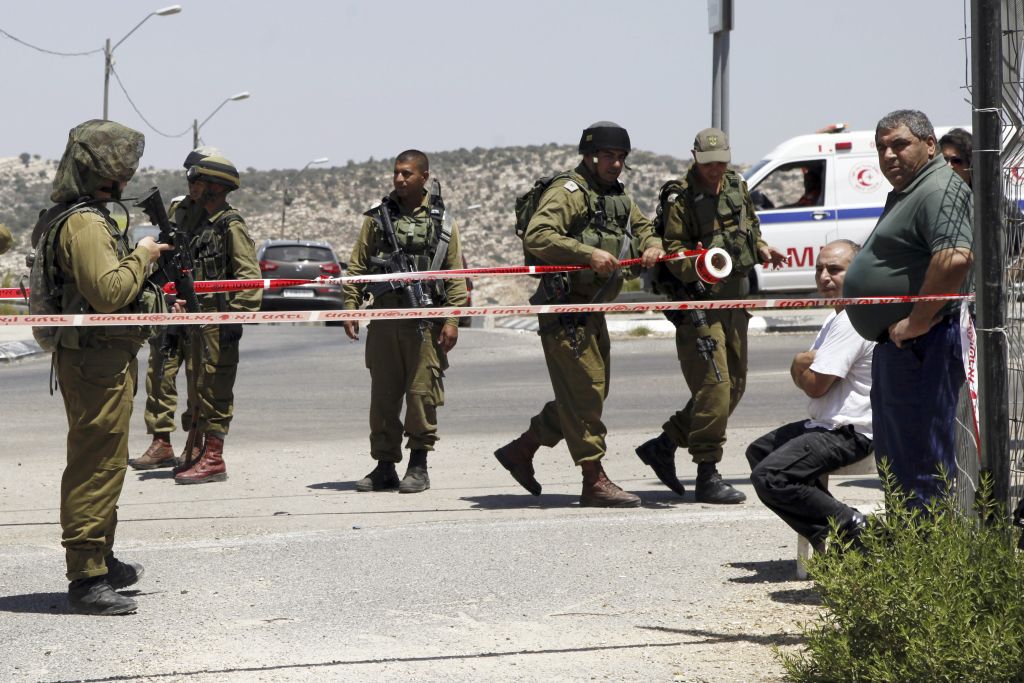
Set your alarms to NOW!, Israeli papers seem to be saying Sunday morning, after twin attacks in the West Bank, apparently uncoordinated, have the press once again in panic mode with sordid thoughts over the security situation.
“Shabbat of terror,” reads the A1 headline of Yedioth Ahronoth, employing a term many might not use to describe an attack on an armed member of military force. Israel Hayom similarly goes with the headline “terror of knives.”
Inside, the tabloid reprises a headline from last week’s spate of attacks, only this time instead of saying “terror follows terror,” it goes with “stabbing follows stabbing.”
But the real news may be the fact that the paper, never shy about speaking its hive-mind, is at a loss for words to describe the state of affairs in the West Bank, or at least unhappy with the words normally used to describe the violence.
“Whether you are talking about lone wolf attacks or spur of the moment attacks, what’s clear is that neither of these terms is sufficient to describe the seriousness of the situation in which two stabbing attacks happened in the West Bank within a few hours,” the paper notes in its news story on the attacks.
Yedioth reports that both attacks were apparently not part of any larger scheme, and quotes tough words from Defense Minister Moshe Ya’alon:
“The assessments are that both incidents were ‘lone attackers’ who acted of their own volition without an terror infrastructure behind them. Ya’alon, who praised the alertness of the troops in both incidents, said last night: ‘It should be known that anyone who tries to hurt Israeli soldiers, border officers or Israeli civilians is risking his right to life,'” the paper writes.
Not so, though, according to Palestinian leader Mahmoud Abbas, who is quoted in Haaretz blaming Israel for the rise in tensions in the West Bank, and accusing the Jewish state of murdering one of the attackers, who was shot and killed after stabbing a soldier in the northern West Bank.
“This is an extension of the continuing daily killings by Israel. The government of Israel is being held fully responsible for the escalation [of tensions] in the West Bank,” he’s quoted as saying.
If tensions do continue to rise, it will likely be because of hunger striking detainee Mohammed Allaan, whose condition has continued to deteriorate, with the Palestinian street growing angrier and angrier.
Haaretz commentator Amira Hass notes that the case of Allaan is a “headache for both sides,” with Israel facing violence and the loss of its tool of administrative detention, and the Palestinians facing a crackdown should the West Bank begin to burn over Allaan’s possible death.
“No party wants the conflagration and escalation that could erupt if this one-person hunger strike were to end in Allaan’s death. Islamic Jihad will have to make good on its vow to respond. If it does so by firing rockets from the Gaza Strip, the Hamas government will not be able to prevent it: That would be considered unpatriotic,” she writes. “And if Israel insists on responding, in keeping with the result, its military superiority would presumably cause more casualties and property damage. There’s no telling what kind of new round of bloodletting that no one wants would happen, though it’s clear the Palestinians would pay the highest price. If Islamic Jihad tries to respond in the West Bank as well, there’s no way to predict what Israel would do, and whether Palestinians will once again face sweeping military incursions and arrests, injuries and killing. That is the last thing they want.”
Danon doesn’t go down easy
Another round of violence likely also won’t look good for Israel in the international arena, and most papers don’t think newly appointed UN ambassador Danny Danon, a minister best known for his hawkish views, will be able to do much to defend the country on the world stage.
Yedioth’s Ben Dror Yemini derides the decision to appoint him as an “own goal.”
Israel is facing a major campaign of delegimitization and demonization. This is known. The central problem is not with the the core people in BDS. They are lost. The fight against them is not lost. When we show their real face — they are against peace, against two states, for the destruction of Israel — we can battle them,” he writes. “But what exactly will Danon say since he is also against two states? Since he is also for more settlements? Since he is for annexation and also against giving civil rights to Palestinians? Even in an Orthodox synagogue in New York they wouldn’t buy this. But that’s what Danon is selling.”
In Haaretz, Barak Ravid also says Israel’s diplomatic corps should have no truck with Danon if it wants to get anywhere at the UN, strongly calling him the wrong ambassador, for the wrong time, for the wrong place.
“Danon’s positions and style will not go down well in Turtle Bay. A quick Google search will show that he opposes a two-state solution and supports annexing most of the West Bank to Israel and cutting off electricity and water supplies to the Gaza Strip,” he writes. “Israel’s ambassador to the UN has to deal with the Israeli-Palestinian conflict on an almost daily basis. The opinions Danon brings with him are like a red flag to Israel’s best friends, from the United States to Germany and from Canada to the Czech Republic.”
Israel Hayom is the only paper not to brook any criticism of Danon, who, while an avowed enemy of Prime Minister Benjamin Netanyahu, is still his appointee. Instead, the tabloid’s report almost exclusively uses laudatory quotes from officials (save one paragraph, buried at the bottom, of opposition bellyaching) and notes that Danon’s departure from the cabinet will lead to a round of squabbling over who will get his empty chair.
“The leading candidate for the ministerial post is Benny Begin, who was appointed a minister when the cabinet was sworn in, but was forced to quit after Gilad Erdan decided to join the government a few days later and was made public security minister,” the paper reports. “There’s also the possibility that Tzachi Hanegbi will become a minister, though the assessment is that Netanyahu will prefer for now to keep him as coalition chief and head of the Knesset Defense and Foreign Affairs Committee.”






The Times of Israel Community.