

Deif the Islamic holy warrior unites Hamas
Attack on IDF post that killed five soldiers is being utilized to portray terror chief as an Islamist superhero, and he won’t want the adulation to fade

 Add ToI as a Preferred Source on Google
Avi Issacharoff, The Times of Israel's Middle East analyst, fills the same role for Walla, the leading portal in Israel. He is also a guest commentator on many different radio shows and current affairs programs on television. Until 2012, he was a reporter and commentator on Arab affairs for the Haaretz newspaper. He also lectures on modern Palestinian history at Tel Aviv University, and is currently writing a script for an action-drama series for the Israeli satellite Television "YES." Born in Jerusalem, he graduated cum laude from Ben Gurion University with a B.A. in Middle Eastern studies and then earned his M.A. from Tel Aviv University on the same subject, also cum laude. A fluent Arabic speaker, Avi was the Middle East Affairs correspondent for Israeli Public Radio covering the Israeli-Palestinian conflict, the war in Iraq and the Arab countries between the years 2003-2006. Avi directed and edited short documentary films on Israeli television programs dealing with the Middle East. In 2002 he won the "best reporter" award for the "Israel Radio” for his coverage of the second intifada. In 2004, together with Amos Harel, he wrote "The Seventh War - How we won and why we lost the war with the Palestinians." A year later the book won an award from the Institute for Strategic Studies for containing the best research on security affairs in Israel. In 2008, Issacharoff and Harel published their second book, entitled "34 Days - The Story of the Second Lebanon War," which won the same prize.
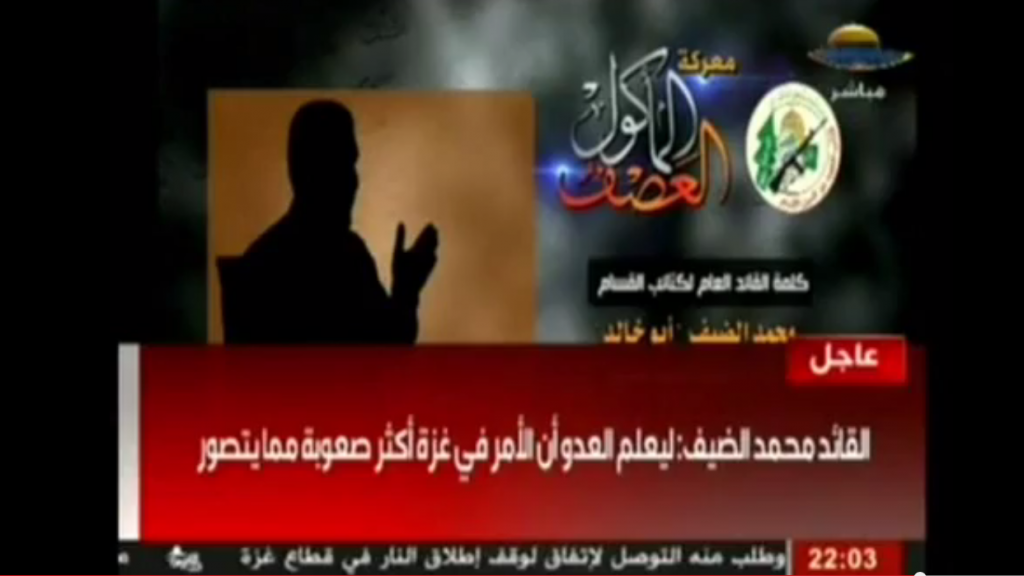
The video clip documenting Hamas’s infiltration into Israel on Monday evening (warning: graphic content) and subsequent attack on an army post south of Kibbutz Nahal Oz in which five IDF soldiers were killed was widely broadcast Tuesday by Arab and Palestinian media outlets.
It was packaged together with a fiery speech by Hamas military chief Muhammad Deif to constitute a resonant “image of victory” — not just a “victory” for Hamas against Israel, but a personal victory for Deif in his struggle for supremacy within the Islamic terror organization.
Deif — who has been wanted by Israel for directing terror attacks since the 1990s, became commander of the Izz ad-Din al-Qassam Brigades in July 2002 and has survived repeated Israeli assassination attempts — was not only directing his victory speech at the people of Gaza and Israel but at his in-house competitors as well.
Over the past 23 days, only two other Hamas figures dared address the Gaza public: political chief Khaled Mashaal, who spoke from a luxury hotel in Qatar of his willingness to die a martyr, and former prime minister Ismail Haniyeh, who wagged his finger and threatened Israel from his fortified underground Gaza HQ.
Tuesday was “military commander” Deif’s turn to deliver a recorded speech.
While Mashaal and Haniyeh sounded like politicians, Deif’s declaration reeked of messianic, Islamist fervor, a world away from the delights of Doha and even the relative immunity enjoyed by Haniyeh.
Deif’s statement was peppered with Koranic slogans, and his shadowy image in the video was embellished with ornate Arabic calligraphy. The aim was to create the sense that this was a sacred message, and his voice echoed as though he were a living saint. In short, someone in Hamas’s military wing was trying to present Deif as a direct heir to the Prophet Muhammad.

As one senior Fatah official put it, “A star wasn’t born, a religious leader was.”
Deif leaned more to the tone and teachings of al-Qaeda than those of his comrades in Hamas. While Mashaal and Haniyeh come off as mere mortals in the eyes of Palestinians, Deif is trying to brand himself as the indomitable hero of a holy war.
That being said, the bottom line of Deif’s message did not stray too far from his peers. Outwardly, at least, there is no disagreement. According to all three, a ceasefire will only be reached after “an end to aggression and a lifting of the siege.”
What does this mean?
First, Hamas wants Israel to withdraw from the Gaza Strip in exchange for a long-term ceasefire. On Tuesday the organization agreed to a 24-hour ceasefire without preconditions, but Israel did not respond affirmatively.
After the IDF withdraws, Hamas expects to continue negotiations in Cairo over the opening of border crossings (easing, to be exact), an Israeli agreement to allow building materials into the Gaza Strip, and an expansion of fishing zone to 12 miles off the Gaza coast. These all appear to be tolerable requests. But Hamas wants something more: the opening of a seaport under international or Palestinian Authority supervision. And this, it appears, Hamas won’t receive.
The final request illustrates how difficult it is for Hamas to stop the fighting. The organization is perceived by the Palestinian and Arab public as the victor in this current battle with Israel. Tuesday’s video only deepens that perception, and it is an image Hamas will now flaunt at every opportunity.
But despite this “victory,” the enormous price paid by the residents of the Gaza Strip is compelling Hamas to continue seeking more symbolically significant achievements, making it difficult for Hamas to agree to a ceasefire at present.
In addition, we must remember that this war has made Hamas a darling of the Arab world. It has also united the disparate agendas within the organization’s leadership, finally establishing a rare moment of unity for Mashaal in Qatar, Haniyeh in Gaza, and Deif in his bunker. A ceasefire now would likely relegate Hamas again to the margins of the international agenda, along with its superhero, the mighty religious warrior Muhammad Deif.







The Times of Israel Community.