

Fischer defends decision to keep interest rates in the basement
Outgoing Bank of Israel governor says preventing shekel from appreciating was of prime importance
 Add ToI as a Preferred Source on Google
Lazar Berman is The Times of Israel's diplomatic reporter
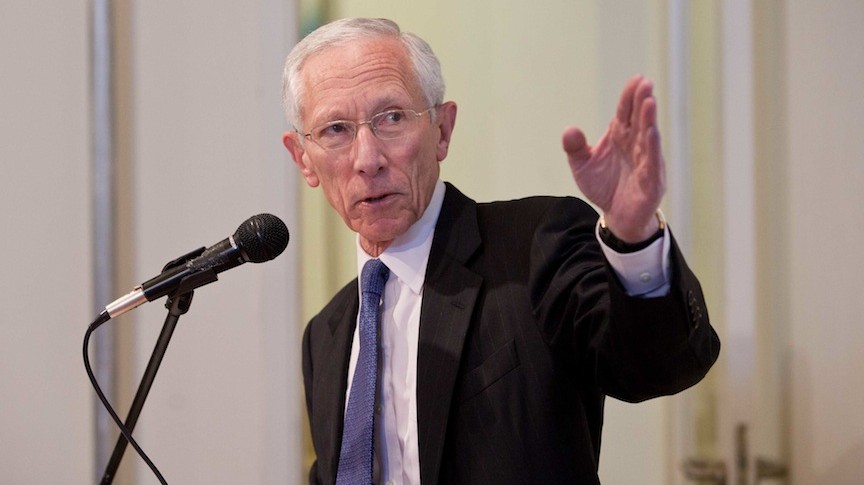
Outgoing Bank of Israel governor Stanley Fischer defended his decision to hold interest rates down during his eight-year tenure, saying Tuesday that keeping the shekel steady was more important than the risks of a real estate bubble.
“If we had dealt with the housing issue by raising interest rates, we would have caused the shekel to appreciate, to increased unemployment, and slow growth,” Fischer told a press conference summing up his tenure.
“A decline in housing prices will be achieved by an increased supply and marketing of land, and not by raising interest rates,” he said.
On Monday, Fischer kept the interest rate for July 2013 unchanged at 1.25%, down from 3.5% when he took office in 2005.
Fischer announced his resignation from the Bank of Israel in January, two years before the scheduled end of his second term. He is set to step down later this week. He will be replaced temporarily at the end of the week by Deputy Governor Karnit Flug until Jacob Frenkel takes over the post in a few months.
Emphasizing the importance of maintaining large foreign reserves, Fischer explained, “This is a country with a lot of uncertainty and we need to always add a margin of safety, including in the state budget.”
But he said that in a macroeconomic sense, the country was an example for other countries.
Touting the Bank of Israel’s achievements during his tenure, Fischer spoke about the creation of the Monetary Committee and the Administrative Council in the bank, and passing the Bank of Israel law. He explained that the formation of the Monetary Committee improved the quality of the debates around interest rates.
Fischer, 69, was born in Northern Rhodesia (now Zambia) and lived in Southern Rhodesia (modern Zimbabwe) before his family moved to the United States. He served as the chief economist at the World Bank in the late 1980s and as first deputy managing director of the International Monetary Fund from 1994 to 2001.
Fischer is widely credited with having protected the Israeli economy from the worst of the global financial ravages. Earlier this month, when he took his leave of the Knesset Finance Committee, he won praise from government and opposition MKs.
After lengthy speculation over who would succeed Fischer, Jacob Frenkel was announced Sunday as the next governor of the Bank of Israel, 13 years after leaving the same job.
Benjamin Netanyahu and Finance Minister Yair Lapid chose Frenkel, who headed the Bank of Israel for almost a decade between 1991 and 2000 and who currently heads the prestigious banking firm JPMorgan Chase, as the man to run Israel’s top economic institution.
During the press conference, Fischer threw his support behind Frankel. “I’ve known Jacob Frenkel for many years. He was always a very successful and important governor. The markets we have today — it’s because of him.”
Times of Israel staff contributed to this report.









The Times of Israel Community.