

Terror strikes twice
Two stabbing attacks leave a soldier and a young woman dead, and the Israeli press dissects the implications for security
 Add ToI as a Preferred Source on Google
Ilan Ben Zion is an AFP reporter and a former news editor at The Times of Israel.
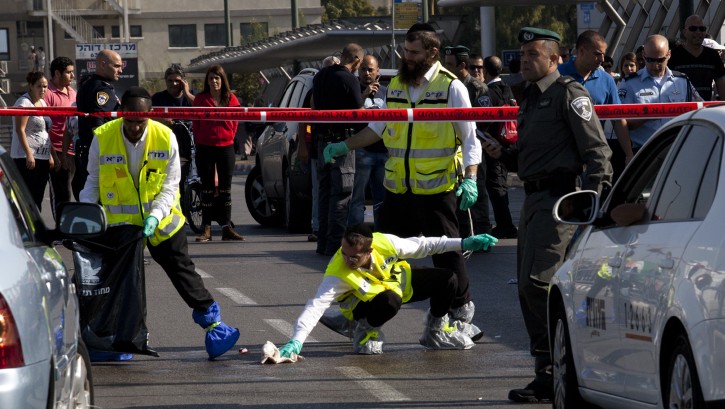
The Hebrew press takes stock after a day marked by two separate stabbing attacks on Israelis which left a soldier and a woman in her twenties dead and two others injured. Meanwhile, chaos prevails as riots continue unchecked in northern Israeli Arab towns and in East Jerusalem.
“Two stabbing incidents in a day: A young woman and soldier killed and two injured,” reads the headline across the top of Haaretz. It repeatedly states that the “security tension in the country is growing,” and leads off with Prime Minister Benjamin Netanyahu’s decision to beef up security nationwide and push forward the demolition of terrorists’ houses as a means of deterrence.
Yedioth Ahronoth dramatizes the death of Almog Shiloni, an air force sergeant who was stabbed outside the Hagana train station in Tel Aviv around noon on Monday and later succumbed to his wounds after undergoing surgery at Sheba Hospital at Tel Hashomer. The front page shows Shiloni and his girlfriend, Noy, and quotes her telling the paper that she was on the phone with him when he was stabbed. “I shouted, ‘Almog’ and he didn’t answer me,” reads the quote emblazoned on the front page. The two were supposed to get married in the coming months, the paper reports, and she heard people shouting on the other end of the line “call an ambulance.”
“Terror without borders” is Israel Hayom’s front page headline covering the two attacks just hours apart on Monday afternoon. It leads off with the woman who was stabbed to death in the Etzion settlement bloc south of Jerusalem in the West Bank, reporting that the perpetrator attempted to run over bystanders at a bus stop near the settlement of Alon Shvut around 4:30 p.m., then came back and stabbed three people, killing Dalia Lemkus from the nearby town of Tekoa. It’s careful to note that the incident took place not far from where three teens were kidnapped, then murdered, earlier this summer.
Both suspected attackers were arrested by police. One was identified as an 18-year-old from Nablus and the second as a 30-year-old man from Hebron with connections to Islamic Jihad. Yedioth Ahronoth notes that the attackers are both “young, single and driven by ideology,” and required only incitement to strike.
Yedioth Ahronoth’s Yossi Yehoshua calls this new threat to Israeli security “attacks that are impossible to prevent,” writing that “the government stands on a slippery slope of losing the security credit that the public lent it.” He says that while this is not an intifada in the conventional sense, the Israeli security agencies are having a difficult time preventing lone wolf attackers “without infrastructure, without intent, without command.”
“There isn’t really any security solution against this old-new type of solo attacks except for calming tensions, on both sides,” he says.
Nadav Shragai writes in Israel Hayom that these lone wolf attacks don’t simply materialize out of thin air, that the conditions have been ripe for them for several years already. He lays blame on Palestinian leaders — Hamas, Fatah and the Palestinian Authority alike — who have amplified it “via a cacophony extolling terrorism and jihad against Israelis and Jews, wherever they may be.” While this uprising has been linked to the alleged Israeli violation of the Al-Aqsa Mosque, it stems, he says, from “the fundamental Palestinian hatred for everything that is Jewish and Israeli, which has now taken the form of anti-Israel incitement and demonization, and the delegitimization of our very right to be here.”
“If we just remember that justice is on our side and that the land of Israel — the land of Zion and Jerusalem — belongs to the people of Israel, we will win in this conflict as well,” he says.
Amos Harel writes in Haaretz that the latest spate of attacks across the country are reminiscent of the lone wolf attacks that took place last year, the only difference being that this time there is significantly more Palestinian public support. In under three weeks, six Israelis were killed in four attacks, he notes, and says that “it would appear as though the series of latest attacks are beginning to undermine, for the first time in a long time, the feeling of relative personal security that most Israelis felt for several years.”
“The government won’t have any alternative but to adopt steps to try and restore this feeling: significant reinforcement of police presence in population centers and a certain addition of IDF forces to the West Bank and a concentrated intelligence effort against terrorist organizations,” Harel writes.









The Times of Israel Community.