

Zalatimo’s venerable pastry is worth the detective work
In a small, hard-to-find Old City ‘cafe,’ a local family has been making a unique delicacy for 150 years
 Add ToI as a Preferred Source on Google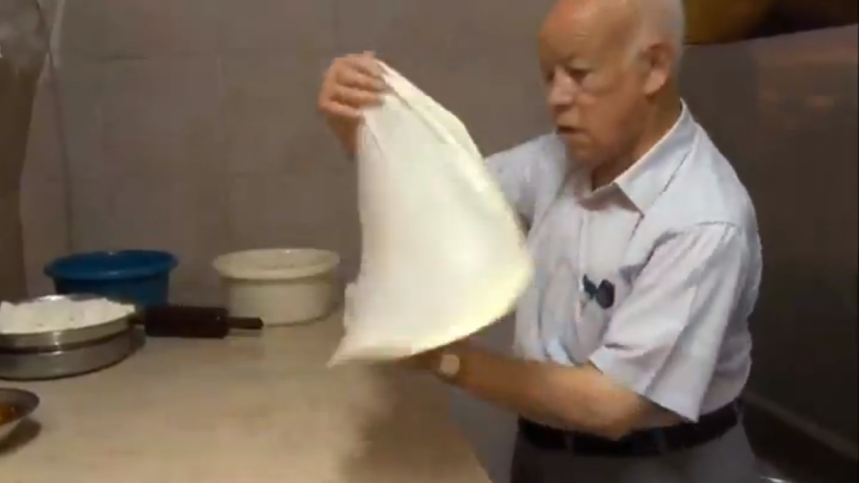
The first time we tried to eat here, early one Friday afternoon, we found the doors shuttered.
The second time, it was closed again, and the man running the stall next door had us believe that, after decades, we’d missed our chance forever. “Zalatimo, he’s closed,” the stallholder sighed, channeling Eeyore. “Such a foolish man.”
Nothing if not persistent, we persevered. And the third time was a charm, kind of. We sighted Mr. Zalatimo! The shutters were open, and there he was in the doorway, an eighty-ish, bald, round-faced gentleman… waving us away. “Really, you’re closed? Can’t you, won’t you…?” We wailed, pleaded, entreated. He shooed us off again, not unpleasantly but adamantly.
Aah, but the fourth time we were rewarded. It was 3:30 on a weekday afternoon, and we knew we were wasting our time. Nobody we’d spoken to had ever eaten here after 2. But the doors were open, and a younger Zalatimo maestro, Hani, perhaps in his late 50s, was manning the marbled pastry surface and the oven.
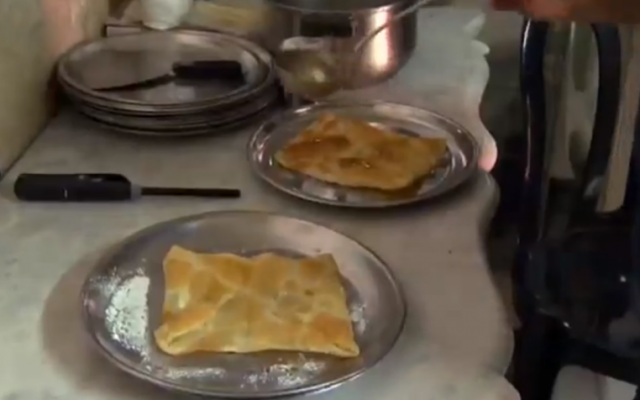
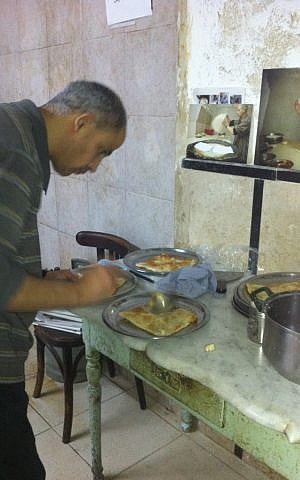
There’s only one item on the menu here, a pastry officially called a mutabak but so iconic as to be more widely known simply as a Zalatimo. The way Hani tells it — in sentences pried out of him as he focuses on rendering his pastry so thin as to be translucent — it was first made here by his great-great-grandfather Mohammad, and the family’s been doing it this way ever since, for something like 150 years: roll and stretch the pastry (the skill is in the wrists), fill with goat’s cheese and clarified butter, fold into a square, pop into the oven for a few minutes until golden, add a gentle rain of sugar syrup and a dusting of icing sugar, and voila! — the Zalatimo, light, delicious, and quite unlike anything you’ve ever eaten before.
As evidenced by our difficulties in actually getting our hands on a Zalatimo, this venerable comestible is not being marketed with any great commercial thrust. In fact, it’s not being marketed at all.
“They prefer you to discover it,” says Mahdi, a Jerusalem Palestinian who’s eating at the table alongside us, and who says he remembers his father bringing him here 35 years ago, “when I was a kid.”
It’s Mahdi who serves as our translator with the reluctant pastry chef, and who reports back that the Zalatimo family — whose offshoots do have more commercial pastry shops in Beit Hanina and Ramallah — has no interest in turning their unique pastry into an empire. “This place pays the bills; he has no complaints,” Mahdi relays to us, adding with dry understatement, “I don’t think they particularly acknowledge the benefits of publicity.”
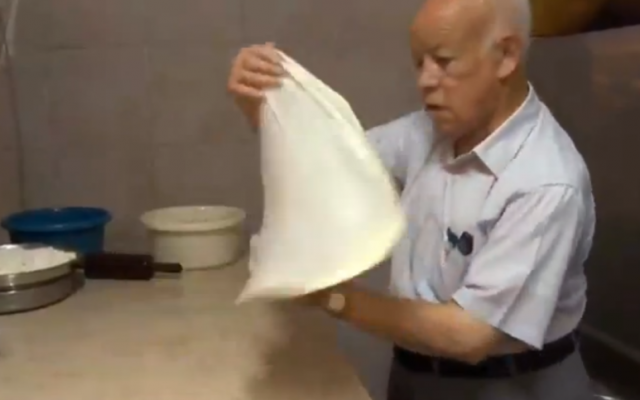
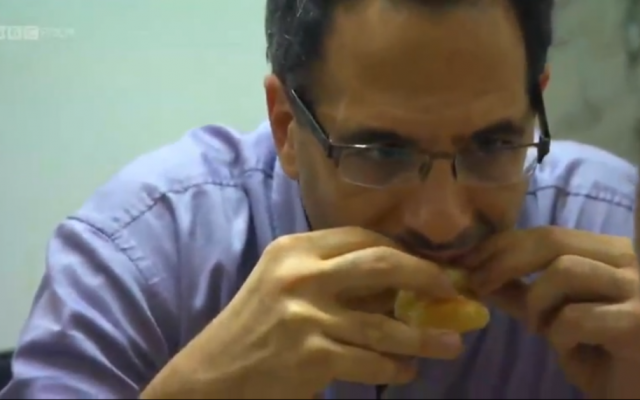
Word gets out, nonetheless. Last year, for instance, celebrated London-based Israeli chef Yotam Ottolenghi filmed a segment here, marveling at the older Zalatimo’s nimble pastrymaking movements — “he’s like a dancer; the whole body moves with the pastry” — and at the texture of the dough, so thin that “you can see the marble” through it. Ottolenghi almost swooned over the finished article: “Aaah, oh my God, you know it’s… that’s so good,” he managed between mouthfuls. “Wow. I really never had anything like that. Never. You cannot recreate this.”
The premises where the Zalatimo is created are the opposite of deluxe.
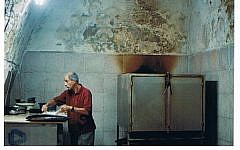
Located close to the Church of the Holy Sepulchre — you’ll have to do the rest of the detective work yourself, it’s half the fun — it would be a stretch to call this a cafe. It’s actually a semi-subterranean, slope-roofed chamber, with zero decor, a washbasin at the back, a glass-fronted fridge with bottles of water, an empty pastry rack, and a handful of tables for the clientele. An internal door, usually locked, leads deeper into underground Old City terrain.
Coffee can be conjured up to order, but it’s not made in the house. It arrives from a stall nearby.
Zalatimo’s does Zalatimos. That’s all it does. It’s worth tracking down.










The Times of Israel Community.