

Butchers and bystanders in Syria
Official definitions of civil war, revolution and genocide are debated, summits are held, and sanctions are discussed, but the horror stories add up — and the the body count keeps climbing
 Add ToI as a Preferred Source on Google
From the very beginning, the story in Syria has reaffirmed the enduring validity of a statement attributed to Edmund Burke: “All that is necessary for evil to triumph is for good men to do nothing.” In Assad’s Syria, the regime’s leaders are the main perpetrators of the ongoing mass atrocities. However, the divided and poorly organized opposition forces have also carried out war crimes. Hezbollah is Bashar Assad’s faithful ally, while Iran, China and Russia are its enablers and protectors. Despite what is happening in Syria, we should not allow ourselves to forget that Iran is the epicenter of the axis of genocidal terror, and Syria and Hezbollah are leading members.
Though there have been reports of covert aid to the opposition, Western democracies, to all outward appearances, have been passive bystanders, confining themselves to the role of the Greek Chorus, commenting on everything but doing nothing.
Clearly there is a responsibility to protect and prevent further bloodshed. The longer the massacres continue, the more dangerous and bloody the post-Assad transition will be, not to mention the dangerous possibility that Syria’s arsenal of chemical and biological weapons will fall into the hands of terror organizations. The clock is ticking.
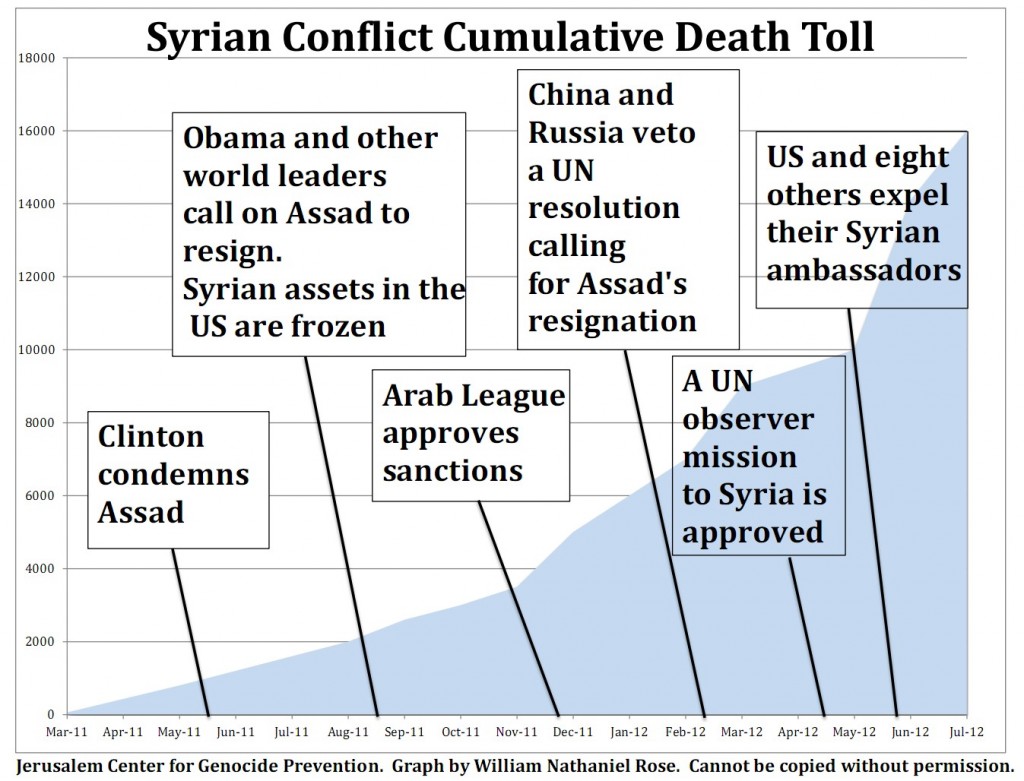
What is clear is that the rate of increase in death tolls has turned sharply upward following the arrival of the UN’s Special Envoy, Kofi Annan. The graph of the cumulative body count prepared by the Jerusalem Center for Genocide Prevention shows the dramatic increase in deaths, which have now reached 20,000. A similar sudden upward inflection was seen at the beginning of the genocide in Darfur, after it became clear that the outside world would stand by.
One cannot help but wonder at the less than stellar record of Annan ever since Rwanda, when he failed to react to the fax of Romeo Dallaire, the Canadian general in command of the UN Peacekeeping forces, warning about the impending genocide. Annan, who was then Undersecretary-General of the Department of Peacekeeping at the UN, denied Dallaire’s request to disarm the militias months before the killing started, saying that a confiscation of their weapons would be “beyond the philosophy of peacekeeping.” What followed was the massacre of 800,000 Tutsis and moderate Hutus over a three-month period beginning in April 1994. Evidence-based assessments are not kind to Annan’s efforts.
Annan’s failures, then in Rwanda and now in Syria, derive from the failure of the democracies to order tougher sanctions, no fly zones, humanitarian corridors, criminal prosecution and targeted bombing of strategic areas. For all practical purposes, until recently, Western democracies have allowed themselves to have their agendas distorted by Russia and China. Who can forget the graphs of Rudy Rummel showing the horrendous politicides perpetrated by the Communists in both countries during the 1930s and the ensuing years. It seems that the roles of international peacekeepers are contracted out to those who are either unwilling or unable to exercise the Responsibility to Protect, or better, the Responsibility to Prevent. Official definitions of civil war, revolution and genocide are debated, summits are held, sanctions are discussed, but the horror stories of rape, torture, destruction will continue as the the body count keeps climbing. Analogies in history can be problematic, but here the parallels to the inaction of the West in the face of Nazi aid to Franco are chilling. What seems to have happened is that responsibility to protect has morphed into conflict resolution, and then into helpless bystanderism, with mediation serving as the fig leaf.
The subtext of conflict resolution, all too often, is moral equivalence. There are no real major differences between perpetrators and victims. Indeed, as the butchery increases in Syria, a post-Assad cycle of revenge becomes ever more likely.
The irony of it all is that the Assad regime, a major player in the axis of genocidal violence, incitement and terror, is itself falling prey to the consequences of its own incitement. Incitement cannot be selectively targeted and cannot be compartmentalized. Although the Assad regime did not specifically incite against its own people, we suggest that dangerous incitement — directed against the West, Israel and “Zionism” — feeds violence and chaos in the society of its perpetrators. So more incitement equals more violence, and in this case, more violence equals more counter-violence.
The abundant information coming out of Syria clearly indicates a regime that has no qualms whatsoever with carrying out a policy of mass butchery. At the same time, preparing for a post-Assad era means holding the opposition accountable for respecting basic human rights, an independent judiciary, freedom of expression and religion and the protection of religious and ethnic minorities.







The Times of Israel Community.