

Centenary of 1.5 million Armenian deaths marked in NYC
Ethnic Armenians living in the US demand that Congress vote to recognize the killings as genocide
 Add ToI as a Preferred Source on Google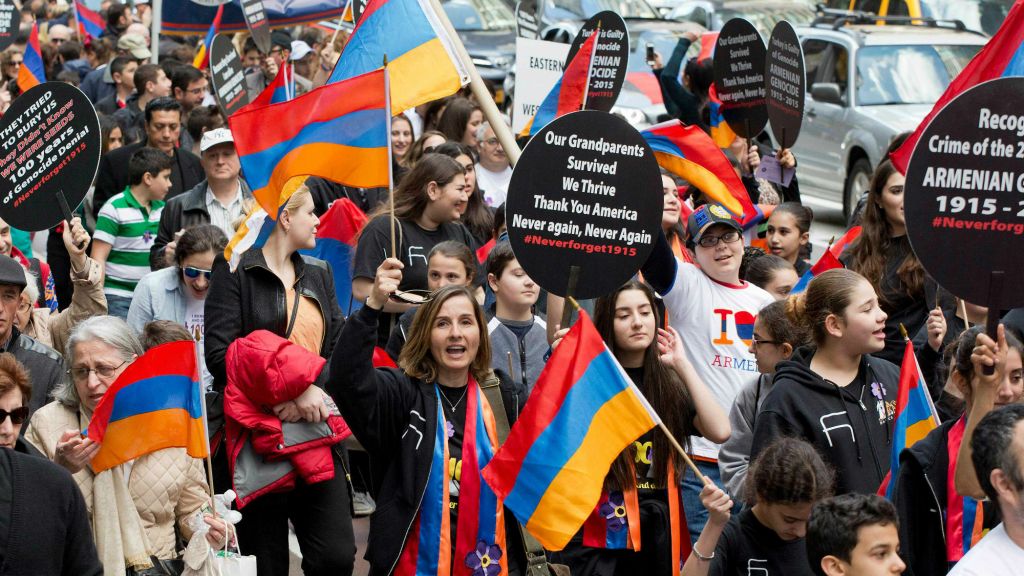
NEW YORK (AP) — Thousands of people packed Times Square on Sunday to demand that the US government recognize the deaths of up to 1.5 million Armenians during World War I as genocide.
The rally marked the centennial of the killings under the Ottoman Empire — today’s Turkey.
“It’s humanity’s issue, it’s not just about Armenian people; history continues to repeat itself,” said Nancy Guetssoyan, 28, of New Jersey. “The US government has not declared it a genocide because they’re allies with Turkey.”
The age-old international dispute over the Armenian deaths focuses on the interpretation of one word: genocide.
Pope Francis recently called the killings genocide, a view widely shared by scholars. Turkey, however, denies that the deaths constituted genocide, saying the toll has been inflated and that those killed were victims of civil war and unrest.
Friday marked the 1915 starting date of what Armenians say were the executions of hundreds of intellectuals and community leaders in Constantinople, now Istanbul. The killings continued during and after World War I, accompanied by forced labor and deportation of women, children and the elderly, Armenians allege.
Turkey has said the death toll has been inflated, and that those killed were victims of civil war and unrest. Last week, Turkish President Recep Tayyip Erdogan insisted that his nation’s ancestors never committed genocide.
Ethnic Armenians living in the United States are pushing for a formal vote in Congress that would classify the killings as genocide.
Democratic Sen. Charles Schumer spoke to the crowd on Sunday, saying, “I stand with you in making sure the deniers are not given any place under the sun.”
Speakers included several Jewish leaders as well as Taner Akcam, a Turkish-born scholar who supports the Armenian cause as a professor at Clark University in Worcester, Massachusetts.
“It is very troubling to see that the United States has still not recognized the Armenian genocide,” he said, adding that the justification for that is Turkey’s crucial role in US security strategy.
Rabbi Steven Burg, the Eastern Director of the Simon Wiesenthal Center, said that Rafael Lemkin, a Polish-born Jew, coined the term genocide after World War II — convincing the world to view the Holocaust as a crime against humanity.
“He started his quest because of the Armenian genocide,” the rabbi said. “We need to support each other, whether it be Rwandans, or whether it be Armenians or Jews.”
Lemkin recognized that the Armenian genocide was the first in the 20th century, Burg said. His definition served as the basis for the UN Convention on the Prevention and Punishment of the Crime of Genocide, adopted in 1948.
The New York rally was sponsored by the Armenian Genocide Centennial Committee of America.




The Times of Israel Community.