

Civic responsibility and heavenly decree: Keen voters see duty in local ballot
Residents of three Israeli towns vote early, hoping to defy predictions that country’s first municipal election with national day off will lower national turnout
 Add ToI as a Preferred Source on Google
Raoul Wootliff is a former Times of Israel political correspondent and Daily Briefing podcast producer.
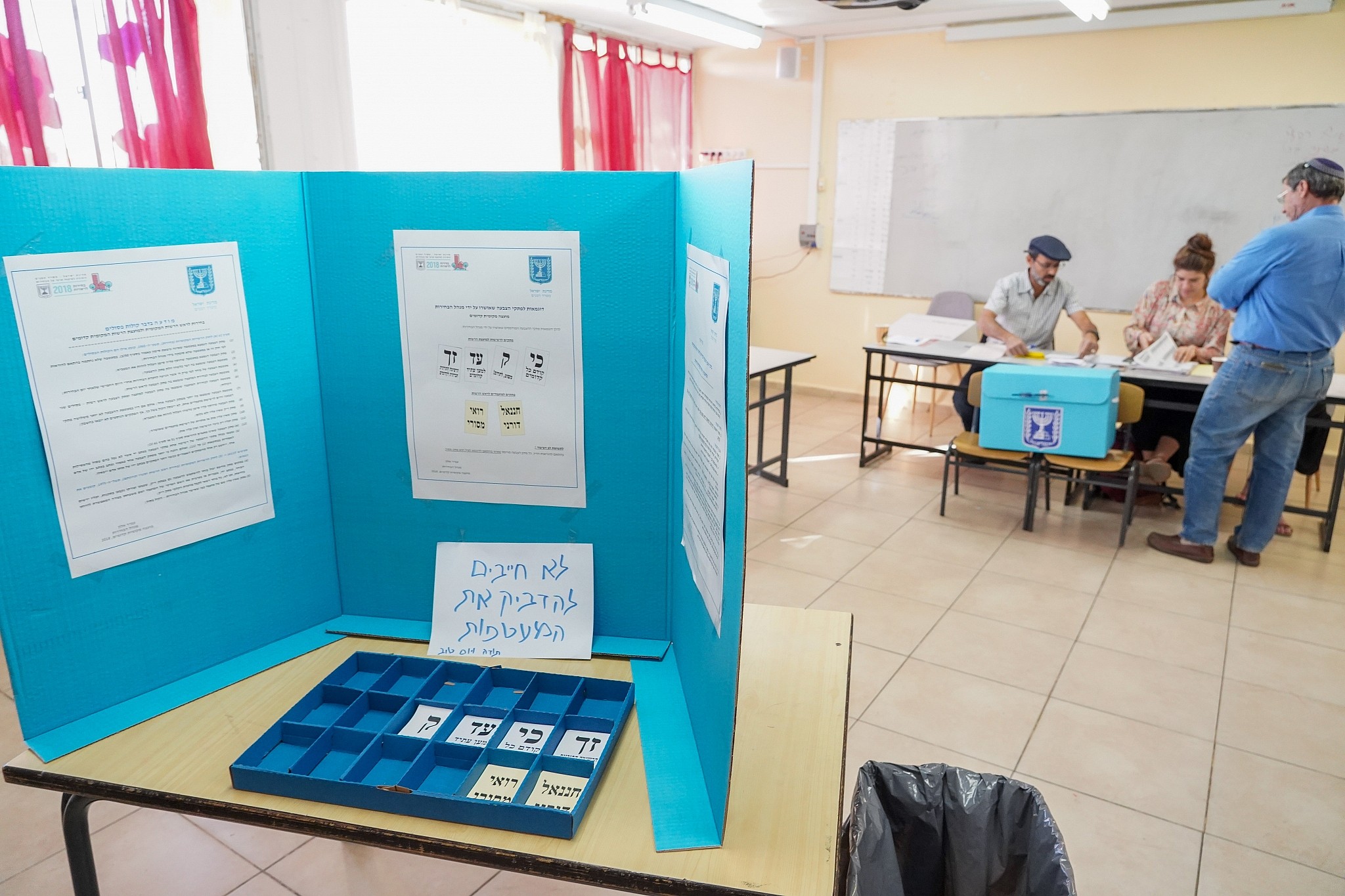
The parking lot between the Avnei Choshen and Yachad schools in the central Israeli city of Modiin usually begins to fill up at 7 a.m. with a constant flow of parents weaving their cars in and out as they frantically drop off their children each day.
But at 7 a.m. on Tuesday morning, just a handful of vehicles occupied the gravel space and an almost serene quiet filled the surrounding streets, replacing the buzz of the hectic school run.
Outside both schools, activists from the 10 lists running in the city’s local elections were setting up shop, hanging the familiar banners of smiling candidates that have adorned Israel’s streets for months and wearing T-shirts with the bright colors and catchy slogans of each party.
With ballot stations open from 7 a.m until 10 p.m, most voters, however, appeared to be taking advantage of the country’s first municipal election national day off to sleep in and relax at home before heading to the polls, or the beach.
For Rivka Kranik, the only voter waiting outside the Yachad polling station as election officials finished preparations inside, election day was a unique opportunity that could not be put off.
“More than Knesset elections, here we can really affect what goes on,” the 62-year-old city resident said of the vote for the municipal council responsible for citywide education, infrastructure and planning. “This is our chance to influence.”
The 90,000-resident city is one of 18 local councils and 11 regional councils in which only one candidate is running to be mayor or municipal head. Haim Bibas, a 10-year incumbent who is also chairman of the Federation of Local Authorities, has nonetheless mounted an energetic campaign for his party’s slate to win as many spots as possible on the 18-seat council, as well as to increase voter turnout across the city.
Kranik said she wasn’t surprised to be the first voter at the polling station and expected the numbers to pick up later in the day. “It might not be thrilling but there is an excitement, and people will come,” she said.
For some of the voters who followed Kranik, casting a ballot was more than just about influencing local policy, and went to the heart of living in a democratic country.
“It’s a civic duty, my responsibility as a citizen,” said Cynthia, a South Africa native who immigrated to Jerusalem 50 years ago and moved to Modiin in 2006.
“Everyone should vote,” she said, “Regardless of whether we only have one candidate for mayor or if you don’t follow politics on a day to day basis.”
Another immigrant, Elliot, who came to Modiin from the US last year, said that Hebrew-speaking family and friends had had to explain the different candidates and issues to him, but he was determined to cast a vote in his first Israeli election.
“It was a duty for me in the US and it’s a duty here,” he said.
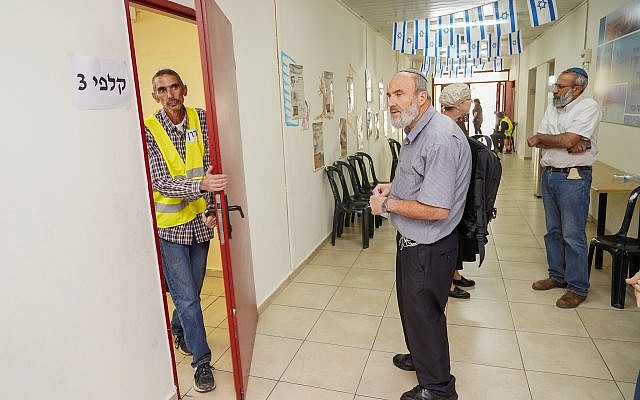
Some 6.6 million Israeli citizens and residents age 17 and up are eligible to cast their votes in the local polls, electing officials to 251 city, town, and regional councils nationwide, according to Interior Ministry figures.
The new Knesset law giving Israelis the day off to vote for their local officials is aimed at jolting voters out of their traditional indifference toward municipal polls.
And while some predicted that a day off may in fact cause a lower turnout, with voters more likely to take a day trip to the beach or one of the many free museums open Tuesday, an Israel Democracy Institute poll showed that 83 percent of the Jewish public and 71% of the Arab public planned to vote. That compares with the 2013 municipal elections where voting turnout rates stood at a national average of 51.9%, with just 28.7% in Tel Aviv-Jaffa, 36.1% in Jerusalem — where Arab residents of East Jerusalem boycott the vote — and 32.7% in Haifa.
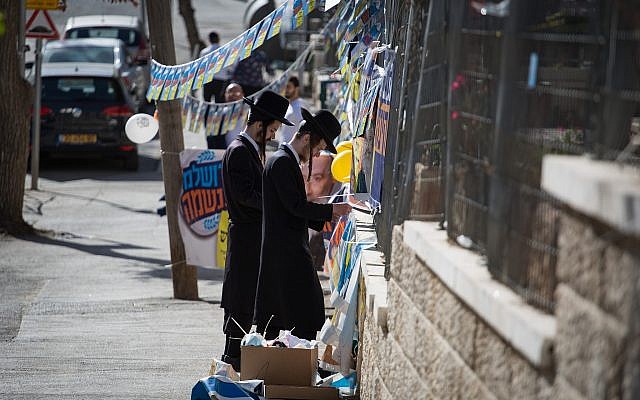
One demographic group with traditionally strong turnout rates is the ultra-Orthodox, and down the road from Modiin, in the the ultra-Orthodox city of Kiryat Sefer (officially called Modiin Illit), several polling stations were already heaving just an hour after they had opened.
At the Ohalei Sefer School in the western half of the city, Moshe Eichler explained that while in many communities voters may wait until the end of the day, in ultra-Orthodox towns, the morning was always busiest.
“Look,” he said, pointing to a stream of men in black jackets and hats making their way to the school from the synagogue across the street apparently oblivious of a honking bus. “We come straight from morning prayers to vote.”
For Eichler, the duty to vote came not from a sense of civic responsibility, but from a higher place.
“I vote according to what God wants,” said the smiling 41-year-old father of five.
And how does he know what that may be? A poster on the bus made it clear enough, at least for some: “The rabbis chose Avner Amar, with the help of God,” read the banner for the ultra-Orthodox Shas party candidate. Amar is challenging the incumbent Mayor Yaakov Gutterman of the ultra-Orthodox Degel HaTorah in the 70,000-strong city just inside the West Bank.
“Yes, it is a religious duty,” agreed Eichler’s neighbor Tuvia of casting a vote, stressing that the mayor and city council “have a lot of power in a place like Kiryat Sefer and we have to make sure they care for our interests.”
Tuvia explained that “people still decide on their own,” but “as with many things in our community,” the rabbinical leadership plays a key role in guiding members.
That decision was nonetheless made easier this year when the two Ashkenazi parties, Degel HaTorah and Agudath Israel — followed the lead of their United Torah Judaism in the Knesset — decided to field a united list in Kiryat Sefer.
Yisrael, a teenage volunteer giving out leaflets for the party, echoed the sense of religious obligation and rabbinic influence in voting, saying that Gutterman — who is widely expected to increase his majority — was the choice of the city’s Chief Rabbi Simcha Kassler and “that is clearly the most important consideration.”
Pushed on why he had chosen to volunteer, Yisrael admitted that divine will may not have been his only motivation.
“Yeah, it’s fun. Everyone is here. It’s a good atmosphere,” he said, grinning. “And we get lunch later.”
Back across the Green Line, in the joint Arab-Jewish town of Ramle, voting habits couldn’t be more different from Kiryat Sefer’s, but the atmosphere outside the polling stations was similarly good-spirited, despite a hard-fought and at times nasty election campaign.
Walking towards the Zeev Bistritzky High School at the entrance to the city, voters arriving at around 9 a.m. were swarmed by volunteers from numerous parties handing out campaign materials and explaining why their candidates were the undeniable best choice.
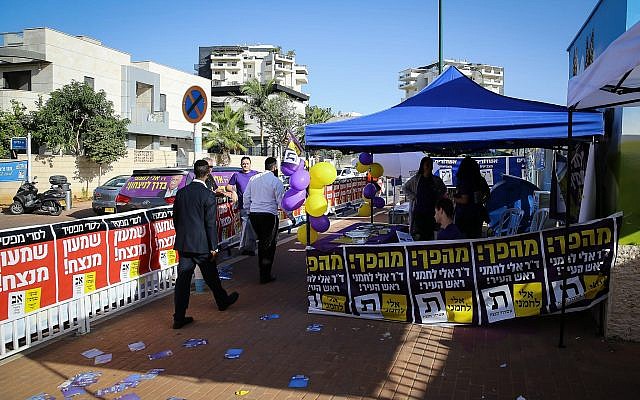
Here, a close battle is playing out between the Likud party incumbent Mayor Michael Videl and Kulanu challenger Adi Shternberg. The race has become somewhat of a referendum between Prime Minister Benjamin Netanyahu and Kulanu chairman Moshe Kahlon, who have each visited the city twice in the past month to campaign for their respective candidates.
Videl and Shternberg have both resorted to negative campaigning against the other. The election for the municipal council has meanwhile been plagued by accusations of racism in the national-religious Jewish Home party campaign, which used anti-Muslim messaging to warn against Jewish-Arab intermingling.
But voters on Tuesday appeared more focused on the positive aspect of exercising their democratic right than on the bitter messages heard in the run-up to the vote.
“This is my first time voting and I’m really excited,” said 18-year old Ma’ayan.
“My parents always told me to get involved, and this is a small way of doing that,” she said.
Maya and Tomer Myerson, who had brought their 8- and 6-year-old daughters with them to vote, said they wanted to show their children that “we all have a say in how the city, and the country is run.”
“To be honest, I tune out a little when people talk about the election,” Tomer said. “I haven’t followed it all, but I would never skip an election.”
Asked if they would not rather spend the day at the beach, the Myersons said that they were in fact going from the polling station to Palmachim Beach, a 15-minute drive away.
“But first, we’ll vote,” Maya said.







The Times of Israel Community.