

Eyeing Nepal, experts warn Israel is unprepared for its own Big One
In a high-risk zone with history of terrible tremors, officials say too little done to protect buildings in Israel and PA from expected quake
 Add ToI as a Preferred Source on Google
Ilan Ben Zion is an AFP reporter and a former news editor at The Times of Israel.
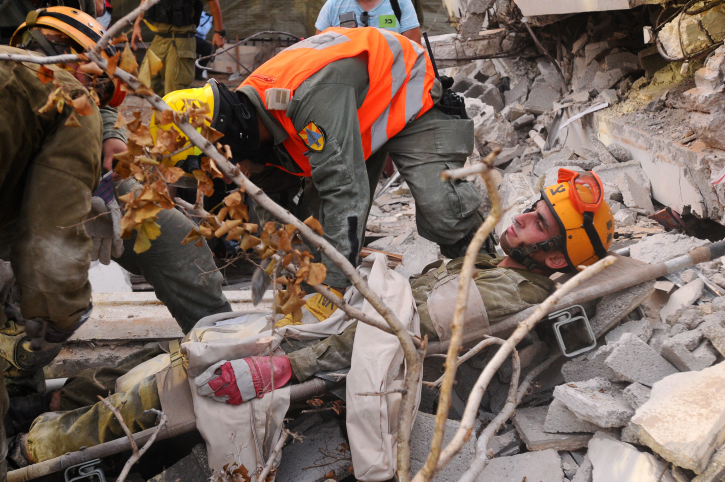
After a massive, but expected, earthquake leveled large sections on Nepal and left over 3,000 people dead, experts in Israel are warning that the country is inadequately prepared for its own impending major quake.
Seismologists say that, with Israel and its neighbors sitting on a major fault line, a large quake could happen tomorrow, or a year from now.
Such a calamity, warned Israeli, Palestinian and Jordanian experts in a 2007 report, constitutes “a real, as well as a current, threat to the safety, social integrity, and economic well-being of the people in the region.”
Israel and the Palestinian territories lie atop a tear in the earth’s crust running along the country’s eastern flank, the margins of two tectonic plates, which seismologists deem a high seismic risk zone.
As the Arabian plate, on which Jordan sits, grinds northward at 20 millimeters per year relative to the neighboring African plate to its west, earthquakes intermittently occur, sowing death and destruction.
No fewer than 17 historically recorded major earthquakes have rattled the country in the past 2,000 years, causing significant destruction and loss of life, according to a 1994 article published in The Israel Exploration Journal.
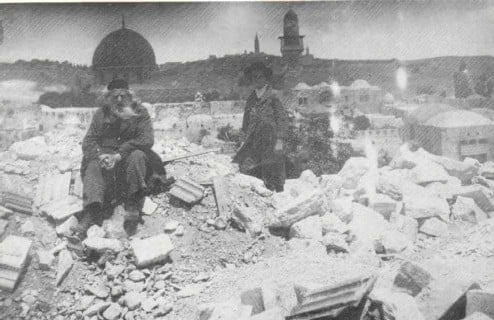
The last major quake struck on July 11, 1927, killing over 400 and leaving “not a house in Jerusalem or Hebron… without some damage,” the Jewish Telegraphic Agency reported in the days following.
Amotz Agnon, an earth sciences professor at Hebrew University, studied the layers of sediment on the floor of the Dead Sea, which has provided a seismological record dating back 70,000 years.
Magnitude-7 earthquakes, like the 7.8-magnitude temblor that shook Nepal Saturday, occur along the Jordan Valley once every 1,000 years on average, the last one taking place in 1033, he said. Less severe ones, on the scale of the 1927 earthquake, transpire every 80-120 years or so.
Predicting quakes, he said, “is a very tricky system.”
There are long periods defined by little major seismic activity and others of more frequent tectonic movement, and Agnon posited we appear to be in the latter. GPS monitoring of tectonic plates that meet in the Jordan Valley indicate that they’re locked against each other, accumulating elastic energy that will eventually be released in the form of an earthquake.
“When it’s stored on a significant depth range,” he explained, “it will probably be released one day during our lifetimes, or maybe later on, but our buildings will have to sustain significant acceleration.”
Because earthquakes are random, unpredictable phenomena, “the only way for us to prevent a disaster is to build properly, Dr. Avi Shapira, a seismologist who chairs an interministerial committee on earthquake preparedness, told The Times of Israel on Sunday.
A government initiative to incentivize reinforcement of older buildings launched in 2005 — called Tama 38 — has had moderate success, he said, with approximately 2,000 buildings undergoing retrofitting to withstand earthquakes.
Roughly 100,000 buildings nationwide that don’t meet earthquake safety codes, however, remain at risk. According to a Science Ministry report filed a month ago, the Tama 38 program is largely ineffective, since the bulk of reinforcement projects are concentrated in the larger Tel Aviv area, while in cities such as Eilat, Jerusalem, Haifa, Beit Shean and Tiberias — which lie closer to the fault lines, and would be hit harder in the event of an earthquake — older, more vulnerable structures remain untouched, Haaretz reported. The ministry report concluded that Israel could preemptively cut earthquake damage by as much as two-thirds, should it budget some 1.7 billion shekels ($430 million) toward reinforcements in high-risk areas.

“We are trying to find other ways or other tools to motivate people to go and reinforce their house,” Shapira said. Israel still has “too many residential buildings that are not prepared to sustain a 6.5 earthquake” and “are poorly constructed,” endangering the lives of citizens.
While Shapira’s committee in 2013 said the country should prepare for as many as 7,000 fatalities, 40,000 injuries and thousands of buildings destroyed in the case of an earthquake, he said Sunday that it was likely that number could be significantly less.
“Israel is better prepared for a strong earthquake than many other countries in the world, including some of the more technically advanced countries in the world,” he claimed. “Israel is, relatively speaking prepared. I wouldn’t say well prepared, there is a lot to do, but it is relatively prepared.”
The IDF’s Home Front Command chief Maj.-Gen. Eyal Eisenberg said in 2012, during a drill that exposed Israel’s preparedness shortcomings, that even a reasonably powerful quake in Israel would cause “damage to life and property on a much more significant scale” than a war.
Those figures, however, took into account the Palestinian cities of the West Bank and Gaza Strip, which are highly vulnerable to seismic activity and plagued by inadequately constructed buildings.
Even a moderate earthquake, of magnitude 6 or 6.5, would result in widespread damage in the West Bank, Dr. Jalal Dabbeek, head of the Urban Planning and Disaster Risk Reduction Center at Nablus’s An-Najah University, said. Surveying buildings in the seven major Palestinian cities in the West Bank, he found that over 70% were “highly vulnerable” to significant damage in the case of such a quake. Less than seven percent were able to withstand major tremors.
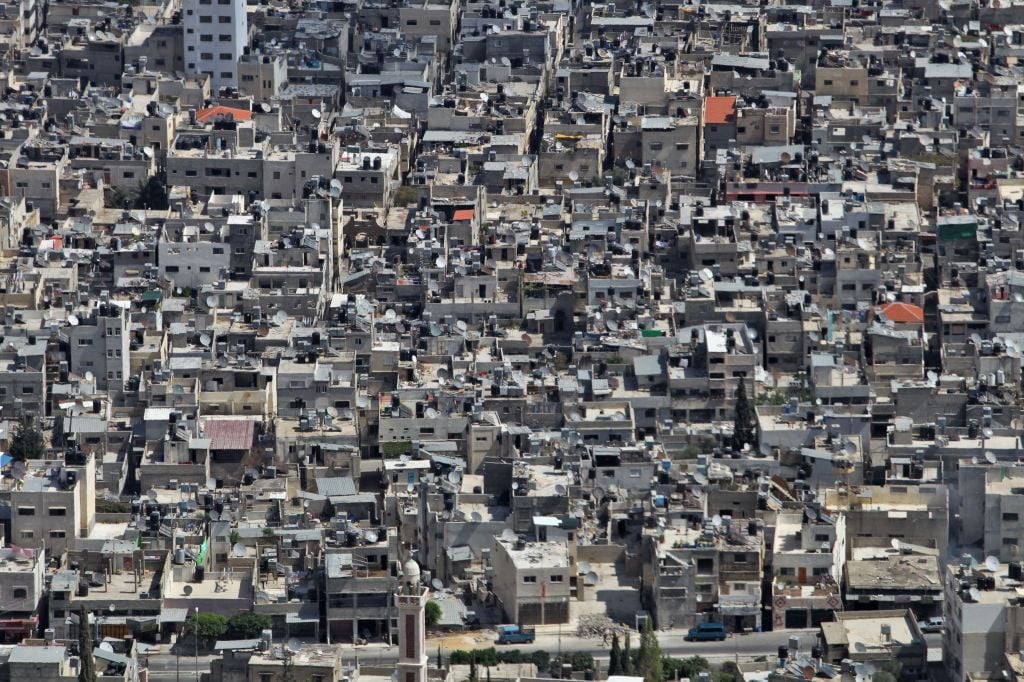
Another limited sample study he conducted projected the possibility of “maybe 5,000-6,000 dead,” in addition to thousands of collapsed and tens of thousands of partially collapsed buildings across the West Bank. He conceded, however, that his project didn’t have a large enough survey, and looks to do more comprehensive studies.
“Every day that passes without an earthquake brings us closer to a big one,” Dr. Rivka Amit, head of Israel’s Geological Survey, said over the phone.
While Israel’s building codes were recently updated to account for more recent geological studies, Amit said that there weren’t enough inspections to make sure older edifices — built before the 1990s — met those standards. Efforts to retrofit buildings built before earthquake-safe standards were instituted are hampered by high costs.
Amit said that Israel is installing a national early warning system to complement the existing local ones, which will “hopefully start in two years.”
“We are not Japan and not the US,” she said. “We have a lot of work to do.”










The Times of Israel Community.