Interview

From pre-state to present, political cartoons paint picture of a dynamic Israel

New book uses the work of Israel’s leading editorial cartoonists, who hold the country’s leadership accountable through clever imagery and biting satire

Renee Ghert-Zand is the health reporter and a feature writer for The Times of Israel.
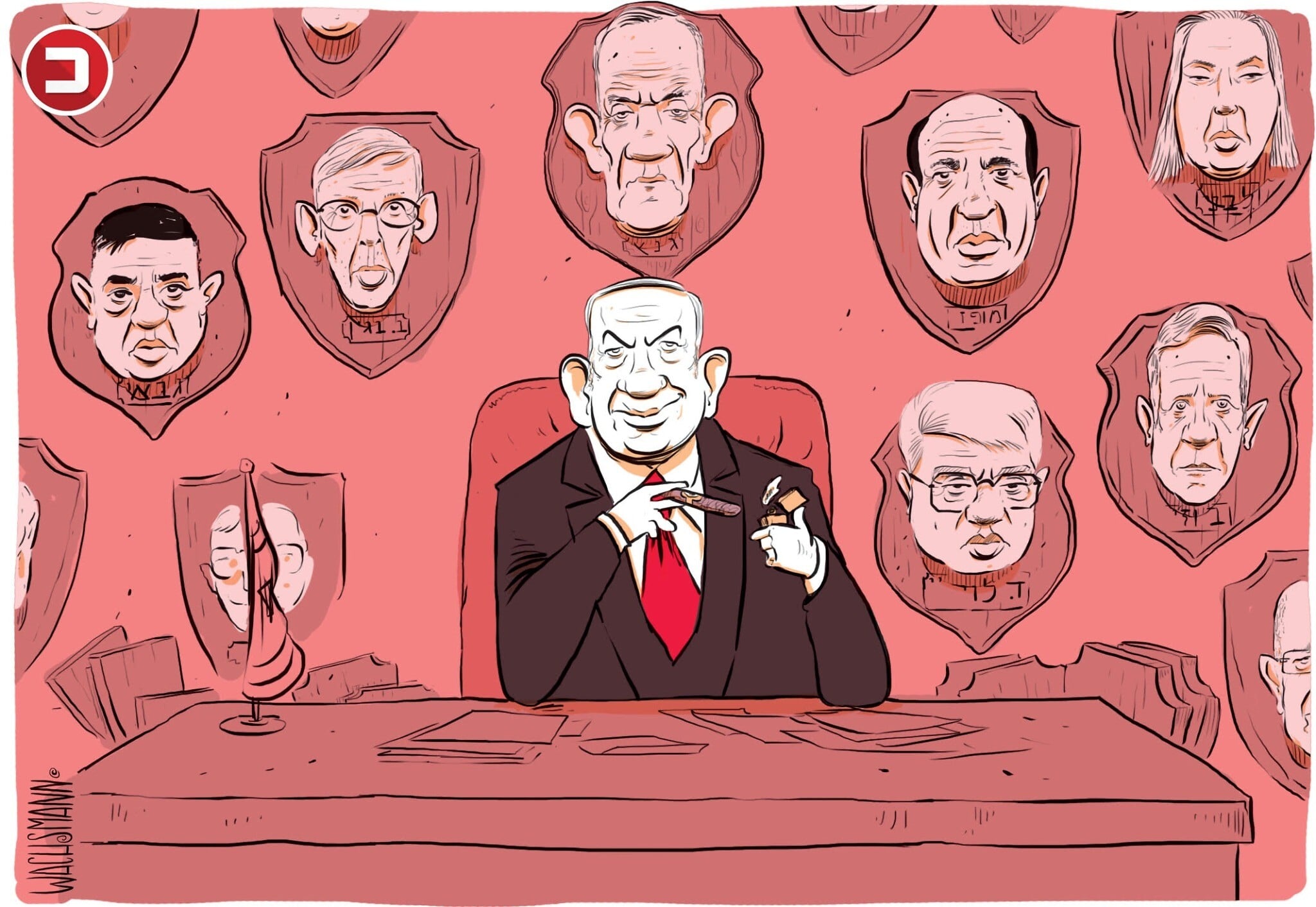
  • The 2010s was the decade of Netanyahu’s mastery of the black arts of political manipulation and manoeuvring. Despite charges of bribery, fraud and breach of trust, despite weekly demonstrations in Jerusalem, despite his wife’s loose understanding of the difference between state responsibility and domestic aggrandizement, Netanyahu saw off one opponent after another. (Yonatan Wachsmann, Calcalist December 3, 2020/Courtesy of Colin Shindler)
    The 2010s was the decade of Netanyahu’s mastery of the black arts of political manipulation and manoeuvring. Despite charges of bribery, fraud and breach of trust, despite weekly demonstrations in Jerusalem, despite his wife’s loose understanding of the difference between state responsibility and domestic aggrandizement, Netanyahu saw off one opponent after another. (Yonatan Wachsmann, Calcalist December 3, 2020/Courtesy of Colin Shindler)
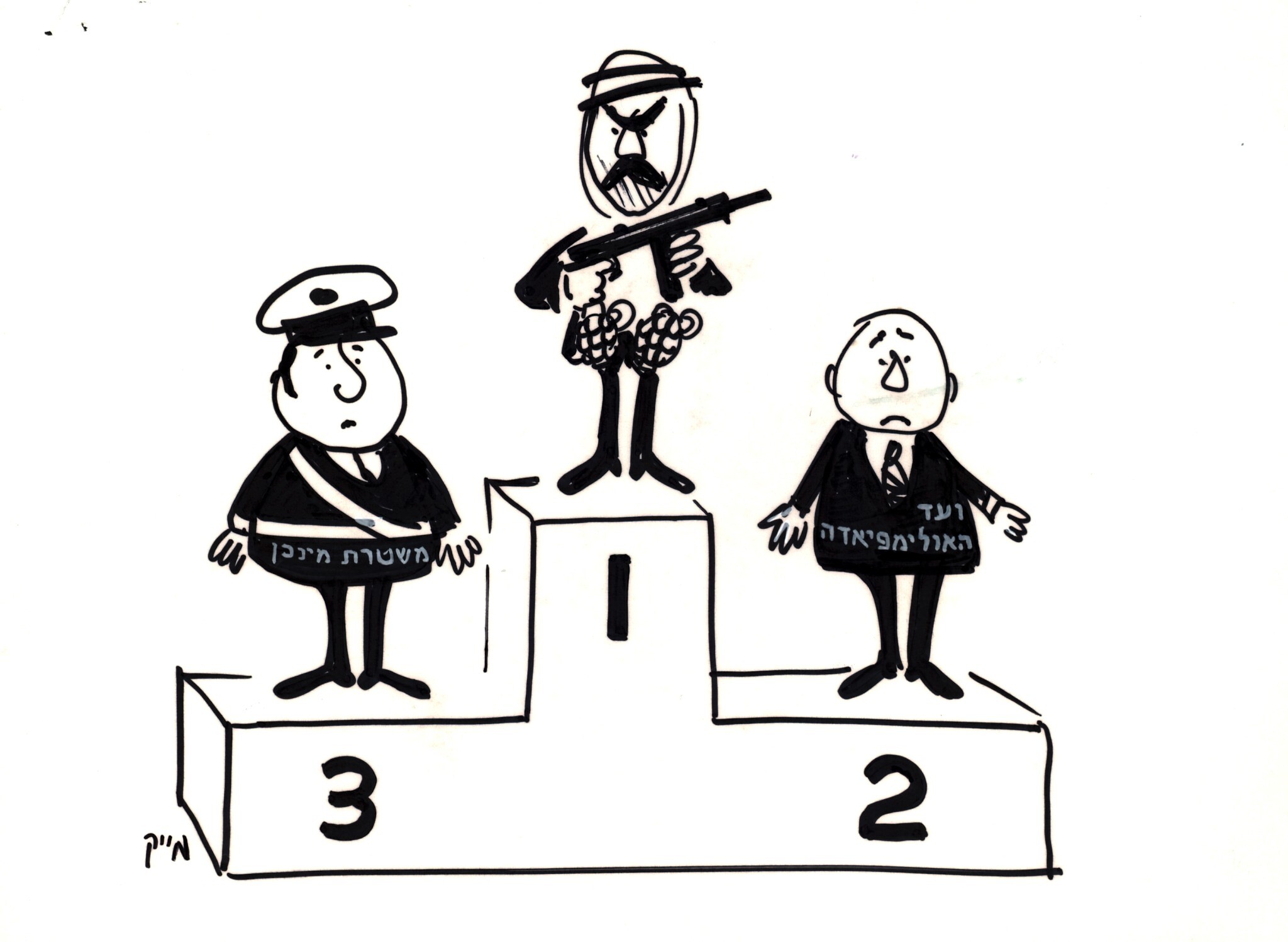
  • The killing of Israeli athletes at the Munich Olympics by members of Black September reflected badly on both the Olympics Committee and the city’s police force.  (Mike, Yediot Aharanot, September 1972/ Courtesy of Colin Shindler)
    The killing of Israeli athletes at the Munich Olympics by members of Black September reflected badly on both the Olympics Committee and the city’s police force. (Mike, Yediot Aharanot, September 1972/ Courtesy of Colin Shindler)
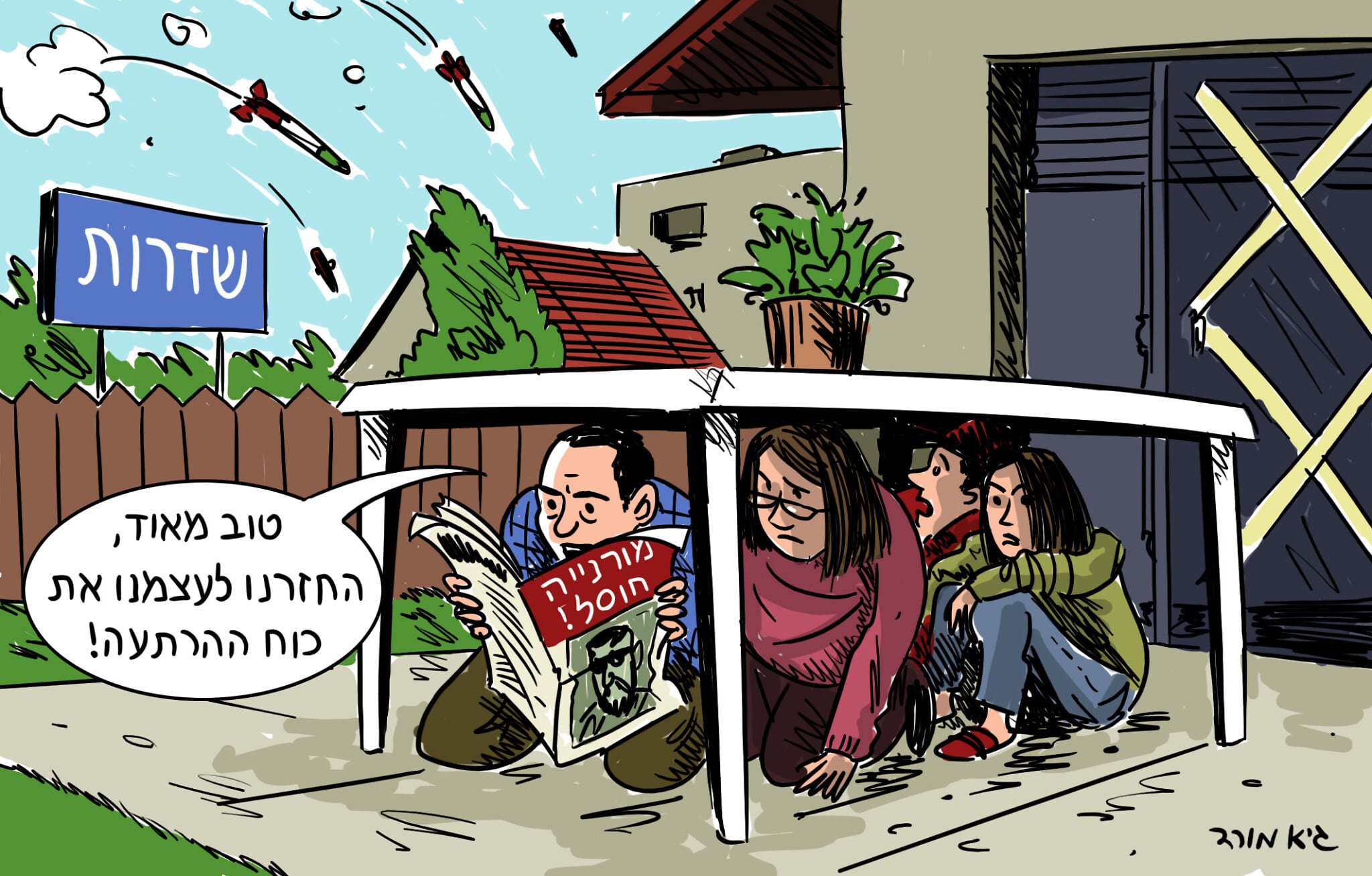
  • Qassams fired at Sderot. Operation Cast Lead, a military offensive against Gaza, was in response to the continual firing of missiles into Israel. A central target of the Qassam rockets was the Israeli border townof Sderot. Here a family in Sderot is seen sheltering from a missile barrage. The front page of the newspaper informs the reader that Imad Mugniyeh, a Hezbollah military leader, has been ‘eliminated’. The father’s cynical comment is: ‘Thank goodness, we have once again proved our power of deterrence!’ (Guy Morad, Yediot Aharanot, February 14, 2008/Courtesy of Colin Shindler)
    Qassams fired at Sderot. Operation Cast Lead, a military offensive against Gaza, was in response to the continual firing of missiles into Israel. A central target of the Qassam rockets was the Israeli border townof Sderot. Here a family in Sderot is seen sheltering from a missile barrage. The front page of the newspaper informs the reader that Imad Mugniyeh, a Hezbollah military leader, has been ‘eliminated’. The father’s cynical comment is: ‘Thank goodness, we have once again proved our power of deterrence!’ (Guy Morad, Yediot Aharanot, February 14, 2008/Courtesy of Colin Shindler)
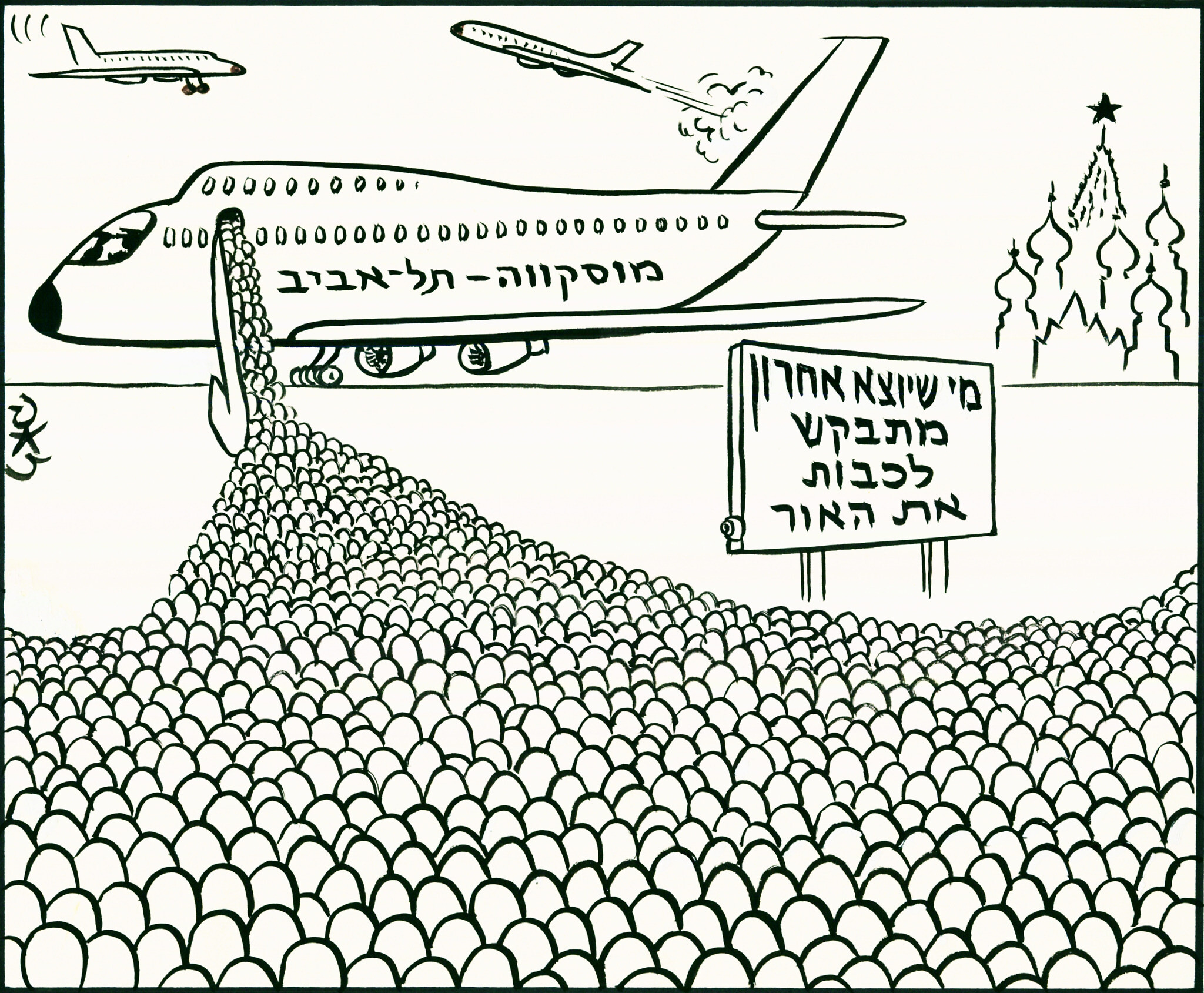
  • A consequence of perestroika and glasnost during the Gorbachev era together with a rapprochement with the United States was the mass emigration of Soviet Jews. Here multitudes of Soviet Jews are queuing to board a Moscow–Tel Aviv flight amidst other flights flying to Israel. The billboard reads: ‘Last one out – please turn off the light...’ (Ze’ev, (Ha’aretz October 1, 1990/Courtesy of Colin Shindler)
    A consequence of perestroika and glasnost during the Gorbachev era together with a rapprochement with the United States was the mass emigration of Soviet Jews. Here multitudes of Soviet Jews are queuing to board a Moscow–Tel Aviv flight amidst other flights flying to Israel. The billboard reads: ‘Last one out – please turn off the light...’ (Ze’ev, (Ha’aretz October 1, 1990/Courtesy of Colin Shindler)
  • he unexpected election of Donald Trump delighted the Israeli Right. Unlike traditional Republican administrations, Trump identified strongly with Netanyahu’s positions on Jerusalem and the West Bank settlements. This image is based on a photograph of Netanyahu resting his head on the lap of his wife, Sara. (Itamar Daube, Yediot Aharanot  November 12, 2016/Courtesy of Colin Shindler)
    he unexpected election of Donald Trump delighted the Israeli Right. Unlike traditional Republican administrations, Trump identified strongly with Netanyahu’s positions on Jerusalem and the West Bank settlements. This image is based on a photograph of Netanyahu resting his head on the lap of his wife, Sara. (Itamar Daube, Yediot Aharanot November 12, 2016/Courtesy of Colin Shindler)
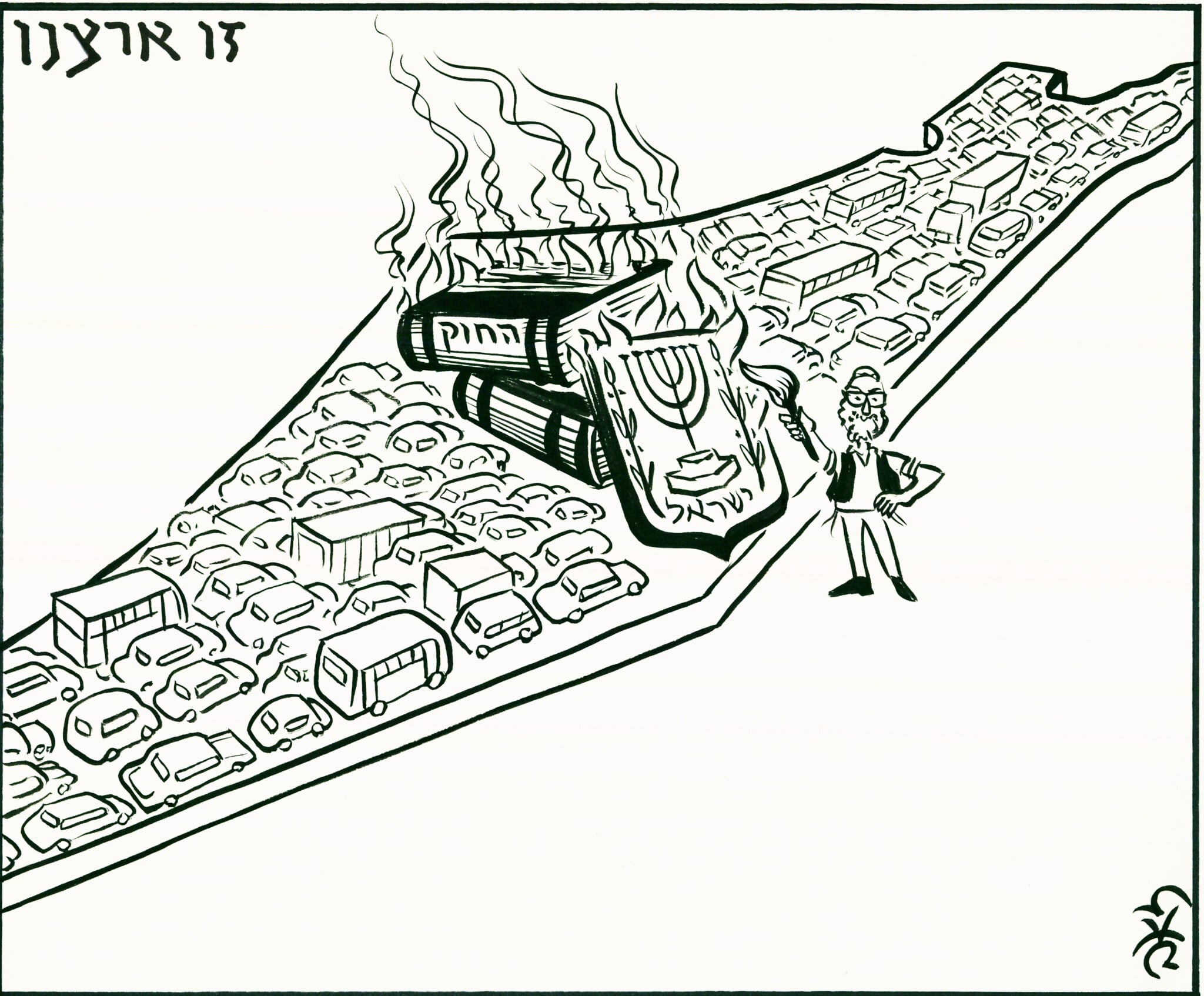
  • Gridlock in Israel by the far Right. In the months before the assassination of Yitzhak Rabin, several far Right groups staged protests and demonstrations against Rabin and the Oslo Accords. One group was Zo Artzeinu (This is our Land), which blocked major roads, causing massive traffic jams, depicted here in the shape of Israel. (Ze’ev, Ha’aretz August 11, 1995/Courtesy of Colin Shindler)
    Gridlock in Israel by the far Right. In the months before the assassination of Yitzhak Rabin, several far Right groups staged protests and demonstrations against Rabin and the Oslo Accords. One group was Zo Artzeinu (This is our Land), which blocked major roads, causing massive traffic jams, depicted here in the shape of Israel. (Ze’ev, Ha’aretz August 11, 1995/Courtesy of Colin Shindler)
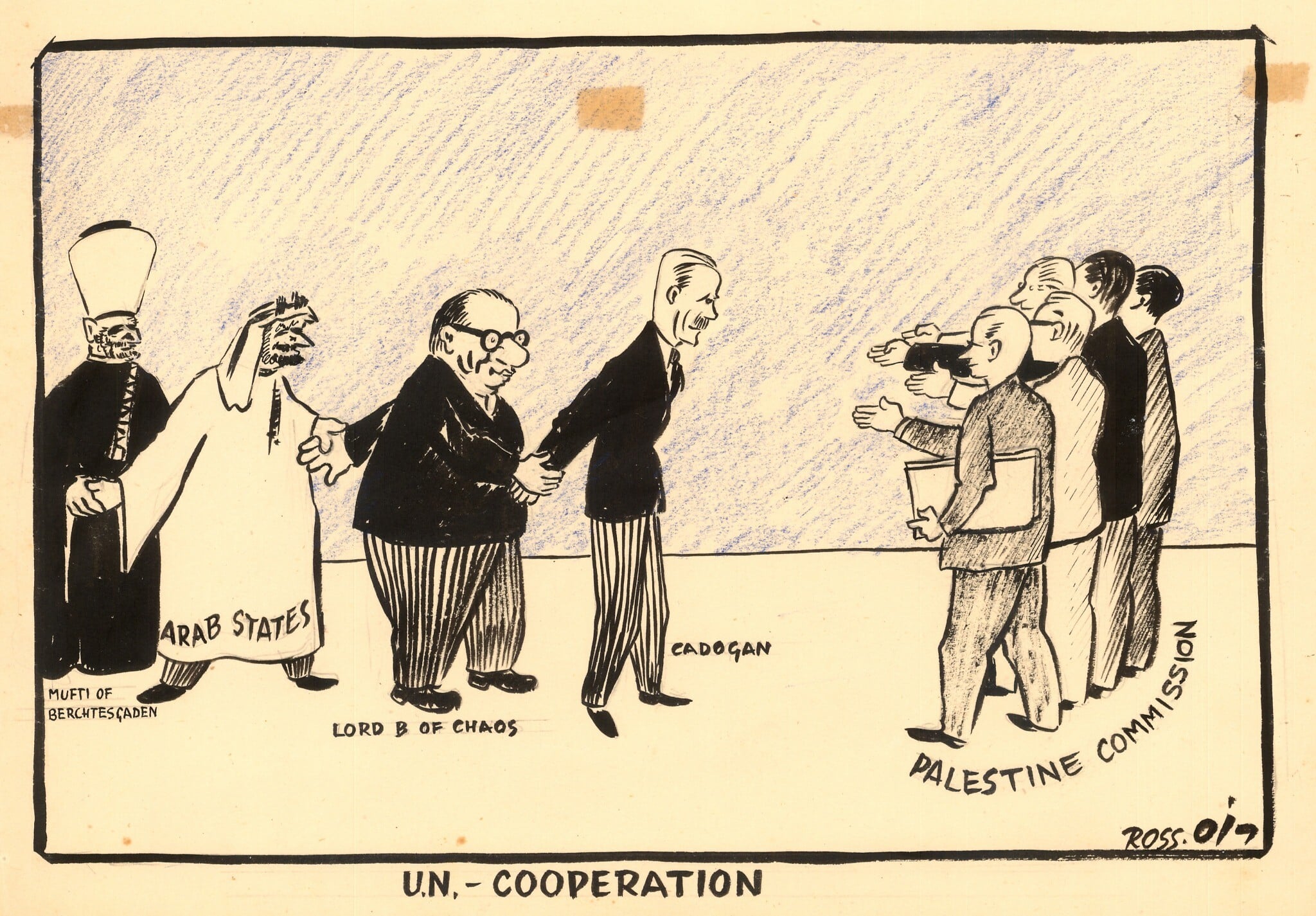
  • There was great suspicion that many of those involved in the UN deliberations on Palestine in 1947 were closet anti-Semites. (Yosef Ross, 1947/ Courtesy of Colin Shindler)
    There was great suspicion that many of those involved in the UN deliberations on Palestine in 1947 were closet anti-Semites. (Yosef Ross, 1947/ Courtesy of Colin Shindler)
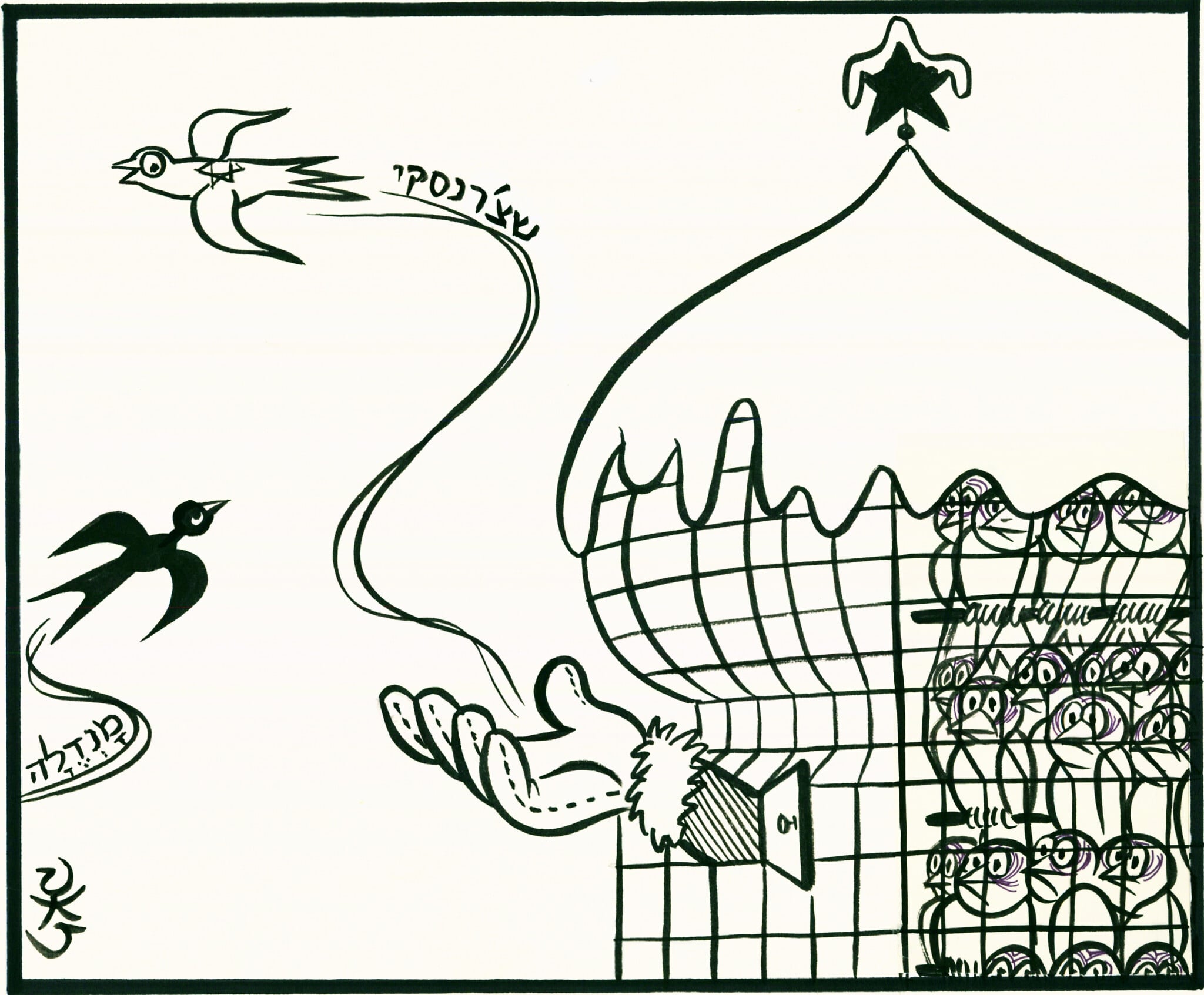
  • Anatoly (Natan) Sharansky, a seminal figure in the Soviet human rights and Jewish emigration movement, was released after nine years in a strict regime labour camp in the USSR, in exchange for Eastern bloc spies imprisoned in the USA and West Germany. A blackbird labelled ‘Mandela’ is also taking flight – an indication of the relaxation of his incarceration by the apartheid regime in South Africa. (Ze’ev, Ha’aretz February 12, 1986/ Courtesy of Colin Shindler)
    Anatoly (Natan) Sharansky, a seminal figure in the Soviet human rights and Jewish emigration movement, was released after nine years in a strict regime labour camp in the USSR, in exchange for Eastern bloc spies imprisoned in the USA and West Germany. A blackbird labelled ‘Mandela’ is also taking flight – an indication of the relaxation of his incarceration by the apartheid regime in South Africa. (Ze’ev, Ha’aretz February 12, 1986/ Courtesy of Colin Shindler)

The famous American editorial cartoonist Herblock once wrote, “If the prime role of a free press is to serve as critic of government, cartooning is often the cutting edge of that criticism.”

This certainly applies to Israeli political cartoons, as is shown in a new book by British historian Colin Shindler titled, “Israel: A History in 100 Cartoons.” Published earlier this year, it is timely reading as the Jewish State marks 75 years of independence at a point when two-thirds of Israelis oppose the current government’s plans for judicial overhaul, with hundreds of thousands protesting weekly against a threat to the country’s democracy.

The book includes editorial cartoons by Israeli artists spanning from a few years before the establishment of the state in 1948 through 2020. They are a stark reminder that visual satire has always been a way for Israelis to lampoon their leadership and cope with ongoing adversity from within and without.

“A cartoon can tell you so much in an instant,” author Shindler said in a recent interview from his home in London.

Shindler, 76, is an emeritus professor at the School of Oriental and African Studies, University of London. He became the first professor of Israel Studies in the UK in 2008 and was the founding chairman of the European Association of Israeli Studies (EAIS) in 2009. He is the author of 12 books, many of them on Zionism and Israeli history and politics.

Inspired by a trip nearly a decade ago to the Israeli Cartoon Museum in Holon, Shindler decided to take a deep dive into the subject. The project picked up steam during the COVID pandemic lockdowns when he spent hours searching through the National Library of Israel’s digitized newspaper collection of the Yishuv (pre-state Jewish community) and the State of Israel. He was also in touch with other cultural and historical institutions, as well as Israeli cartoon artists and their families.

Prof. Colin Shindler. (Courtesy)

Shindler begins the book with a detailed introduction to the history of caricatures, comics, and cartoons. He also discusses how Jews have been historically connected to all three.

“Cartoonists were, by definition, outsiders,” Shindler writes.

He explains that since Jews have historically been outsiders, it is not surprising that they have been “disproportionately represented as members of the fraternity of cartoonists and satirists.”

‘Israel: A History in 100 Cartoons’ by Colin Shindler. (Cambridge University Press)

After a section on the origins and history of Zionism, Shindler launches into the heart of the 367-page tome. He divides the modern State of Israel’s history into decades, providing a single representative cartoon for each. Each decade is then broken down into 4-page mini-chapters for each year containing a cartoon, a 30-entry timeline of key events, and a two-page historical-contextual summary.

“It was the hardest book to write out of all my books because I had to do extensive research into the specific details of what happened each year. I had to read everything about a given year and select a cartoon for the specific episode I decided to focus on,” Shindler said.

He told The Times of Israel that he approached choosing the 100 cartoons based on the historical or political event depicted, rather than on artistic merit.

“I can’t say that I’m an expert in caricature. I’m a historian. I deal in politics. I tried to pick a cartoon not so much because of the cartoonist, but because of the episode that it tried to illustrate,” Shindler said.

“Do you want to have a balance among cartoons or a balance among cartoonists? It became very complex,” he said.

With editorial cartoons appearing daily or weekly in so many Israeli publications, it was indeed difficult to choose. Although Shindler includes the work of 25 cartoonists, some appear more than others. One is Ya’akov Farkash (1923-2002), who was known by the pen name Ze’ev. A Holocaust survivor born in Budapest, he started with Ma’ariv in 1953 and was given a weekly page in Haaretz in 1963.
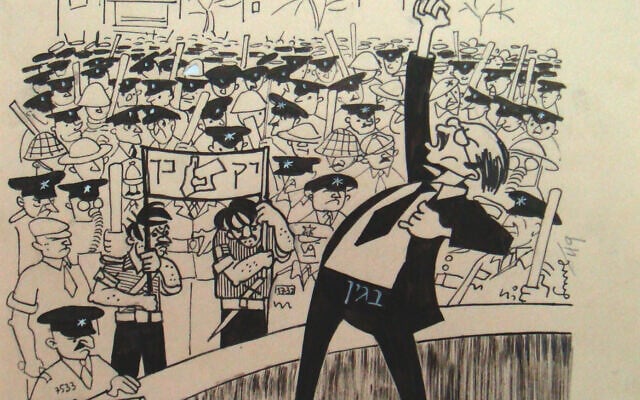
Menachem Begin addresses an election rally of his supporters in Moghrabi Square, Tel Aviv in January 1949. Accompanied by multitudes of police, two supporters hold a banner in front of Begin, bearing the Irgun slogan, ‘Only Thus’. The map includes Israel, the West Bank and the state of Jordan – as Begin’s party, Herut, did not recognize the first partition of Palestine in the 1920s. (Ze’ev, January 18, 1949/Courtesy of Colin Shindler)

“I chose quite a lot from Ze’ev. I do like his work. One of my favorites of his is one he did of Menachem Begin addressing an election rally of his supporters in Moghrabi Square, Tel Aviv in January 1949. His fist is in the air and his few supporters hold a sign with the Irgun’s slogan, ‘Only Thus,’ and the map of greater Israel including Jordan. Meanwhile, most of the audience consists of policemen,” Shindler said.

While not all of the cartoonists are familiar names, some will be to those who have followed the Israeli press over the decades. These include Amos Biderman, Shay Charka, Kariel Gardosh (Dosh), Michel Kichka, Moshik, and Avi Katz.

Notably, only one woman is included. A cartoon by German-born Friedel Stern (1917-2003) represents 1958. It shows a housewife with an unmistakable resemblance to prime minister David Ben-Gurion wearing a typically Israeli “tembel” hat, placing an object labeled “Who is a Jew?” in a refrigerator freezer. This reflects a government crisis over the issuing of identity cards brought on by this question. Ben-Gurion is seen as preserving his coalition by putting the “Who is a Jew?” debate on ice.
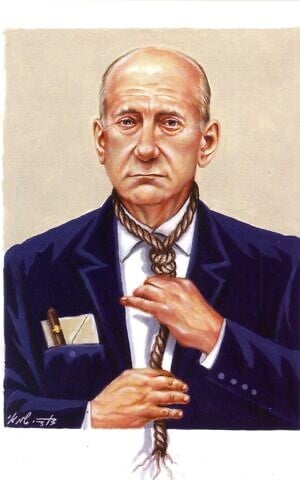
Ehud Olmert and Corruption. A snappy dresser, Olmert is pictured here with a cigar and a brown envelope – perhaps containing illicit funds – in his breast pocket. He is tying the noose as if it was a tie. His downfall was perceived widely as being of his own making. (Dudy Shamai, Ma’ariv, May 2008/Courtesy of Colin Shindler)

“As far as I can see, it wasn’t a profession for women. I obviously would have made an effort to balance between men and women, but as far as I could see, there was nothing there,” Shindler explained.

Shindler noted that he perceived a harshening of tone in political cartoons as the decades went on, especially post-1967. They became much more biting and dark.

“There’s this amazing 2008 image by Dudy Shamai of convicted former Prime Minister Ehud Olmert. A snappy dresser, his tie is a noose he tightens around his neck as the reader recognizes signs of his corruption in the drawing. It signifies that his downfall was of his own making,” he said.

Although the book ends in 2020 with the election of the short-lived Bennett-Lapid government, it serves as an encouragement for readers to pay attention to political cartoons in the press, on social media, and also on protest signs on the streets today.

“In the current situation, the [government is trying to sell] the idea that the judicial overhaul is just merely a bureaucratic measure, that it’s not a challenge to the rule of law and a wiping away of everything that upholds the rule of law,” Shindler said.

“This gives current Israeli cartoonists who are trying to strive for some sense of objectivity, truth, and fact a prime target,” he said.

Israel: A History in 100 Cartoons by Colin Schindler

This article contains affiliate links. If you use these links to buy something, The Times of Israel may earn a commission at no additional cost to you.


Most Popular
read more:
If you’d like to comment, join
The Times of Israel Community.
Join The Times of Israel Community
Commenting is available for paying members of The Times of Israel Community only. Please join our Community to comment and enjoy other Community benefits.
Please use the following structure: example@domain.com
Confirm Mail
Thank you! Now check your email
You are now a member of The Times of Israel Community! We sent you an email with a login link to . Once you're set up, you can start enjoying Community benefits and commenting.