

Gas! Gas! Quick, boys!
An ecstasy of fumbling by the press over the Tamar field going online; some are happy, some want electricity prices to drop
 Add ToI as a Preferred Source on Google
Ilan Ben Zion is an AFP reporter and a former news editor at The Times of Israel.
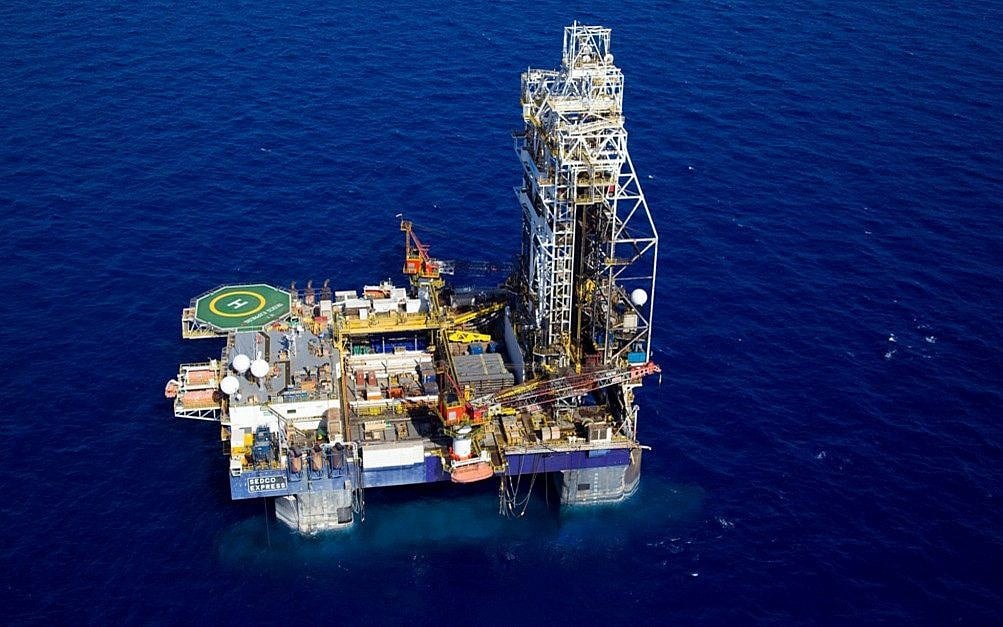
Israel’s top story on Sunday is gas, but not the kind resulting from too much stuffed cabbage. Four years after its discovery, natural gas from the Tamar field, off the Israeli coast, will start being pumped to customers. The towering sea oil rig, surrounded by the cerulean seas of the Mediterranean, graces the front pages of the main Israeli papers, and the keyword in the news coverage is energy independence.
Israel Hayom pulls a phrase from the Bible with its headline “Land flowing with milk and gas” and notes that after millions invested and years spent drilling, the Tamar field’s reserves “will bring about a revolution in the Israeli energy market.” It quotes the prime minister (of course) calling Sunday’s ribbon cutting “an important day for the Israeli economy.”
Only much farther down — sandwiched between praise of the projected boon — does the paper mention that the introduction of new gas sources won’t make a dent in electricity costs.
An optimistic Yedioth Ahronoth offers very little meat by way of information on the gas field, although the story takes up a full page of the pre-holiday broadsheet. It calls Israel a “gas superpower,” now that the Tamar rig is pumping gas into the country.
“Gas supply from Tamar changes the picture with its providing [gas] to power plants and large factories and its turning Israel into a country that isn’t dependent upon any external factor for supplying its gas demand, at least for the next two to three decades,” it writes.
For Haaretz, however, that’s the name of the game. The overline on its front-page article on the new gas flowing into Israel notes that “the electricity rate won’t drop in the next two years.” Although the Tamar field’s supply will replace imports from Egypt and from the older Tethys Sea field and will have “many economic benefits, it will only reach the pockets of consumers in a number of years,” the paper writes.
It reports that the Israel Electric Company was forced to burn more expensive fuels in recent years due to gas shortages, resulting in price hikes for customers. Because the company is still in debt, the public will meanwhile have to pay those fees for the foreseeable future, despite the drop in electricity production costs due to the Tamar gas. Haaretz reports that the cost of fuel for the IEC in 2012 was NIS 19.5 billion, more than twice that of 2010, when gas was readily available. Electricity prices are still slated to rise in May by 6.5%, and by an additional 2.4% in 2014.
Maariv, while dealing with the nuts and bolts of the matter, also notes that the real returns for the Israeli public won’t be felt until 2015. It mentions that the main well is located 1.6 kilometers below sea level and is pumped through a double submarine pipe — 160 kilometers long — to the rig, 24 kilometers off the coast of Ashdod.
“Flow of gas from Tamar to Israel will bring an end to the serious shortage of natural gas on the market, but will not bring a drop in electricity rates for at least the next two years, and next month it is even expected to increase by 6.5% and 3% more further down the line,” it reports.
In other energy news, Yedioth reports that the IDF plans to purchase a fleet of Better Place electric cars for its staff officers, in an effort to reduce the military’s carbon footprint and due to expected Defense Ministry budget cuts. According to the report, the IDF will purchase 10 of the cars as test vehicles, and consider further purchases thereafter.
Maariv’s lead story is about radicals taking over the Syrian civil war against President Bashar al-Assad, and offers brief descriptions of extremist Muslim groups, such as Jabhat al-Nusra, which have made significant gains in the fight against Damascus.
“A multitude of independent groups, which themselves are divided into independent cells, make control over rebel forces difficult and offer a preview of the war between the groups over assuming control [of Syria] on the day after Assad falls,” it writes. “Among the more than 80 groups, there are several especially radical organizations that are likely to threaten the Israel-Syria border on the day the Assad regime falls.”
Amira Hass writes in Haaretz that the Palestinian Authority’s 2013 budget demonstrates one thing above all: the PA’s dependence on donor states, foremost the US, for its financial existence. The PA’s aim of independence — and support of resistance — comes in contradiction to its primary aim of financial stability.
“The budget’s official intention is to help the population resist the Israeli occupation and strive toward establishing a state. At the same time, however, the Palestinian Authority is financially dependent on Israel and the donor states, first and foremost the United States,” she writes.
Two-thirds of the PA’s income comes from taxes and customs collected by Israel on its behalf, and aid from the US, both of which were frozen after the Palestinian delegation’s upgraded status at the UN General Assembly in November, she notes. Millions more in aid from the Gulf States never reached PA coffers.
“The PLO and PA are committed to fiscal stability, which requires appeasing Israel and the US. This means preserving a political status quo, which is contrary to the budget’s declared goal of advancing the popular and political struggle against the occupation.”








The Times of Israel Community.