

Getting testy from schools to shuls: What the press is saying on August 30
Aspects of the coming opening of the school year remain a pop quiz wrapped in an enigma; while lab workers and Bratslavers test the government’s policies, dangers be damned
 Add ToI as a Preferred Source on Google
Joshua Davidovich is The Times of Israel's Deputy Editor
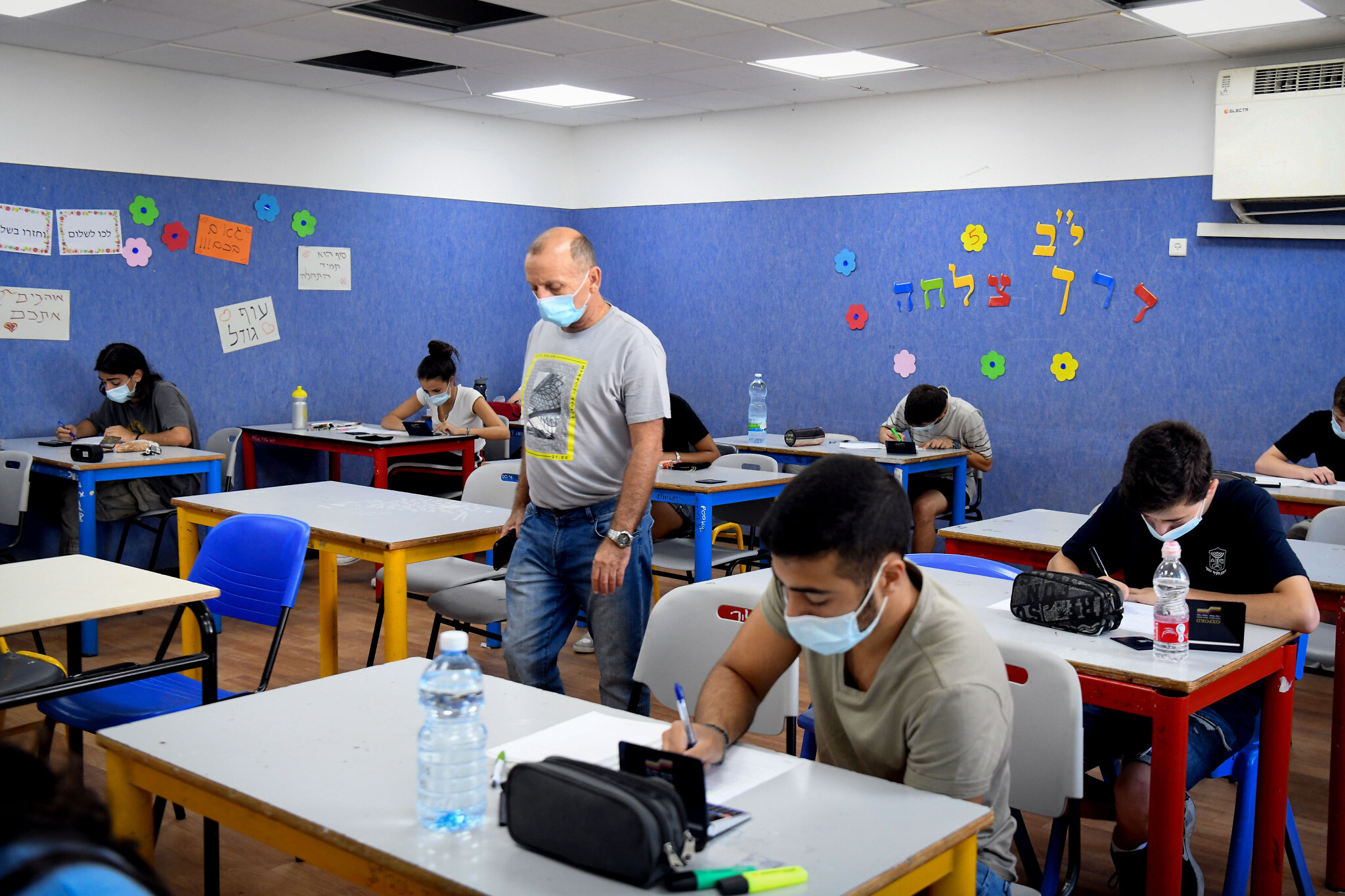
1. Academic accidemic: A relatively slow weekend newswise to close out a summer of madness allows the press on Sunday morning to look ahead to the looming opening of the school year, set for Tuesday, with requisite puns aplenty.
- “Schools to the test,” reads the top headline on Yedioth Ahronoth’s front page, leading off a large package on the challenges of returning to school.
- Lest you think that test is coronavirus, the pandemic merits almost nary a mention by the tabloid, which instead focuses on road safety outside of schools, noting that “according to research being published now, close to 5,000 children between the ages of 5 and 19 have been injured in traffic incidents over the past five years on their way to or from school — as pedestrians, bike riders or on electric scooters or bikes.”
- Still, the package is marked as “Returning to school under the shadow of the coronavirus” and the front page blurb makes it seem as if the focus of the coverage is the pandemic, so it’s unclear if the total absence of the No. 1 issue on most parents’ minds is a result of an error, or a sly comment on the fact that the virus has made most people ignore the very real and very present other dangers lurking for the little ones.
- Backing up the latter theory is a press release sent out by the Beterem children’s safety organization, which features what it calls “coronavirus doctors” warning of the other dangers of sending kids to school and noting that some 116 kids die in accidents of various types every year.
- “Accidents are more dangerous for kids than the coronavirus and similar diseases. Don’t tell me it won’t happen — it’s our responsibility to prevent the next disaster,” the head of the group says.
2. Making the grade: Another argument for avoiding mentioning the pandemic is the fact that with two days to go, nobody is quite sure what is going on, and the story appears to be changing rapidly.
- “48 hours to the bell,” reads the top headline in Israel Hayom, which focuses on efforts in so-called red cities to avoid their schools being kept shut by fiat.
- “Education Minister Yoav Gallant said that while his ministry had initially considered postponing the start of the school year in red cities for grades 10-12 until after the High Holidays, it was possible that the postponement would apply to kindergartens, elementary schools, and middle schools in red cities, as well,” reports the paper.
- It also notes that there is tension between the health and education ministries as to how to deal with schools in high-morbidity zones (never mind the fact that the cabinet has yet to approve coronavirus Czar Ronni Gamzu’s city-rating scheme that would determine what a “red city” is.)
- “You can’t talk to them. We’ve proposed measures that would make it possible for third and fourth-graders to attend school in separate groups, to allow more fifth and sixth-grade students to go to school … They [the ministry] did not agree to it. We’ve stopped fighting with them,” a Health Ministry official is quoted saying.
- “There’s no doubt that the crisis has created problems and challenges we’ve never dealt with before; the biggest challenge for administrators is working under conditions of uncertainty and with contradictory rules from the health and education ministries, which have not been synchronized to the end,” the principal of a middle school in the Negev tells Walla.
- Channel 12 news reports that teachers are unhappy with the plans for the “capsules” of students and one of the main teachers’ unions is threatening to strike.
- “As it stands now, it seems that there is widespread anger in the education system, putting the start of the school year in real danger,” it reports.
- Haaretz quotes a number of experts who say that Israel cans safely reopen schools and avoid the spike of infections it had in May, though it will take a bit of work, like actually enforcing guidelines.
- “Experts in Israel, like the authors of official reports by many international organizations, agree that children will suffer more from the closure of schools than from exposure to coronavirus in the classroom,” the paper writes.
- “We can’t do what we did in May, acting like everything is normal, because then the schools will close, and we will have achieved nothing,” Hebrew University Prof. Ora Paltiel is quoted saying.
3. Will the test be on this? Throwing a spanner in the works is a strike by public health lab workers.
- For now, lab workers say their action only includes not notifying those tested for the coronavirus of negative results, but they would still be reporting those who come up positive, though they say that will end Sunday evening if no agreement on better pay is reached.
- “If they do not bring an attractive offer by the end of the day there will be no positive [test] results for coronavirus,” union rep Esther Admon tells the Kan public broadcaster.
- (Numbers released by the Health Ministry, showing that there have been 929 tests runs Sunday, with 56 coming up positive — about one tenth of the normal number of tests and positive cases — appear to belie the claims that the lab workers are only carrying out an Italian strike.)
- Health Ministry head Chezy Levy tells Army Radio that “I respect the lab workers, but you don’t go on strike in the middle of a war. I hope it ends today.”
- In Israel Hayom, lab worker Galila Tenenboim tries to explain why they are so essential and should be paid more: “This is a profession that needs much work and responsibility. We have to give accurate and credible test results, and as medicine advances, the equipment also evolves. But we do not have enough manpower,” she writes. “It’s too bad the state has turned its back on us. It’s a pity that those who sit in the government and all the officials don’t see us.”
4. Give me Uman or give me death: Pilgrimages to Uman, Ukraine, for Israeli Hasidic Jews are suddenly back on the table Sunday, the day after contingents of ultra-Orthodox joined the increasingly eclectic protests against Prime Minister Benjamin Netanyahu outside his official residence.
- “While many of those participating in the demonstrations were secular, left-leaning Israelis, an unusual feature of Saturday night’s demonstration was the arrival of around 200 members of the Bratslav Hasidic sect who are upset that the government has banned their annual Rosh Hashanah pilgrimage to visit the grave of their venerated Rabbi Nachman in Uman, Ukraine. The group carried signs such as ‘Netanyahu is against Rabbi Nachman’ and ‘Netanyahu you have lost our votes,’” writes Anat Peled for ToI.
- “It is not fair, they let people travel to a lot of places and there are a lot of people in Eilat, every hotel is packed, also in Greece,” one protester tells her.
- Nissim, another Bratslav Hasid, tells Army Radio that his people don’t care about politics. “Only one thing interests us — and it supersedes issues of danger to life — Uman on Rosh Hashanah. We will give our lives for it.”
- Science Minister Izhar Shay, on the committee to deal with Uman that was announced late Saturday night, says the main goal will be making sure the Israelis in Ukraine can come back home, but he adds that “We will also check the possibility of travel [to Uman], if at all, of additional people.”
- Haaretz’s Anshel Pfeffer notes that risking life and limb to travel to Uman is nothing new for the Bratslav sect, which did the same under the Communists: “Over the past six months, politicians and public health authorities from Jerusalem to New York have had to confront some Haredi rabbis – not all; there are rabbis and communities acting responsibly – who have insisted that their right to exclude any outside influence from their communal autonomies, and continue all their religious traditions and cultural practices as normal, transcends modern medicine and the science of pandemic prevention. Uman is just the latest battlefield in this confrontation.”
- But he also pushes against the claim that there is no difference between going to synagogue or a protest and going to Uman with thousands of other Jews seeking a mystical magical experience: “No one who has spent Rosh Hashana in the dank narrow Pushkina Street in Uman, sleeping in the cramped dormitories, eating at communal kitchens and pushed their way through a scrum of thousands of bodies trying to touch Rabbi Nachman’s cloth-covered grave can honestly say that it is similar to a protest in the open air of Jerusalem’s Paris Square and Balfour Street.”
- Rabbi Yaakov Zhan, the head rabbi of Uman, tells Israel Hayom that Israeli leaders are flubbing the affair by trying to ban trips, claiming that visitors will be fine at observing social distancing, though the situation is not quite ideal: “We are between two large mountains — woe is us if we say don’t come to Uman, and woe is us we say come.”
- He also claims that the situation is already leading to anti-Semitism and other problems, thanks to pilgrims who would normally come only a few days before the holiday rushing to get there now.
- “Look at what’s happening at the borders. Whole families stuck without food or drink. People are asking for mercy. Why create this anger? The Israeli regime made a decision that will be remembered [in infamy] forever.”
5. Muddle jumper: Israelis may not be going to Uman, but some are gearing up to head to Abu Dhabi (The Uman of the Gulf), as part of an Israeli-American delegation taking what is being billed as the first commercial Israeli flight to the UAE Monday.
- According to the Walla news site, defense officials, including representatives of every security and intelligence agency, were originally supposed to fly Monday but will instead travel to the UAE within the next two weeks for separate talks on security aspects of the normalization agreement between the two countries.
- Instead, the flight will only feature economic-civilian figures, led by National Security Adviser Meir Ben Shabbat, who is apparently not a security official.
- “The decision to push off security talks was made against the background of the Americans understanding that there could be difficulties in this area, including around the question of the F-35,” reports Channel 12 news. “So the sides have decided to focus first on civilian issues which are easier.”
- Israel Hayom calls it the “flight to peace” and reports that the El Al flight number LY971 was chosen to pay homage to the UAE’s calling code. The flight back will thus be LY972, Israel’s country code.
- The paper also reports, with no sourcing, that the flight will traverse Saudi Arabia, after getting an okay from Riyadh.
- Ynet’s Itay Blumenthal reports that as of yesterday, Israel’s request to Saudi Arabia to overfly its airspace had not yet been granted:
חברת התעופה אל על הגישה אתמול לרשויות בסעודיה באמצעות המל"ל בקשה רשמית לחלוף בשטחה האווירי במהלך הטיסה ההיסטורית לאבו דאבי. טרם התקבלה תשובה, אבל באל על אופטימיים. במידה והבקשה תאושר זאת תיהיה הפעם הראשונה אי פעם שמטוס עם רישום ישראלי יחלוף בשמי סעודיה ????????????????????????@ynetalerts pic.twitter.com/nLcMzGkuXM
— איתי בלומנטל ???????? Itay Blumental (@ItayBlumental) August 29, 2020
- On Sunday, he notes that a private jet on a “diplomatic circuit” took off from Ben-Gurion and circled over Sharm al-Sheikh while it awaited permission to fly over Saudi Arabia, destination unknown.
מטוס מנהלים ישראלי (רישום מהאי מאן) המריא לפני זמן קצר מנמל התעופה בן גוריון לכיוון המפרץ הערבי עם "סיבוב דיפלומטי" מעל שארם בכדי לקבל אישור להיכנס למרחב האווירי הסעודי. היעד עדיין לא ברור @ynetalerts pic.twitter.com/khkG7dj07f
— איתי בלומנטל ???????? Itay Blumental (@ItayBlumental) August 30, 2020
- Globes reports that the Israeli officials are optimistic that they will get the okay, with one official noting that other unofficial flights from Israel have been allowed to make the journey in the past.
- Also, failure is not an option: “For security reasons, the flight tomorrow will take place in a narrow-bodied Boeing 737-900, which are designed for short-haul flights, rather than a wide-bodied Dreamliner. According to the El Al Pilots Association, flying over Saudi Arabia to Abu Dhabi from Tel Aviv would take three hours while skirting around the peninsula and Yemen could take as long as eight hours, which is on the margins of the 737-900’s capabilities. If the Saudis do not approve the flight, El Al would have to reconsider which aircraft to send.”









The Times of Israel Community.