

How did 2 of Israel’s most prominent ministers end up outside the 21st Knesset?
Bolting Jewish Home for New Right, Bennett and Shaked offered a trailblazing religious-secular partnership. Bizarrely they then reversed, and tried to return to an unforgiving base

 Add ToI as a Preferred Source on Google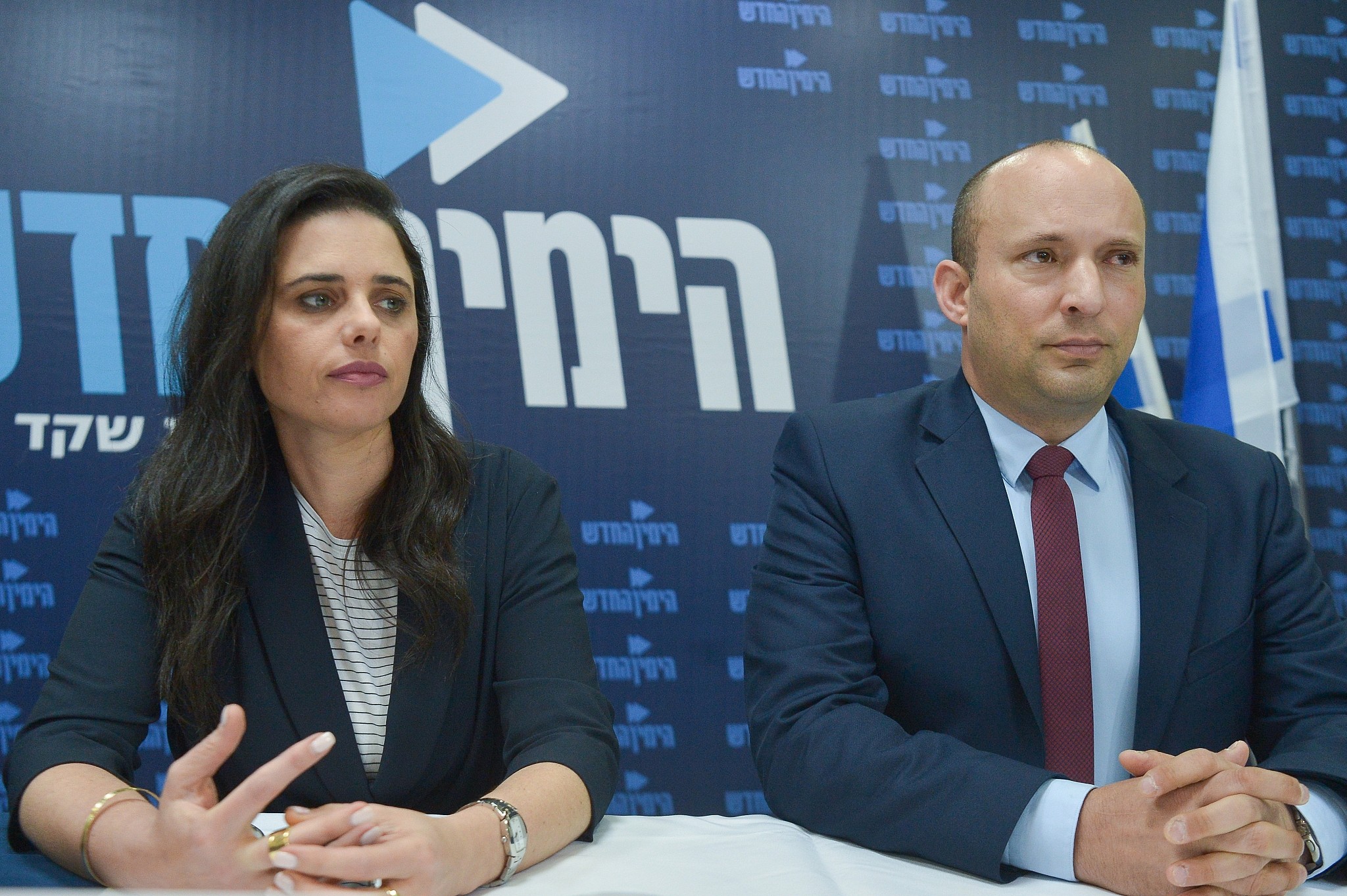
While New Right party leaders Ayelet Shaked and Naftali Bennett have demanded a recount after the Central Election Committee tally left them just short of the votes needed to make it into the Knesset, their fate appears to be all but sealed.
The two, among Israel’s most popular ministers, abandoned the Jewish Home party in December with the declared goal of broadening the right-wing bloc, insisting the flagship national-religious party would not be impacted by their desertion.
They ended up gutting their erstwhile party — which dropped from eight seats in the outgoing Knesset to five as part of the newly formed Union of Right Wing Parties — while earning zero seats for their new vehicle, the New Right.
The mere 138,101 ballots cast for their New Right might have come as a surprise to those following the polls through the election campaign. The final surveys last weekend, indicating the fledgling faction would receive up to six seats, were a far cry from the 10 predicted immediately after the Jewish Home divorce, but none were suggesting it wouldn’t cross the necessary threshold of 3.25 percent of the national vote.
So what went wrong?
For starters, the polls are generally recognized as not being very reliable. But substantively, Shaked and Bennett were plagued from the get-go with too narrow a target audience and an overly niche agenda. Their spectacular miscalculation in abandoning the Jewish Home now means Shaked will bid farewell to the Justice Ministry and Bennett can give up on his dream of the Defense Ministry.
Forcing religious Zionists to choose
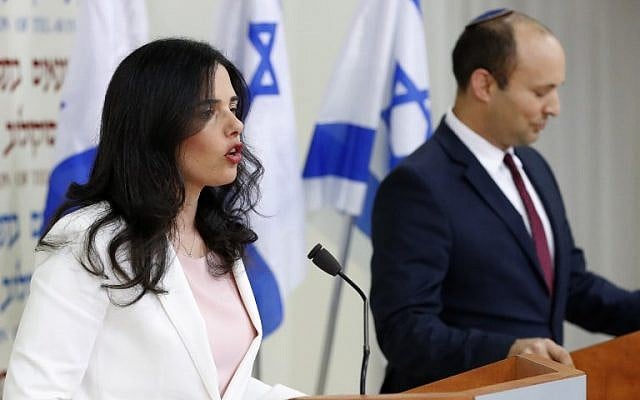
Explaining his decision to bolt the Jewish Home in December, Bennett said he had come to recognize that “the prime minister understood the religious Zionists [were] in his pocket.”
Thus, he said, his new party would forge a “true partnership between secular and religious.”
But it didn’t take long for the New Right to change that “partnership” messaging, having apparently quickly concluded that it wouldn’t draw enough voters. Did their own polling guide this fateful decision, or did they lose their nerve and shrink back from enthusiastically championing their more liberal outlook on issues of religious and state?
Instead, Shaked and Bennett returned to targeting the community that had given them their previous political success: religious Zionist, also known as national religious, Israelis. They knew their old Jewish Home — which subsequently merged with the National Union and Otzma Yehudit to form the new Union of Right Wing Parties — remained the representative faction of the national religious sector, but appeared to believe that this base was large enough for two slates to lean on, and also appeared to believe potential voters would forgive them for bolting Jewish Home.
“The Jewish Home is more of a Hardali party,” Bennett said last month in a Q&A session on Facebook Live, referring to the increasingly religious and nationalist subset of Israeli Zionist Orthodoxy that now dominates the URWP. In contrast, Bennett claimed, his New Right party would “represent the mainstream of religious Zionism, connecting it with secular Israelis.”
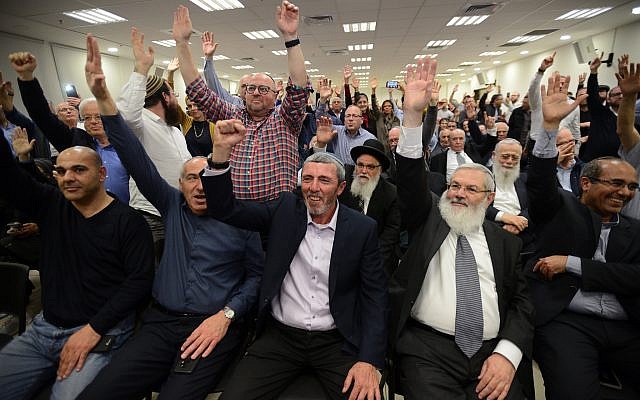
New Right pamphlets started showing up in synagogues throughout the country, while Shaked, who is secular, vowed that the party would continue to consult with senior rabbinic figures in the national religious camp before making major political decisions.
This strategy further angered the URWP leadership, which was still deeply smarting from the duo’s original sudden departure, and which now publicly reminded Bennett and Shaked that they had justified their decision to bolt Jewish Home by claiming their new party would seek to draw new voters to the right-wing camp.
“The moment they returned to the base of the religious Zionist movement, they lost all of their legitimacy for creating their party,” incoming URWP MK Idit Silman told The Times of Israel on election day.
Naturally, her comment was politically motivated, but the argument that the national religious camp isn’t large enough for a second sectoral party rang true as the results started to come in late that night.
The New Right did manage to win a plurality of votes in certain more religiously liberal communities such as Efrat, Alon Shvut and Tekoa in the West Bank’s Gush Etzion bloc. But in the more hardcore settlements, as well as in the periphery towns and cities where the vast majority of religious Zionists live, the percentage of support for Bennett and Shaked’s party was in the low single digits, well behind Likud and URWP.
Unlike the majority of the ultra-Orthodox community, religious Zionists have long integrated into society, dispersing their votes (worth roughly 18 seats) among political parties across the spectrum. This, in turn, left an increasingly Hardali base supporting the Jewish Home — hard-line enough to overwhelmingly back a merger with the extremist Otzma Yehudit in February.

Bennett and Shaked hoped that their new party could provide a home to those religious Zionists who felt that the Jewish Home had gone a step too far. While disillusioned Jewish Home voters did indeed cast their ballots for the New Right, Bennett and Shaked were doomed by the many other liberal Orthodox Israelis who shifted to more mainstream parties, as well as to Moshe Feiglin’s Zehut party, which, though it failed to clear the electoral threshold, siphoned away many thousands of votes that could otherwise have gone to New Right.
Prior to the establishment of the New Right, religious Zionists who were interested in voting for a sectoral party hadn’t been forced to decide whether they were more “mainstream” or “Hardal.” Bennett and Shaked required them to do so, and paid the ultimate political price.
No match for gevalt
The establishment of Benny Gantz’s Blue and White alliance filled a vacuum to the left of Likud where Bennett and Shaked never appeared interested in competing. Instead they campaigned to the right of Likud, as they always had done, asserting that a strong New Right would be crucial in preventing Prime Minister Benjamin Netanyahu from bringing Blue and White into the coalition and in stymying US President Donald Trump’s long-anticipated peace plan.
But during a campaign in which Netanyahu branded Gantz as a weak leftist who attends memorials for Hamas terrorists and needs psychiatric care, it became clear to most voters that a unity government consisting of the two major parties was highly unlikely. As a result, the New Right leaders lost their trump card.

As expected, when in the days leading up to the election Netanyahu began warning that Gantz represented a real threat to his sustained rule — the prime minister’s so-called “gevalt” campaign — many right-wing Israelis heeded the call to vote for Likud rather than a smaller right-wing party. Ultimately, those voters propelled Netanyahu’s Likud to 36 seats, hurting URWP too, but leaving Bennett and Shaked with nothing.
Even New Right’s attempt to reach out to periphery town voters with its placement of Hapoel Beersheba owner Alona Barkat at number three on its slate did not dent Likud’s dominance in such communities.
Localities in the south, which Barkat vowed to represent in the Knesset, barely recognized New Right at the ballot box. In Sderot, Netivot, Ashkelon and Ashdod, New Right received 2.8%, 2.8%, 2.1% and 2.9% of the vote, respectively.
It’s not the courts, stupid
Beyond choosing too narrow a target audience in an already fractured national religious camp, New Right’s campaign messaging was also quite niche.
“Shaked will defeat the High Court of Justice, Bennett will defeat Hamas,” read the party’s campaign posters, plastered along highways throughout the country.

While many on the right appreciate Shaked for appointing more conservative judges to all levels of Israel’s courts and backed her stated goal of passing legislation in the next Knesset that will curb the High Court’s power to overturn legislation, this largely elitist issue is dwarfed by the security and socioeconomic concerns many Israelis had in mind when they arrived at the polls.
As for Bennett and his pledge to eradicate Hamas, the pitiful levels of support the New Right received in towns surrounding the Gaza Strip suggest that those residents felt considerably more comfortable placing their security in Netanyahu’s hands than in Bennett’s.
Religion and state
The irony is that Bennett and Shaked’s campaign-launching pledge to unite secular and religious Israelis potentially did have the power to change the discourse on the right on issues of religion and state.
The pair had avoided the issue like the plague during their previous term in the Knesset, knowing that their personal attitudes toward other streams of Judaism, the privatization of religious services, and LGBT rights, were more liberal than those of the rabbinic leadership in the national religious camp they represented.
The establishment of their own party, not beholden to those rabbis, provided them an opportunity to stake out positions on these issues that would attract a growing number of liberally minded religious Israelis. Instead, unfathomably, they once again opted to skirted the topic, announcing that they would establish a public committee to debate matters of religion and state — conveniently, after the election was held.
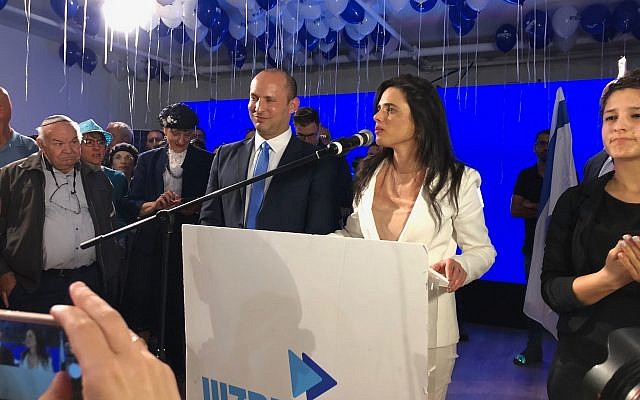
In came Feiglin’s Zehut, which took on the mantle of a religiously minded party that calls for the separation of church and state. The pro-cannabis-legalization party similarly did not cross the electoral threshold, but polls suggested that a plurality of its supporters were national religious youth who might have been willing to get behind Bennett and Shaked had the two truly championed and elaborated on the implications of their “secular-religious partnership.” Moreover, despite holding a relatively similar view as Zehut in favor of free-market economic policies, the New Right made the issue a a mere afterthought in its campaign; so when voters arrived at the polls with that topic in mind, Bennett and Shaked’s party was nothing more than an afterthought for them as well.
A former Jewish Home official told The Times of Israel that Shaked initially opposed Bennett’s plan to leave in December. In the end, she came around, and the pair set off to establish a party that would go on to split the national religious camp. With Tuesday’s electoral failure, their own partnership would appear to be over, too.





The Times of Israel Community.