

Imprisoned ex-president Katsav faces parole hearing Sunday
Possibility of early release after two rape convictions draws firestorm of criticism from victim, female lawmakers
 Add ToI as a Preferred Source on Google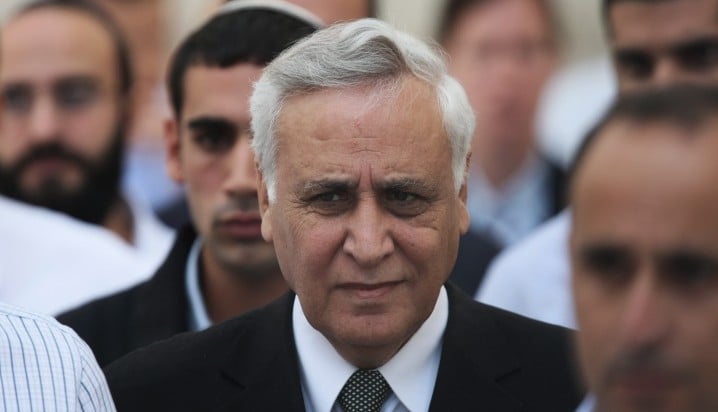
Former president Moshe Katsav was set to come before a Prisons Service parole board Sunday, four years and four months into his seven-year prison term for rape, to ask for a one-third reduction of his sentence that would see him a free man in several months.
The parole request has triggered a firestorm of criticism, including from lawmakers and at least one of Katsav’s victims.
Katsav, 70, was convicted on December 30, 2010, on two counts of rape, among other charges. He began serving his sentence in December 2011, and is slated for release in December 2018. If he wins parole, he will leave the minimum-security Ma’asiyahu Prison in Ramle in July.
Katsav continues to proclaim his innocence, even after his conviction and multiple failed appeals, a fact cited by those opposed to his parole.
“It would be unprecedented in Israel, and would send a very negative message, both about women and about sex offenders,” Odelya Carmon, who was attacked by Katsav in the early 1990s, told Army Radio Sunday.
Carmon worked with the former president when he served as transportation minister from 1988 to 1992. She was known as “A” during Katsav’s trial, before coming out publicly to accuse the ex-president.
“Those offenders who are now in [prison] rehabilitation programs won’t have the motivation to continue at it, and future offenders will say, ‘Why do I even have to apologize if I can get out early without doing so?'” Carmon said.
“I don’t think that at his age he’s going to get out and force himself on women, but there is still an extraordinary danger here,” she said. “How will hundreds of women I have met feel about his parole when he hasn’t even admitted [to his misdeeds], when he claims that all these women were liars? What message does that send the public?”
Early parole is very common in the Israeli prison system, with a majority of prisoners managing to obtain the standard one-third reduction to their sentence for good behavior. In Katsav’s case, the parole board will have to determine whether he constitutes a danger to the public and meets the good behavior requirements for early parole.
If Katsav is denied his request, his last recourse will be to appeal for a pardon to President Reuven Rivlin. The two are former Likud lawmakers who served together for decades in the Knesset before Katsav won the presidency.
“Katsav never expressed remorse, never acknowledged his deeds. There is no reason for him to get a ‘discount,'” MK Merav Michaeli (Zionist Union) said Sunday.
“The most important consideration” for the parole committee “is the message that is sent to women who are abused and raped, and the social ramifications of that message,” Meretz leader MK Zehava Galon said.
“This isn’t about revenge, but about justice,” said MK Shelly Yachimovich (Zionist Union). “It’s about not sending a terrible message to victims of sexual assault who are today afraid of complaining.”
Gila Oshrat, head of the Israel branch of the Women’s International Zionist Organization (WIZO), called the possibility of parole for Katsav “intolerable.”
“The possibility that a former president of the state will be released early without first recognizing the severity of his actions, taking responsibility for them and apologizing to his victims is intolerable.”
The case has sparked a debate about convicted political leaders, with those opposed to the parole insisting that Katsav’s stature as a former president makes it all the more important to ensure that his sentence not be seen as lenient.
“His stature requires that he serve the full term,” insisted Yachimovich on Sunday.
Others, including MK Betzalel Smotrich (Jewish Home), called for Katsav to be treated as any citizen would in similar circumstances.
Katsav has made intensive preparations for the hearing, according to sources close to the former president, obtaining four expert testimonies stating that he does not constitute a public threat.
His attorney, Zion Amir, has argued that conditioning his parole on the expression of remorse amounts to denying Katsav the innate right to insist on his innocence even after he is sentenced.
If anything, Katsav’s public role was a factor in the severity of his sentence, the attorney said, “so there’s no reason for someone like him, who meets all the criteria established in law for early parole, to be denied it only because of his celebrity.”








The Times of Israel Community.