

Inside the Samaritan high priest’s fruity sukkah, literally
While Jews use holiday to spend time outdoors, this ancient Israeli community, now numbering just 750, builds its festive huts indoors, and not out of wood, but fruit
 Add ToI as a Preferred Source on Google
MOUNT GERIZIM, West Bank — The Samaritan high priest’s small home was marked by a modest plaque outside the gate. “Home of the high priest, Abdullah Wassef Tawfiq,” the Arabic script read.
Inside, the 83-year-old leader of the Samaritans — a small community that traces its origins to the split of the Jewish kingdom after the reign of King Solomon — sat on a small cream couch, greeting a group of journalists.
He was dressed in a long teal-blue robe and donned a circular white hat, similar to a Muslim Imam.
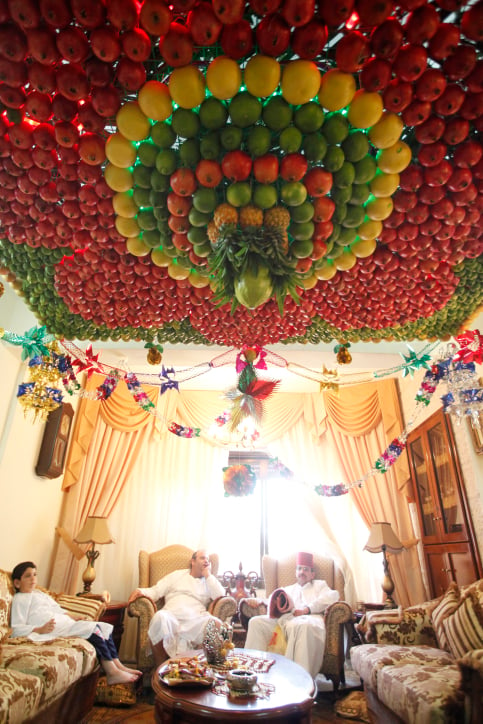
The home decor was modest, with one quite colorful exception: the roof had been decorated with an ornate pattern of citrus fruits, as well as branches from the palm, myrtle and willow trees. These are the four species God commands Jews to “take for themselves” during the holiday of Sukkot, as detailed in Leviticus.
This citrus-roof is the Samaritan version of the Jewish sukkah, a hut built by Jews once a year for the Sukkot holiday, which commemorates when God protected the Jews in their 40-year desert march from Egypt to the Holy Land.
Unlike Judaism, which has gone through significant changes through 1,500 years of rabbinical tradition, the Samaritans derive their religious customs straight from their version of the Torah or Pentateuch, which parallels closely the story of the Five Books of Moses. (Nonetheless, there are reportedly 6,000 discrepancies between the Jewish and Samaritan Torah, 3,000 of which change the narrative, to varying extent.) But the three main pilgrimage holidays mentioned in the Bible, Sukkot, Passover and Shavuot, are still celebrated today by both Samaritans and Jews alike.
The colorful array of fruits that make up the Samaritan sukkah follow the biblical verse in Leviticus literally, which only mentions “fruit of goodly trees,” whereas Jews have adopted one specific fruit — the etrog.
Additionally, rather than bringing the four species into the sukkah or to the synagogue, as Jews do, the Samaritans use them as the literal building blocks for their home-adorning huts.
‘No obligation for sukkah to be outside’
Next to the high priest sat his younger brother, the 73-year-old Husney Cohen. Cohen is also a priest and could one day take his brother’s position, as the title passes to the oldest member of their family. The Samaritan Cohen family say they trace their lineage back to the Israelite priests of yore, hence the last name Cohen, meaning priest in Hebrew.
The high priest acts not only as a spiritual leader and a village judge, but also has bureaucratic duties such as getting travel documents for the villagers. This last duty is no small task, as Samaritans hold Palestinian, Israeli and Jordanian citizenship and indeed vote in all three elections.
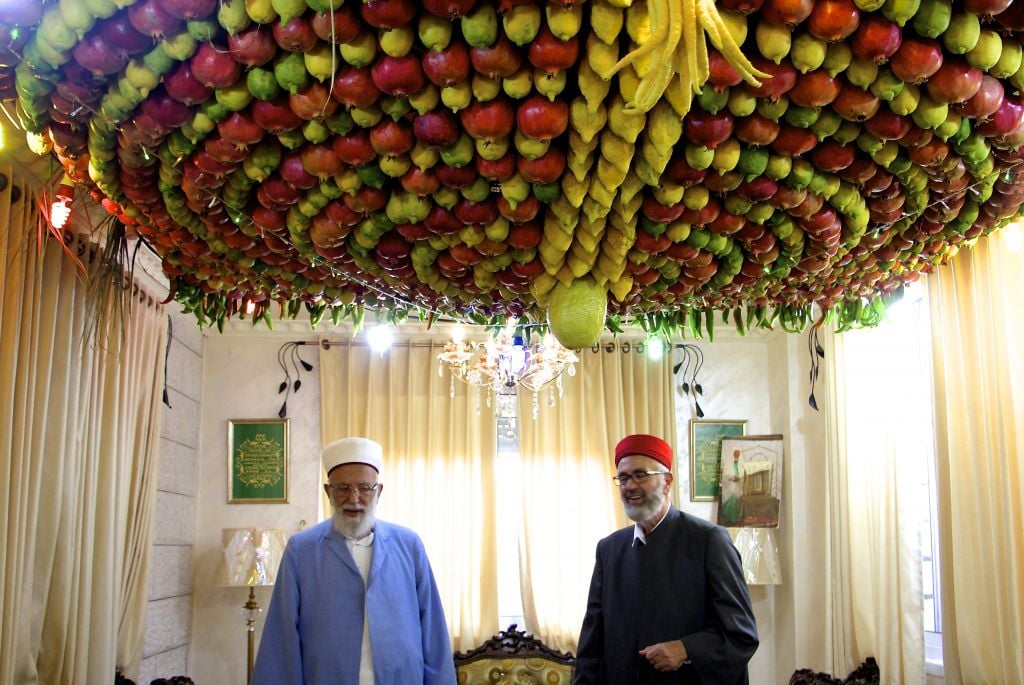
Cohen, who was dressed in a long black robe and a round, red hat, told the crowd of journalists visiting that according to Samaritans, “there is no obligation to build the sukkah outside.” And since one is required to eat and sleep in the sukkah, building it inside the home is the easiest way to accomplish that, he said.
The high priest himself did not speak much, though he did insert a quick backing of a two-state solution to the Israeli-Palestinian conflict and recited the priestly blessing for the journalists present.
The high priest’s loquacious younger brother — who, upon meeting the journalists, immediately claimed to be the only person who knows the truth about the biblical splitting of the Red Sea and the secret meaning of the late Palestinian leader Yasser Arafat’s name — did most of the talking.
Samaritans in general trace their lineage back to the biblical tribes of Menashe and Ephraim, the sons of Joseph. They defied imperial conquests and clung to the land while much of the population of the Northern Kingdom of Israel was exiled to Assyria — presently northern Iraq — by King Sargon II in 722 BCE.
When exiled Jews began returning to Jerusalem from Babylon in the 6th century BCE and building the Second Temple, they refused to recognize the Samaritans as coreligionists.
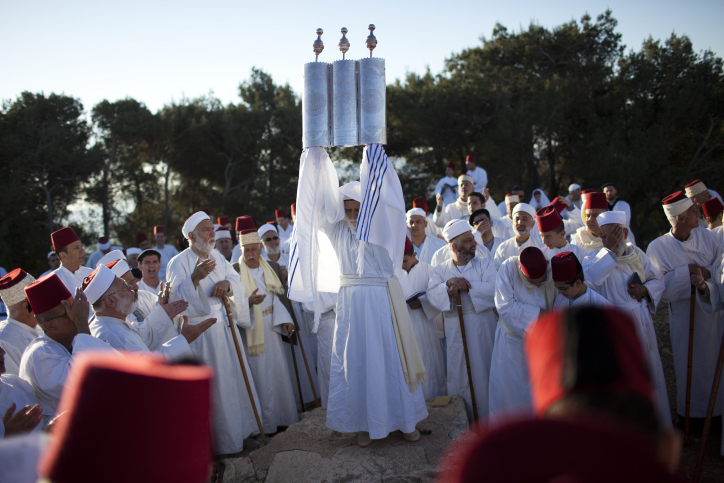
From the nearly 1,000,000 strong Samaritan kingdom that existed in the Roman period, only 750 Samaritans populate the earth today. Half live in the Samaritan village on Mount Gerizim near Nablus, which they believe is God’s chosen site rather than Jerusalem, and where layers of the ancient Samaritan temple destroyed and rebuilt over millennia still exist today. The other half live in the Israeli city of Holon.
When asked by The Times of Israel whether there were any other customs for the holiday, Cohen said the Samaritan community from Holon travels to the Samaritan village, and passes from sukkah to sukkah, while enjoying food, drink and song.
Historian: Byzantine persecution brought Samaritan sukkahs indoors
The Times of Israel also spoke Tuesday with the Samaritan scholar and historian Benyamim Tsedaka, who translated and published the first ever English version of the Samaritan Bible in 2013.
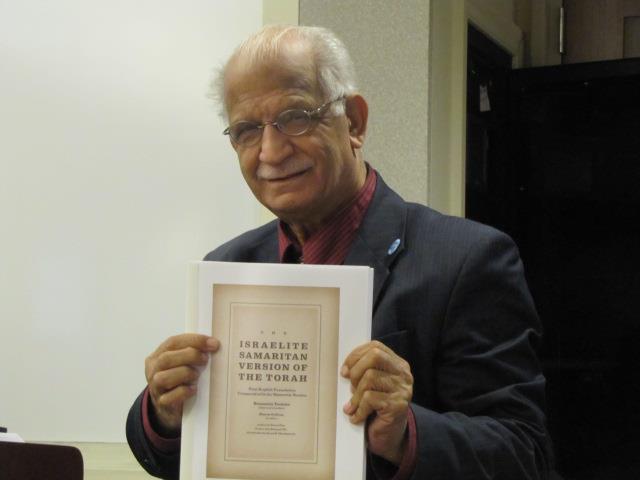
According to Tsedaka, the origin of the Samaritan custom to build the sukkah inside the home originated during the Byzantine Empire.
“During the Byzantine period, there were three great Samaritan revolts,” said the historian.
“One of the ways the Byzantines persecuted the Samaritans was by burning their sukkahs that were outside their homes. So, 1,500 years ago the high priest decided you have to put the sukkah inside your home, in order to give it respect and honor. And since then, its never changed,” he said.
What happens to all that fruit decorating the roof when the holiday is over?
Tsedaka said it is juiced and stored in the refrigerator for drinking pleasure over the entire year.
Elhanan Miller contributed to this report.










The Times of Israel Community.