

Israel’s newest digital bank to start offering zero-fee accounts in early 2026
Esh Bank Israel will operate accounts completely free of fee charges for both retail customers and small businesses, and share interest revenue with depositors
 Add ToI as a Preferred Source on Google
Sharon Wrobel is a tech reporter for The Times of Israel

Esh Bank Israel Ltd., the country’s second digital bank, co-led by Nir Zuk, the American-Israeli billionaire founder of cybersecurity firm Palo Alto Networks, Inc., will offer zero-fee accounts and equally share interest revenue with its depositing customers when it launches early next year.
Esh Bank, in 2022, was awarded the second license in three years by the Bank of Israel for the establishment of a new bank, in an effort to boost competition in the highly concentrated sector dominated by five traditional banks.
Since then, the digital bank has operated in stealth or pilot mode with invited customers for two years. Starting in early 2026, Esh is rolling out a soft, or limited, launch, offering existing account holders to invite new customers, its co-founder and group CEO Yuval Aloni said.
Aloni said that Esh will operate bank accounts completely free of charges for both retail customers and small businesses. The digital bank will have no physical branches and offer basic banking services, including credit provision, receiving and managing deposits, and current accounts, with none of the account, payment, statement, or other occasional or hidden fees that traditional banks charge.
In addition, Esh said it will share 50 percent of the interest revenue it generates from customer balances in their current accounts with depositors.
“What we are going to do is share 50% of the revenues that Esh bank makes from using [depositors’] money, while expenses are coming out of the bank’s remaining 50% share, instead of passing them on to the customer, which means that we must be extremely efficient and automated,” said Aloni. “The result is zero fees, full transparency, and high interest on current accounts.”
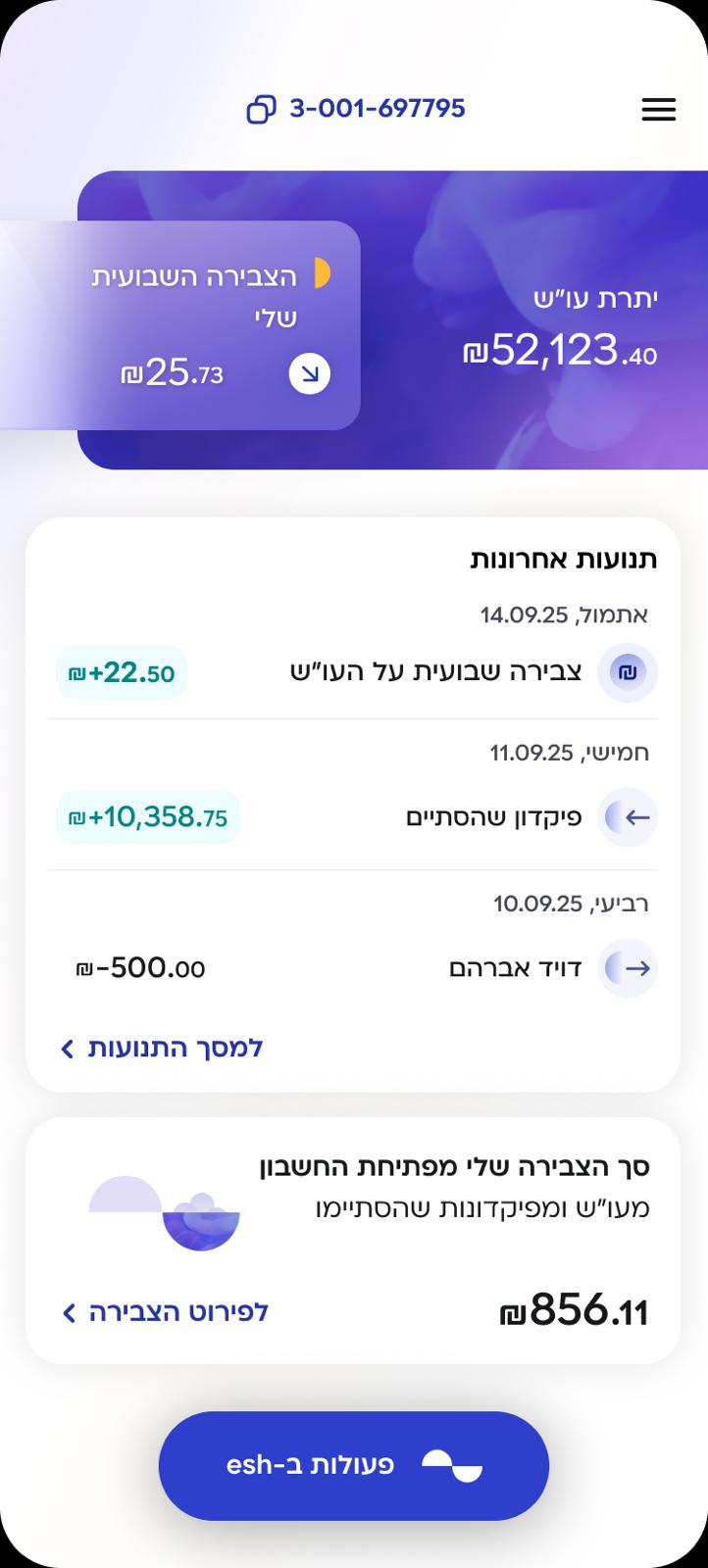
“We are going to share it in real-time with a live ticker on the app so the customer can see the share of revenues growing in real time, just as the bank does, and the interest gained is automatically paid into the account every week,” he added.
Aloni explained that the idea behind the “equal sharing model” is to offer customers an alternative to the “built-in conflict of interest” inherent in the traditional banking system.
“The way all banks work is by taking our money, then holding only a fraction of it while they lend the rest to make money for themselves,” said Aloni. “While they present our $100 in the account, $94 of it is not even there — this is money that is making money for the bank, not for us customers.”
“We solve this conflict of interest with transparency… customers can see exactly how much money the bank makes with deposits in real time, how much the bank actually keeps, and how much interest is being earned with the money,” Aloni said.
Zuk, a former engineer at Israeli cybersecurity firm Check Point Software Technologies, set up the competing Santa Clara, California-based Palo Alto Networks in 2005. Other members of the founding group of entrepreneurs of the digital bank include Kobi Malkin, a former CEO of Bank Massad.
Former head of the Israel Securities Authority Prof. Shmuel Hauser serves as chairman of the new digital bank, and Dr. Nadine Baudot-Trajtenberg, a former deputy governor of the Bank of Israel, is deputy chairman of the lender’s Board of Directors.
Israel’s concentrated banking system is largely controlled by five large banks, which have been accused of profiteering thanks to high interest rates for credit and mortgages, posting record profits as much of the rest of the country struggles to make ends meet amid the rising cost of living and an economy battered by two years of war.
With little competition, the country’s banks can charge excessive fees with little fear of blowback. When it comes to interest paid on deposits and savings, the lenders have been criticized for sluggishness in offering customers higher rates accordingly, or for failing to do so altogether.
“From my experience in the central bank, we tried many different ways to introduce competition to the sector — it’s really not an easy thing to do,” said Baudot-Trajtenberg. “Financial products are often made more complicated by the suppliers either because they have bad systems or because they can more easily take advantage of the fact that not everybody wants to spend hours trying to figure out whether it’s a good deal or not.”
The new bank will be supervised by the Bank of Israel’s supervisor of banks to ensure its stability and to safeguard its depositors’ funds, similar to the oversight of other banks in Israel.
Esh follows in the heels of the first fully digital bank, One Zero Digital Bank Ltd., set up by tech entrepreneur Amnon Shashua, the nation’s first new bank in more than 40 years, which launched operations in early 2023. Shashua is also the founder of the autonomous driving systems company Mobileye (an Intel subsidiary).










The Times of Israel Community.