

Knesset legal adviser says PM immunity bill requires changing Basic Law
Legal opinion could further hamper Likud lawmakers’ efforts to pass legislation protecting a prime minister from criminal investigation
 Add ToI as a Preferred Source on Google
Stuart Winer is a breaking news editor at The Times of Israel.

Knesset legal adviser Eyal Yinon delivered a legal opinion Monday that said a bill aiming to grant serving prime ministers immunity from corruption investigations will require changing one of Israel’s semi-constitutional Basic Laws, a process that could pose new hurdles for passing the legislation into law.
According to signed agreements between the parties that make up the current ruling coalition, no changes to Israel’s Basic Laws can be passed without the agreement of all six coalition parties, giving each coalition partner a veto over such bills.
Yinon wrote his opinion in response to a query submitted by opposition Zionist Union MK Yoel Hasson, Channel 10 reported Tuesday.
He said that the immunity bill cannot be advanced like a regular bill because it appeared to clash with existing Basic Laws.
Care must be taken “that there should be no contradiction between the Basic Law and an ordinary law,” Yinon cautioned.
“The enactment of a norm that seeks to impose additional restrictions on the possibility of investigating the prime minister constitutes a change of the existing constitutional arrangement, and therefore requires an amendment to the Basic Law,” he declared.
Yinon said the same was true of a clause in the bill that limits the number of terms a prime minister can serve consecutively. Under an existing Basic Law, after each election, the president selects an elected member of Knesset and asks him or her to form a government. There are no limits in the Basic Law as to which MK the president may select, and introducing such a limit — i.e., forbidding the president from selecting an MK who has already served eight consecutive years as PM — requires a change to that Basic Law, Yinon argued.
“The Basic Law does not restrict the president in the election of a member of Knesset to whom the task of forming the government will be placed, and therefore the determination of any restriction requires the amendment of the Basic Law so as not to create a contradiction between the Basic Law and the ordinary law,” Yinon explained.
The Basic Law dealing with the formation of a government and parliament is also protected from being amended by no less than a majority of all Knesset members — 61 out of the total of 120.
Yinon made similar argument about the so-called “French Law,” which would grant serving prime ministers immunity from corruption investigations. The current law gives the attorney general the authority to decide on opening an investigation against a prime minister. The bill would curtail this power, and therefore must do so by amending the Basic Law that grants it, Yinon said.
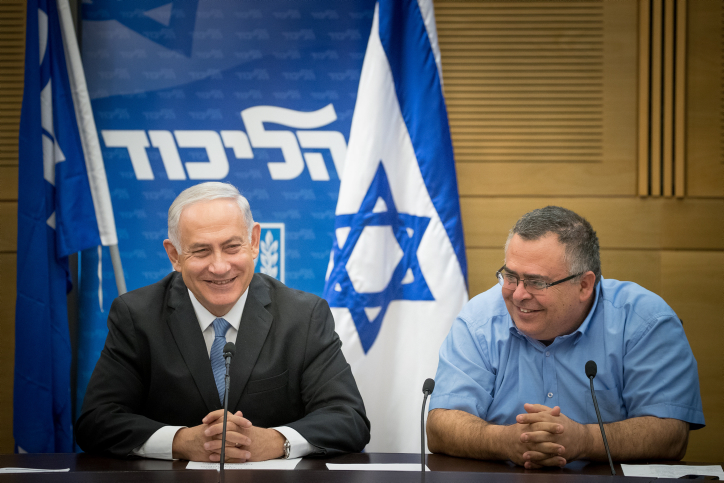
The immunity bill encountered obstacles in parliament even before Yinon’s opinion was issued. It was not raised for debate Sunday in the key Ministerial Committee for Legislation, despite threats from Likud lawmakers to freeze other parties’ legislation if the bill was not advanced.
The ministerial panel convened after a morning beset by coalition infighting, with coalition chairman MK David Bitan (Likud) vowing to push it forward despite opposition from the Jewish Home and Kulanu parties.
The bill is intended to prevent sitting prime ministers from having to deal with investigations into their affairs during their terms, leaving them able to focus on the business of governing the country. Its current draft excludes from its protections any investigation already launched, and so would not protect Prime Minister Benjamin Netanyahu from ongoing probes into him.
Critics, including Attorney General Avichai Mandelblit and many lawmakers, have said the measure would place prime ministers above the law for years at a time, making them more likely to act unethically while they occupy the highest office in government. Fears have also been raised that provisions protecting Netanyahu himself could be added to the bill in committee after it passes its first readings in the plenum.
The proposed legislation comes as Netanyahu is being investigated in two corruption cases.
Earlier this month, it was reported that police were deepening their investigations into the actions of the prime minister and that he will be summoned soon for questioning in the two investigations, known to police by their codenames “1000” and “2000.”
Case 1000 relates to allegations that Netanyahu and his wife, Sara, received illicit gifts from billionaire benefactors, most notably hundreds of thousands of shekels’ worth of cigars and champagne from the Israeli-born Hollywood producer Arnon Milchan.
Case 2000 involves a suspected illicit quid-pro-quo deal between Netanyahu and Yedioth Ahronoth newspaper publisher Arnon Mozes that would have seen the prime minister hobble a rival daily, the Sheldon Adelson-backed Israel Hayom, in return for more favorable coverage from Yedioth.
The prime minister denies any wrongdoing in either case.
Investigators are also expected to set a date for Netanyahu to provide testimony as a witness in Case 3000, which involves suspected corruption by several associates of the prime minister in the sale of German submarines to Israel. Though Netanyahu is not a suspect in the submarines case, his critics have accused him of pushing the prime minister immunity bill in order to ensure that he won’t be made one in the future.
Times of Israel staff contributed to this report.







The Times of Israel Community.