

Lapid: Ending the conflict should be Israel’s only priority
Yesh Atid leader plugs regional solution to Israeli-Palestinian conflict, but says first Israel must ‘build a higher wall’
 Add ToI as a Preferred Source on Google
Rebecca Shimoni Stoil is the Times of Israel's Washington correspondent.
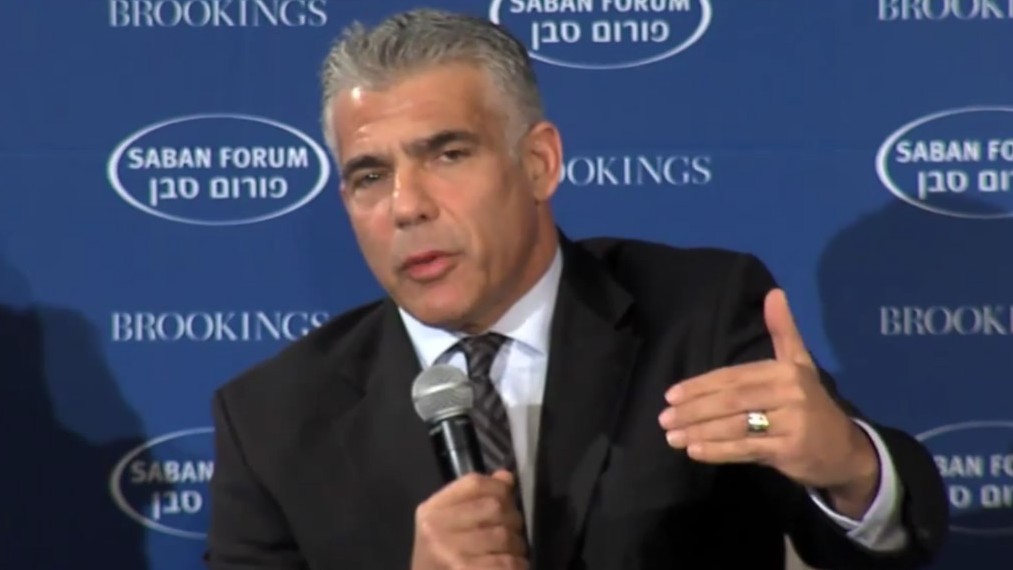
WASHINGTON – Putting an end to the Israeli-Palestinian conflict should be Israel’s “only priority,” Yesh Atid leader and Knesset member Yair Lapid told an audience at the Brooking Institution’s Saban Forum Saturday morning. While vowing that he would not criticize the current government while on an overseas visit, Lapid asserted that Israel did not have any real strategy for resolving the decades-old puzzle.
“The only coherent strategy is how to separate from the Palestinians,” he said. “This is not a rewarding path. You think instinctively about making peace as some sort of enlightening moment, as a moment of some sort of grace. But it is not. Because peace is the end of the process. In the beginning it is some sort of arrangement or agreement that is politically unrewarding, that is painful, technical and non-dramatic. But you have to go there because anything else is an existential threat.”
Lapid suggested that in the face of broader regional instability, Israel should “gather the Sunni countries, go to a regional summit from which will be the opening salvo for a regional process that will end up with us separating from the Palestinians.” In recent months, Lapid has pushed for a regional peace conference, similar to the framework of the Arab Peace Initiative, which offered to exchange regional recognition of Israel for a comprehensive peace deal with the Palestinian Authority.
Separation, he said, was a necessary precondition for eventual peace. “In the beginning, it is not breaking the wall like in the famous Reagan speech,” he warned. “It is building a higher wall in order to make it feasible for our children to have peace ten, fifteen years from now.”
“We have been waiting for 40 years for the right timing to have peace with the Palestinians. Enough is enough — we need to do it,” Lapid proclaimed. Solving the conflict, he asserted “is not the number one priority of Israel, it is the only priority.”
https://youtu.be/KOt8b3NCFY0
Lapid’s comments were in contradiction to Defense Minister Moshe Ya’alon’s address before the forum a day earlier. Ya’alon stressed a culture of inter-dependency between Israel and the Palestinian Authority, arguing that the two were linked like “Siamese twins.”
Speaking on the same panel with Lapid, former George W. Bush-era National Security Advisor Stephen Hadley agreed that “an Israeli-Palestinian peace must be embedded in a broader Israeli-Arab reconciliation,” but offered a dimmer vision of the prospects for an agreement.
“Simply getting to the table and talking does not generate success,” Hadley warned. “The piece of the puzzle always missing is the situation on the ground – how to make conditions of Palestinian life better now.”
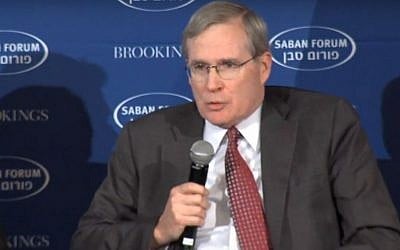
Three consecutive US administrations, Hadley reminded Lapid and an audience full of former US negotiators, had failed to reach a comprehensive solution to the conflict. Further failures, he warned, would further erode the ability to reach an eventual agreement. “You can’t keep going down this road and failing,” he warned.
Hadley said regional powers had other more pressing concerns — particularly the Syrian civil war — but that the talks in Vienna toward resolving the Syrian civil war could provide a vehicle for momentum toward a regional peace agreement between Israel and the Palestinians.
He suggested that a “subgroup of Arab states and Israel” could meet on the sidelines of the Vienna talks to discuss a peace initiative.
“If it can be an outgrowth of a Vienna process that begins to gain momentum, that can be a framework for what you’re talking about,” he told Lapid. “I think you need to get progress on these issues before you get the opportunity for the kind of process that Yair [Lapid] talked about.”
Former peace negotiator Martin Indyk disagreed with Hadley on the Vienna angle, saying he did not believe that those talks were going to lead to any success on the Syrian front.
“The chances that Vienna’s going to go somewhere in any reasonable time frame is practically nonexistent,” Indyk said. “So you’re therefore holding back something that might be lubricating the Syrian peace process,” he said, referring to Lapid’s initiative.
“If you had an Israeli government that was coming forth with such an initiative, I would grab it,” Indyk added.








The Times of Israel Community.