

Likud is from Mars, Labor is from Venus
It’s not yet clear which parties or alliances will be on the ballot, but the battle to define what the election is about is already underway
 Add ToI as a Preferred Source on Google
Haviv Rettig Gur is The Times of Israel's senior analyst.
Don’t believe the hype. For all the noise, the election campaign is still in its sleepy infancy.
A month remains until January 29, the deadline for submitting final Knesset slates to Israel’s Central Election Commission. Until that day, parties can still merge or split. Major parties — Likud, Labor, Meretz, Jewish Home — still have primaries ahead of them. No one can say for certain if the election ballots will include one Arab party or three, whether Labor’s newfound popularity after its merger with Hatnua will hold or evaporate, whether Shas will survive as a viable party until Election Day, or whether Yisrael Beytenu will be able to mount a coherent campaign with so many of its officials under investigation for corruption.
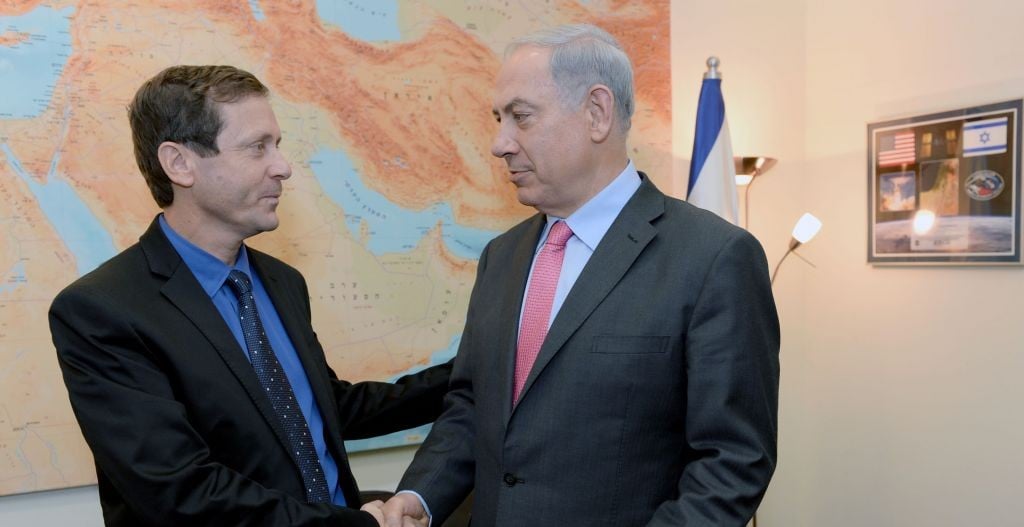
It is in this chaotic ferment that the two major camps materializing on either side of the political spectrum, one led by Benjamin Netanyahu’s Likud and the other by Isaac Herzog’s Labor, are attempting their first serious efforts to define the contours of the battle that lies before them. It is too early, and the character and identities of their opponents still too unclear, to launch the systematic campaigns we can expect later on. The sides are battling for something more basic, and arguably more politically important: the context.
Each campaign wants the election to become a referendum on the issues where its side is stronger.
Likud has tried to keep the conversation focused on security, where Labor has a distinct “trust deficit” among the electorate, while insisting there are no meaningful differences between Labor’s economic policies and its own.
Labor, meanwhile, has tried to shift the conversation to the economy, where the incumbent Likud is weakest, while insisting there are no meaningful differences between Likud’s security policies and its own.
So on Monday, when the government called a special Knesset plenum session to approve the appointments of two deputy ministers to manage ministries abandoned by Yesh Atid ministers who resigned earlier this month, Labor MKs led by Shelly Yachimovich gathered 25 lawmakers’ signatures to add economic issues onto the agenda.
The plenum debate wasn’t really a debate, but an opportunity for electioneering. None of the speakers remained in the plenum to hear their colleagues’ rebuttals, as Deputy Minister Ofir Akunis noted angrily.
“We should check how many MKs asked for a special debate, how many came to the debate and how many remained to hear responses,” he said in the plenum.
The speeches, too, carried the distinctive tenor of election stumping.
“We have a government that serves the strong instead of the weak,” Meretz MK Michal Rozin declared, accusing the Netanyahu government of “dispensing public funds to special interests, settlers, tycoons and the corrupt.”
The comments echoed those of the Labor party in recent days, such as the Thursday press release that accused the Netanyahu government of favoring security issues over economic ones, and “totally failing” to tackle poverty.
“While the prime minister is busy with imaginary armored personnel carriers, a social avalanche is taking place under his nose,” Labor charged. “We need a serious, multi-year plan with appropriate funding and clear goals for reducing poverty to ensure that Israel’s children don’t go to bed hungry. That will be one of our central goals when we form the next government.”
And even more explicitly, Labor’s Knesset faction chair MK Eitan Cabel had this to say last week: “Every day new statistics are published that bear witness to the social collapse that Netanyahu’s years in power have caused. The new government we will establish after the elections, under the leadership of Isaac Herzog, will be a truly social government, which will restore hope to millions of poor and to the collapsing middle class.”
It is a potent narrative for an electorate worried about its economic prospects, and the right has scrambled to respond with its own initiatives borrowed from the economic left.
“We have managed the Israeli economy responsibly, and raised the minimum wage from NIS 3,700 [to NIS 4,300] per month, and will do so again in April,” Akunis said in the plenum Monday.
The minimum wage hike promised by the prime minister last month — just days after announcing new elections — is a long time coming, and has the support of many Likud, Labor and other lawmakers from across the political spectrum. It isn’t the substance of the government’s newfound support for the measure that has drawn cynical comments, but the timing.
Yet it has moved ahead, with Labor and Likud teaming up in the Knesset to push through the legislation despite the pre-election recess, and the Finance Ministry (now under Netanyahu) announcing on Monday that it had reached an agreement with Histadrut labor federation head Avi Nissenkorn to implement a gradual increase to NIS 5,000 per month in the coming months.
But the bulk of Likud’s political rhetoric is focused on changing the subject to security issues, as evidenced by Akunis’s quick pivot in his Monday speech.
“I want to address the diplomatic situation and the Palestinians’ unilateral actions,” he said in the plenum, unbidden. “I want to say in the name of the government that Israel retains the option of taking its own unilateral steps in the broad arsenal of responses available to us.”
A press release from the Prime Minister’s Office the day before also focused on these concerns.
“Prime Minister Benjamin Netanyahu held a briefing in the afternoon to follow up on the implementation of the plan to strengthen security in Jerusalem,” reads the Sunday statement.
The Jerusalem operation, dubbed “Guardians of the Walls,” has seen the addition of 400 police to the city’s force, “and has led to a decrease in [terror] incidents,” the statement assured.
Where Labor attacks on the economy, Likud does so on security. While Likud successfully defends the country, the left has a history of acting “irresponsibly” with national security, Likud officials say at every opportunity.
And just as Likud works to defend itself on the economy, Labor has devoted efforts to doing the same on security.
“When it comes to defending Israel and its citizens or battling terror, there is no opposition or coalition,” Labor’s Herzog insisted this week on a visit to Haifa’s Melkite Christian archbishop George Bacouni.
The race may yet be shaped and reshaped by events — war, economic downturn, political scandal. But its earliest, most basic structure is already materializing as a twofold race: not only between left and right, but between two competing priorities, the electorate’s dissatisfaction with the right’s handling of the economy and its distrust of the left’s handling of defense and diplomacy. Victory, then, will depend not only on the positions of any party in the race, but on which issue comes to dominate the political discourse.




The Times of Israel Community.