

Mr. Trump goes to Washington
The sight of The Donald in the halls of American power sets Israeli pundits’ tongues a-wagging as they try to explain what a Trump administration means for Israel
 Add ToI as a Preferred Source on Google
Joshua Davidovich is The Times of Israel's Deputy Editor
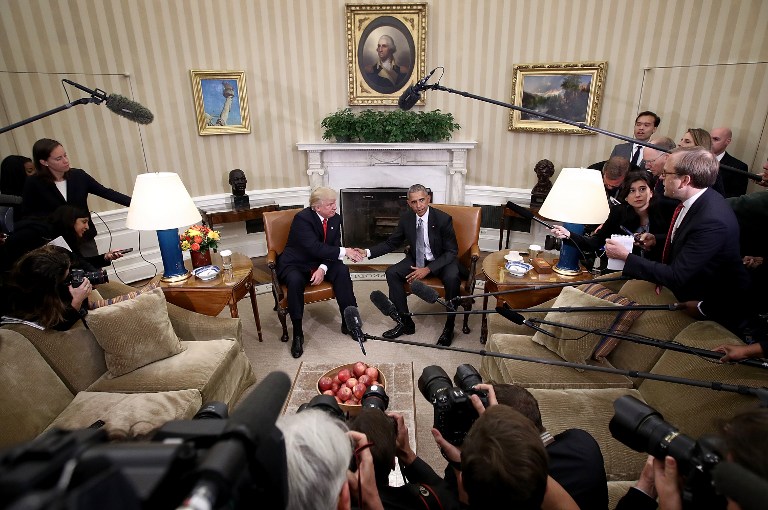
Not much happened in the last 24 hours. Donald Trump is still president-elect, he met with President Barack Obama and Congressional leaders and exchanged pleasantries. Some people in the US took to the streets to protest. Yet Trump and his shock victory is still the actualites du semaine, its repercussions as vast as the country he will soon lead, and despite seemingly exhausting every possible wrinkle with their gush of punditry the day before, Israeli papers show that they are made of sterner stuff, rallying to provide readers with yet another day of analyses, commentaries, opinions – and even some news.
Given the fact that it’s more a propaganda arm than a news outlet, its somewhat ironic that the one newspaper with actual Trump-related news, and not merely commentary, on its front page is Israel Hayom. But then again, given the fact that it’s owned by Trumps’ bigliest donor, Sheldon Adelson, and that it shares a bigliest best friend in Prime Minister Benjamin Netanyahu, perhaps it should come as little surprise that the Trump camp’s (or Trump himself in the words of the tabloid) first official statement to Israeli media is published there.
And the word is “published,” not “reported,” because the net result of the paper’s big honking front page headline “Trump to Israel Hayom: Peace will come via negotiations between the sides, and not by fiat” is stenography, and not journalism. (Never mind the fact that the statement is the same one adviser Jason Dov Greenblatt has been peddling to anyone who will listen, including The Times of Israel.)
In the statement, dutifully run in full as the lede to the story without a shred of context, Trump (or more likely son-in-law Jared Kushner) writes about how much he loves and respects Israelis, shares their values, recognizes the country as the sole democracy and defender of human rights in the Middle East and hopes to strengthen ties with us.
“I believe my government can fill an important role in helping the sides reach a just and lasting peace that needs to be reached via negotiations between the sides themselves and not imposed on them by others. Israel and the Jewish people deserve that,” he writes (in a translation back into English), shortly before the paper’s columnist Boaz Bismuth opines with some gushing admiration for the president-elect.
“What a huge moment for democracy, what a huge moment for America,” he writes, describing Trump’s visit to the White House for a sit-down with Barack Obama.
One man’s “huge moment for democracy” is another’s surreal trip through a political Twilight Zone, as evidenced by Haaretz’s lead story: a column by the left-wing daily’s former US correspondent Chemi Shalev titled simply, “Trump in the White House.”
The anodyne headline is anything but, as Shalev writes of the surreal quality of the phrase and the difficulty he is having coming to grips with it.
“The phrase still sounds like a New Yorkey joke from Seinfeld in the 90s. Or maybe a sequel to the cult movie ‘Idiocracy’ about a wrestler and porn star elected president in a future where idiocy and reality [television] shows rule all,” he writes. (In fact, it was the Simpsons who correctly predicted a President Trump, using his name as a jokey placeholder for the most ridiculous thing possible.)
“Even the fact that in another 70 days Trump will be situated in the Oval Office, the place from which Franklin Roosevelt, Dwight Eisenhower and John Kennedy, among others, managed world affairs, is more of a fantasy than anything,” he adds.
In case it isn’t clear, he isn’t talking about the good kind of fantasy.
Trump’s visit to the halls of power Thursday also had the full attention of Yedioth Ahronoth, though its shock and mockery (shockery?) is less nuanced, starting with the front page headline “The new landlord” over a picture of Trump surveying the National Mall from Capitol Hill along with wife Melania and Speaker Paul Ryan.
Writing about Trump’s visit to his future home and chat with Obama, the paper’s US correspondent Orly Azulay sees not the patching up the two men tried to telegraph yesterday but rather a “cold” confrontation.
“Just three days ago, the two were still involved in a take-no-prisoner battle with each other,” she writes. “And here, yesterday, they met face to face in the Oval Office – the same room that Obama will vacate on January 20 and make room for Trump. They shook hands, and even forced a few smiles, but it was clear that neither of them enjoyed the meeting.”
Perhaps of more import than parsing that meeting are continuing efforts to try to demystify what Trump’s stance toward Israel will be, and how it will shake out for the Jewish state.
Though many officials have groused about Trump’s unpredictability and the difficulty in making any sort of plans with him in the White House, Israel’s Foreign Ministry has at least taken its best shot at an educated guess, with Haaretz’s Barak Ravid reporting on an internal document that says Israel’s diplomats think Trump will lower the flame on US involvement in the Middle East.
“As part of his minimal interest in foreign affairs, Trump doesn’t see the Middle East as a good investment and it’s reasonable to assume he will seek to reduce American involvement in the region, alongside his commitment to maintaining the struggle against Islamic State…,” Ravid quotes from the document. “The diplomatic process between Israel and the Palestinians will not be a top priority for the Trump administration and it’s reasonable to assume this topic will also be influenced by the staff surrounding him and developments in the field. Trump’s declarations do not necessarily point to a coherent policy on this issue. On the one hand he has expressed support for the settlements and for moving the US Embassy to Jerusalem, but in other statements he said that he wants to remain neutral and that the two sides should reach a deal themselves.”
That might seem like good news for Israel’s rightist government, but highlighting that uncertainty, Yedioth analyst Yoaz Hendel, a former Netanyahu adviser, writes that the situation is likely a bit more complicated than that, and that Jerusalem will need to take charge if it wants to use Trump’s win to its advantage.
“Whoever thinks that Trump is joining [the far-right] Jewish Home tomorrow doesn’t understand what happened to the candidate the moment he became the winner. His speech was minutely prepared: Aside from it being the polar opposite of what he was during his campaign – presidential and conciliatory – it also included commitments to other countries. This means Arab oil exports (and Republican interest in that oil) and Iran. The Israeli-Palestinian conflict also figures in,” he writes. “Israel’s best option now is to push forward with a plan of its own: Israel can return to the Bush understandings on building in the settlement blocs and East Jerusalem, and add in the Jordan Valley and even improve the standing of the Golan Heights. It can even make annexation of the blocs and the Jordan valley a far-off goal.”
Israel Hayom, which already has Trump’s stance toward Israel figured out (see his note to the paper) instead turns its attention to bashing the media for not backing the future president. Besides playing up Newsweek’s unwise confidence in printing covers with Clinton’s face and “Madame President” written at the top, the tabloid’s Motti Tochfeld attacks the press both in the US and Israel as a gang of leftists bullying those in power, going so far as to join Prime Minister Benjamin Netanyahu’s in attacking journalist Ilana Dayan (remember that?).
“The election between Clinton and Trump wasn’t the only contest between left and right,” Tochfeld opines. “Also the affair of the new public broadcaster and the issue of Ilana dayan and the famous response. Fact: Almost all of those who exploded over the response of the prime minister, outstanding both in its length and sharpness – politicians, journalists and leading social media personalities – were on the left. Most of those who kept quiet, or who rejoiced in their heart of hearts over the prime minister teaching a lesson to the journalist with a known political bent, or who supported the response out loud – were on the right,” he writes. “So no matter how many ways you wrap it in nice stories about freedom of speech, democracy, the role of journalism and the audacity of the prime minister, none of it will change the reality as it is.”






The Times of Israel Community.