

Nazis restored old manuscripts to hunt down Jewish ancestry, researcher finds
University of Oxford expert uncovers role of paper restorers and bookbinders in deciphering church and civil records to compile ‘hitlist’ of Jews
 Add ToI as a Preferred Source on Google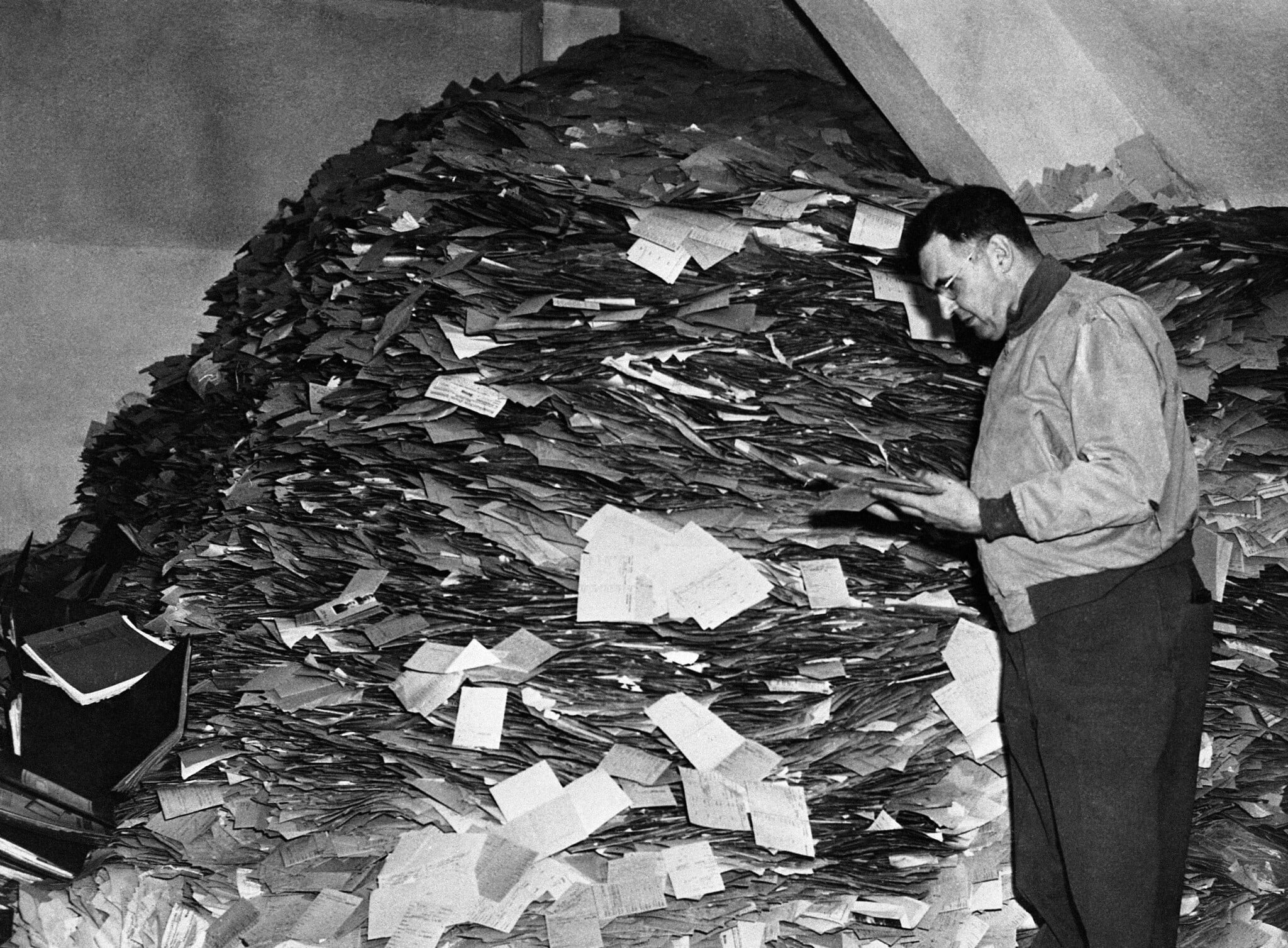
A British researcher has found that the Nazi regime in Germany engaged bookbinders and restorers to repair old records so that they could be combed for the names of people who had Jewish ancestors, the UK’s Guardian newspaper reported Wednesday.
Morwenna Blewett, a researcher in conservation history at the University of Oxford, was investigating cultural heritage organizations established under the Nazis. She was puzzled at references to bookbinding and the restoration of church documents.
“I found in the archives official documents about engaging bookbinders, as well as letters between various officials talking about cleaning documents, in the hope that these records would represent ‘racial purity,'” she told the newspaper.
During the 1930s and 1940s, paper restorers and bookbinders repaired historic church and civil records to make them legible so that the Nazis could hunt for people with Jewish ancestors, Blewett explained.
“They were creating an accumulated record of who might potentially be killed – a kind of hitlist, really,” she said. “They went above and beyond to enforce their ‘racial’ registration of populations.”
During the Holocaust, Nazi Germany murdered six million European Jews who were hunted down in Germany and the countries it occupied.
The craftsmen restored documents recording marriages, births, conversions, and baptisms, enabling the Nazis to look for those who inherited “racial” status, Blewett said.
She based the research on letters and other material she found while scouring public institutions such as the German federal archives in Berlin.
One Nazi official was quoted as writing at the time that “German church books, which capture the smallest place and every little farmstead in their closely bound mass of more than a hundred thousand volumes, are by far the most important source for the German population history, the proof of descent and the genealogy.”
The work was needed as some centuries-old manuscripts had become dirty, damaged by mold, and fragile.
Blewett said the restorers used destructive methods, noting, “They weren’t ensuring the safety of the historic objects, they were making them readable. It didn’t really matter to them what these objects were.”
“Through their work, restorers conspired with the Nazi regime to aid and abet criminal acts,” she wrote in her book on the subject, “Art Restoration Under the Nazi Regime,” which is to be released this month.
Blewett has previously researched how Jewish art restorers fled Germany and occupied Europe in 1933-1945, the Ham and High local newspaper reported in 2013. At the time, she was looking for Jewish restorers who moved to Hampstead, in London.










The Times of Israel Community.