

Netanyahu and Abbas supporters enraged by perceived weakness from leaders
The PM resists calls for a harsher security response to terrorism and more settlement building; the PA chief opts not to end security cooperation with Israel; lots of their constituents are fuming
 Add ToI as a Preferred Source on Google
Elhanan Miller is the former Arab affairs reporter for The Times of Israel
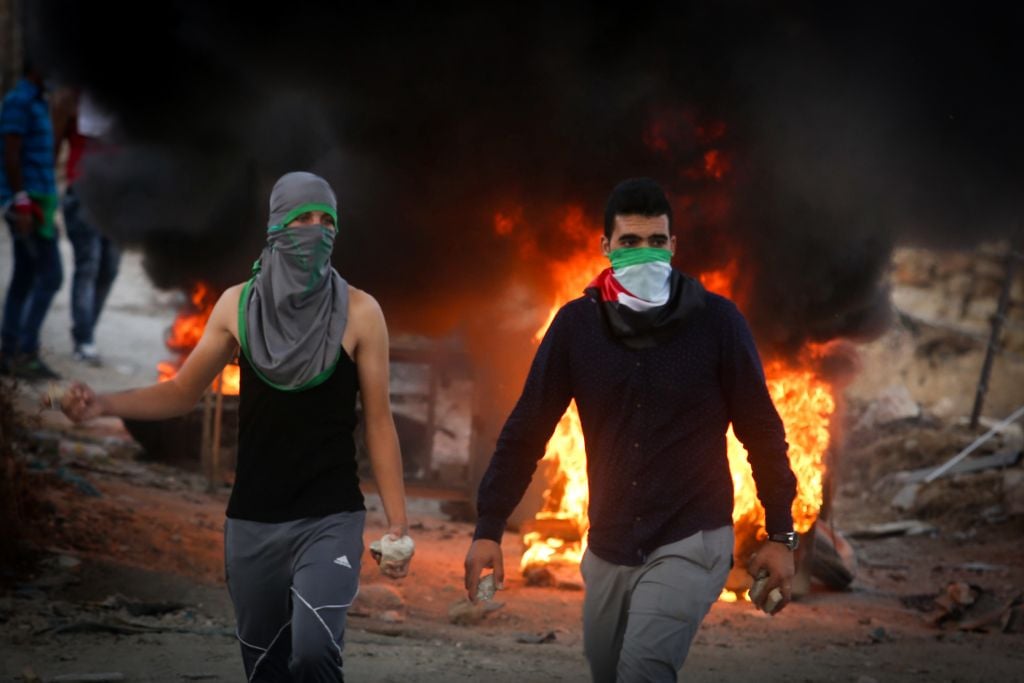
At roughly the same time, two leaders, Israeli Prime Minister Benjamin Netanyahu and Palestinian Authority President Mahmoud Abbas, met with their respective cabinets and security experts on Monday night to discuss the uptick in violence in Jerusalem and the West Bank.
Both meetings produced decisions that would leave large segments of their constituency deeply disappointed.
Far from implementing any of the three demands voiced by his education minister Naftali Bennett following the terror attack that killed Naama and Eitam Henkin last week — namely, to “untie” the hands of Israel’s security forces in dealing with Palestinian terror; to “immediately” construct a new settlement or neighborhood (beyond the Green Line); and to re-incarcerate terrorists released during the Shalit deal or as an overture during the last round of negotiations — Netanyahu’s decision was much more modest.
He instructed Justice Minister Ayelet Shaked, a member of Bennett’s Jewish Home Party, to ease the bureaucracy guiding the demolition of Palestinian terrorists’ homes. The same night, the homes of three Palestinian terrorists in the West Bank who carried out attacks during 2014 were either demolished or sealed.
In Ramallah, too, many were awaiting a dramatic decision from Abbas, who announced at his United Nations speech last week that he was no longer bound by the Oslo Accords. With dozens of Palestinians injured and two killed in clashes with IDF soldiers over the weekend, halting security cooperation with Israel was seen by many Palestinians a bare minimum. Even in Haifa, Arab demonstrators called for a third intifada.
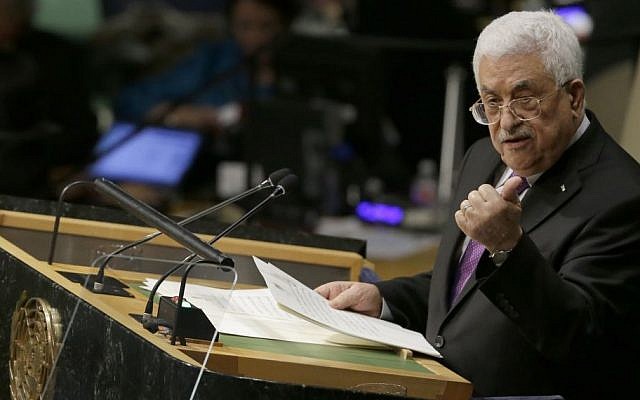
Cognizant of the sentiment on the street, Abbas chose to focus the meeting on his diplomatic coup against Israel in New York last week. He highlighted the symbolic raising of the Palestinian flag at the UN, as well as the numerous meetings held with international leaders.
“Our diplomatic standing is in a good situation, as international support for our just national rights is widening and deepening,” he told his generals according to the Ma’an news agency, asking them to foil “the Israeli schemes aimed at escalating the situation and dragging us to violence.” The operative instructions that followed were to quell the popular protests.
As long as both Netanyahu and Abbas are focused on winning the international blame game, neither leader is likely to order dramatic political moves
As long as both Netanyahu and Abbas are focused on winning the international blame game, neither leader is likely to order dramatic political moves that could be used against him by the opponent. But as violence continues, pressure on the leaders to produce a more coherent policy will undoubtedly increase, now even from within their own camps.
“The situation in Israel has become intolerable,” Likud backbencher Oren Hazan told Walla news at a demonstration across from the Prime Minister’s Residence on Monday evening. “Minister Bogie Ya’alon, minister of no-security, it’s time for you to wake up,” he added, referring to Defense Minister Moshe Ya’alon.
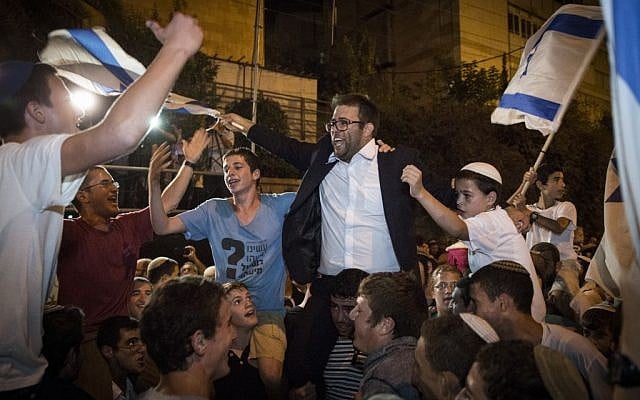
Another speaker at the rally, Likud’s Welfare Minister Haim Katz, told the audience he did not come to demonstrate against the prime minister, before echoing Bennett’s demand for more settlement construction in response to terror attacks. “The prime minister is the only one capable of eradicating terror and building the Land of Israel, and we expect him to do so.”
On the Palestinian side, brazen defiance of Abbas was limited to Hamas, which has long called for an escalation of violence in the West Bank. But even a cursory examination of Fatah Facebook pages reveals how attractive the notion of violent escalation currently is among key party members.
Mahmoud al-Aloul, a member of Fatah’s Central Committee, shared on Sunday a poster designed by Fatah’s youth movement, the Shabiba. Displaying masked Palestinians hurling Molotov cocktails and rocks, the image’s caption read “More violence and escalation in the face of the occupier everywhere. Let’s turn the ground into hell in the enemy’s face.” Aloul also changed his Facebook cover photo to display images of four Palestinian “martyrs,” including Jerusalem terrorists Muhannad Halabi and Fadi Aloun.
“We cannot always rely on improvisation,” Tawfiq Tirawi, another member of Fatah’s Central Committee and former chief of intelligence in the West Bank, told London-based daily al-Quds al-Arabi in an interview August 29, tacitly criticizing Abbas. “For instance, we want to head to the UN … what will we consider victory? What are the repercussions of victory? We know that the Americans and the Israelis are against us. If we fail in our efforts at the UN, what is our alternative plan? All of this does not exist.”
Netanyahu and Abbas will both continue to be outflanked from the right within their own movements if they fail to produce a coherent plan that can justify, or thwart, the rising death toll in their respective societies.




The Times of Israel Community.