

Obama: Yemen operations unaffected by turmoil
As rebels take capital, US president says current strategy for restive country still the ‘best option’
 Add ToI as a Preferred Source on Google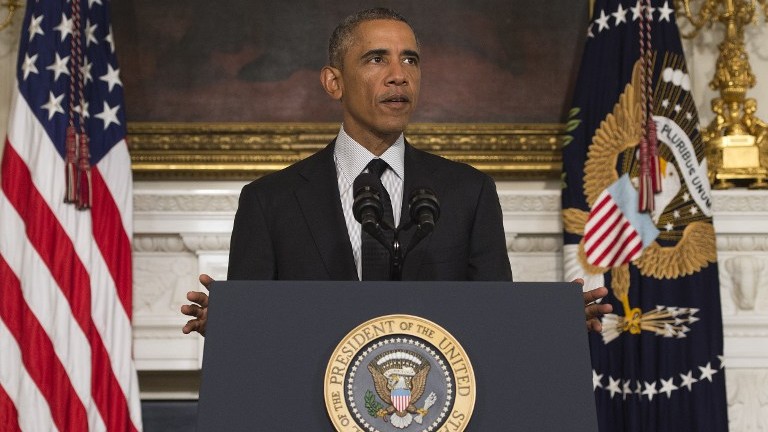
NEW DELHI (AP) — President Barack Obama defended his counterterrorism strategy in tumultuous Yemen Sunday, as influential lawmakers from both parties suggested the US may need to turn to special operations forces to root out terrorists from the Middle Eastern nation and elsewhere in the region.
Obama, who is traveling in India, said US operations against a dangerous al-Qaeda affiliate in Yemen would not stop because of the country’s political vacuum. In his first public remarks on Yemen since the country’s American-backed president and Cabinet resigned after rebels seized the capital last week, the president rejected the notion of moving away from the current drone-based campaign to a heavier footprint on the ground.
“We’ll continue to try to refine and fine-tune this model, but it is the model that we’re going to have to work with,” Obama said during a joint media appearance with Indian Prime Minister Narendra Modi. “The alternative would be massive US deployments in perpetuity, which would create its own blowback and cause probably more problems than it would potentially solve.”
In a direct challenge to Obama, Republican Senator John McCain and Democratic Senator Dianne Feinstein told CBS’s “Face the Nation” that more special operations forces in particular may be necessary in Yemen and elsewhere.
McCain, the new chairman of the Senate Armed Services Committee, accused the administration of being “delusional” in thinking that its strategy in the Middle East was working and said Iran was “on the march.” The Shiite rebels, known as Houthis, who now control Yemen’s capital of Sanaa are widely believed to be backed by Iran, though they deny having any support from the Islamic republic.
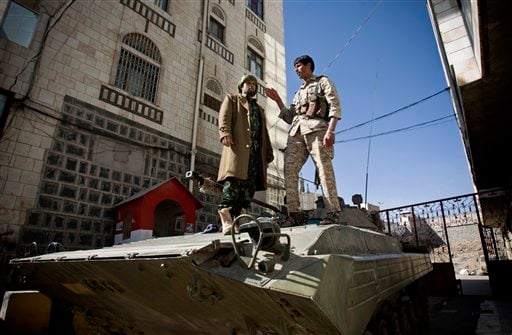
“We need more boots on the ground,” said McCain, a Republican representing Arizona. “I know that’s a tough thing to say, and a tough thing for Americans to swallow. But it doesn’t mean the 82nd Airborne. It means forward air controllers. It means special forces, it means intelligence, and it means other capabilities.”
Feinstein, the top Democrat on the Senate Intelligence Committee, said she agreed that more special operations forces are probably necessary. She also said the US needs more human intelligence in the region instead of relying so heavily on intelligence gathered by technical means.
The California Democrat said that while Americans “don’t want another war,” she believes it is time “to look more deeply and broadly into what we’re doing and how we’re going it.” She said the US must also do more to protect US partners in the region, including Israel, Jordan and Saudi Arabia.
Yemen is home to al-Qaeda in the Arabian Peninsula, which the US views as the global terrorist network’s most dangerous branch. The group has been linked to numerous failed attacks on the US and claimed responsibility for the attack on a Paris satirical magazine this month.
Obama has relied heavily on drone strikes to take out terror targets in Yemen. There were 23 US drone strikes last year and 23 the year before, according to Long War Journal, which tracks the strikes based on local media reports.
The US military also has trained elite counterterrorism units of Yemen’s military that have battled al-Qaeda.
The president has compared his counterterrorism strategy in Yemen to the military operations against Islamic State militants in Iraq and Syria, where the US is relying on airstrikes to combat the extremist group. In going after both AQAP and the Islamic State, Obama has warned of the “long, arduous process” of operating in places like Yemen that have troublesome political landscapes.
“It is not neat and it is not simple, but it is the best option that we have,” he said.
Copyright 2015 The Associated Press






The Times of Israel Community.