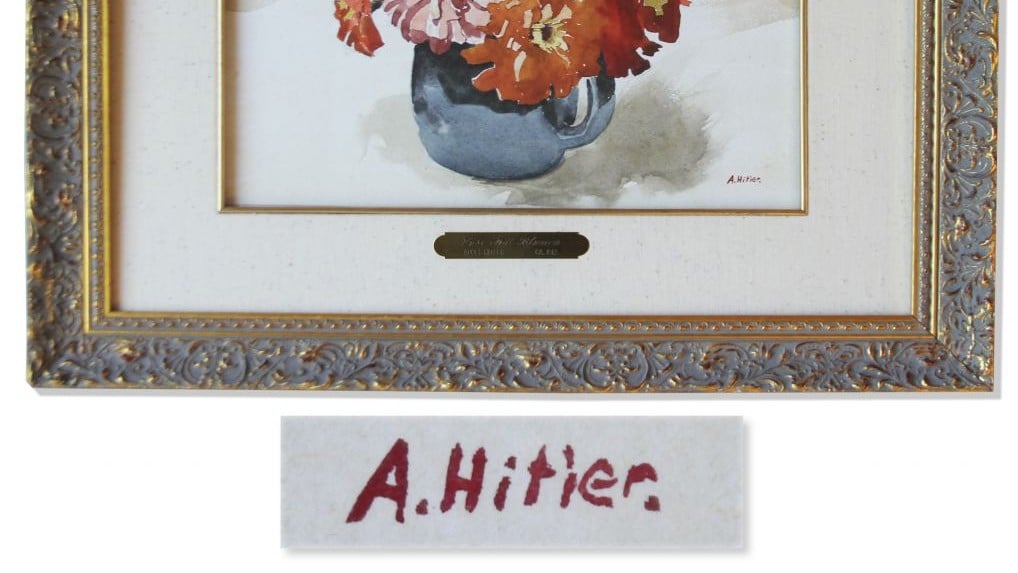
Adolf Hitler's signature on a painting he did in 1912. (Courtesy Nate D. Sanders catalog)
BERLIN, Germany — Watercolor paintings and drawings by Adolf Hitler from about a century ago were sold at auction in Germany at the weekend for nearly 400,000 euros ($450,000), organizers said.
The most expensive was a painting of King Ludwig II’s Neuschwanstein Castle in Bavaria, now a tourist magnet, which went to a buyer from China for 100,000 euros, Nuremberg-based Weidler auctioneers said, quoted by German news agency DPA.
A still-life of carnations changed hands for 73,000 euros and all of the works on offer, which date from 1904 to 1922, most signed A. Hitler, sold at the auction which ended Saturday.
Bidders included private investors from Brazil, the United Arab Emirates, France and Germany itself, the auction house said, without identifying the buyers.
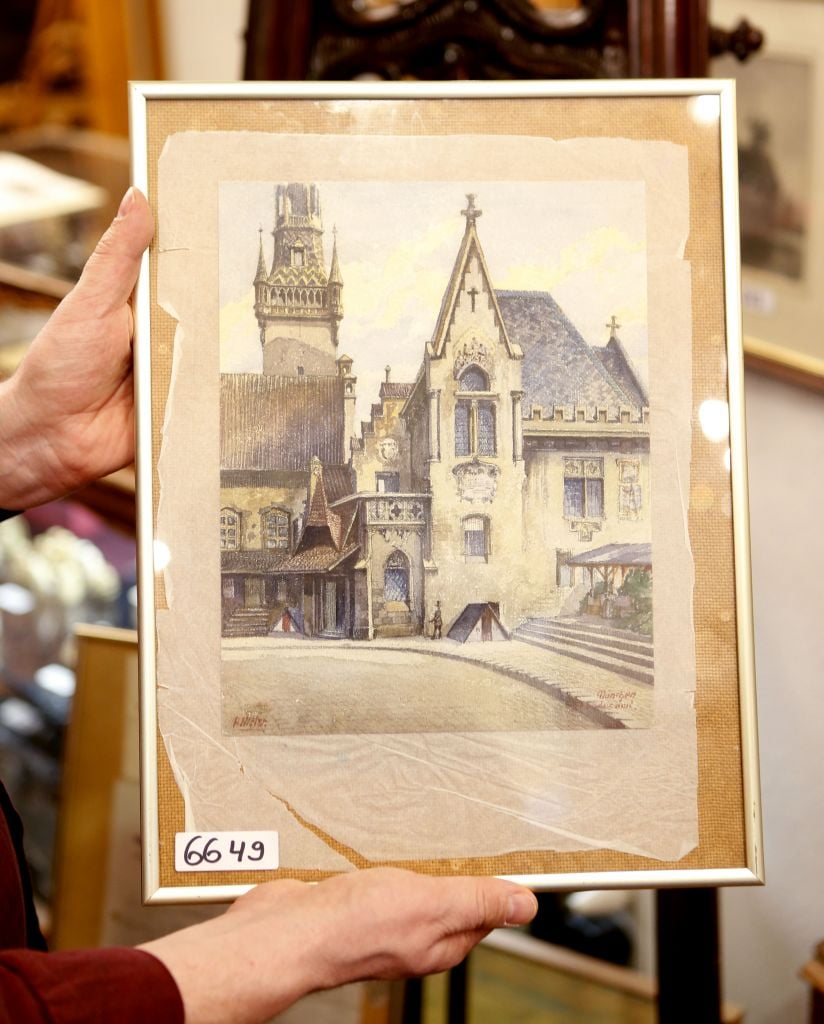
A picture titled “The Old City Hall” painted by Adolf Hitler is displayed in an auction house in Nuremberg, Germany. (photo credit: AP Photo/Michael Probst)
“These collectors are not specialized in works by this particular painter but rather have a general interest in high-value art,” Kathrin Weidler of the auction firm told DPA.
Get The Times of Israel's Daily Editionby email and never miss our top stories
In November, a watercolor painted by a young Hitler in 1914 of the city hall in Munich sold for 130,000 euros at a sale organized by the same auction house.
The buyer wished to remain anonymous.
As a budding young painter, Hitler applied to the Vienna Academy of Art but was rejected. He continued to paint however, copying images from postcards that he sold to tourists.
Advertisement
Experts consider his work to be of mediocre quality.
Germany permits auction houses to sell the late Nazi leader’s paintings as long as they do not feature any banned symbols.
Help us report truthfully on social media
As a multimedia journalist, my job is to take the quality, fact-based journalism produced by The Times of Israel newsroom and make it accessible across every platform — from Instagram posts to podcasts to short-form videos.
This is how many, especially young people, consume news these days. But misinformation is rampant on social media. Our team at ToI produces accurate, responsible short-form reporting on Israel and the Jewish world.
If you believe in the importance of factual social media journalism, please consider joining our reader support group, The Times of Israel Community. Your financial support is essential to sustain responsible multimedia reporting.
We’re really pleased that you’ve read X Times of Israel articles in the past month.
That’s why we started the Times of Israel - to provide discerning readers like you with must-read coverage of Israel and the Jewish world.
So now we have a request. Unlike other news outlets, we haven’t put up a paywall. But as the journalism we do is costly, we invite readers for whom The Times of Israel has become important to help support our work by joining The Times of Israel Community.
For as little as $6 a month you can help support our quality journalism while enjoying The Times of Israel AD-FREE, as well as accessing exclusive content available only to Times of Israel Community members.
Thank you, David Horovitz, Founding Editor of The Times of Israel


 Add ToI as a Preferred Source on Google