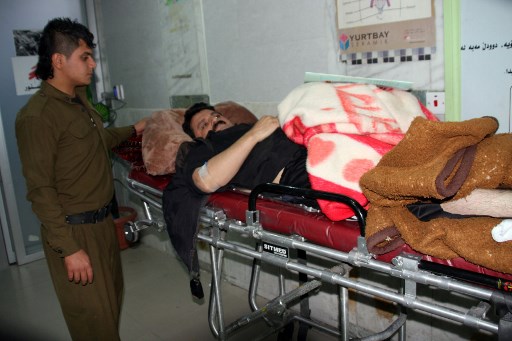
An earthquake victim is brought to Sulaimaniyah Hospital on November 12, 2017, in Sulaimaniyah, Iraq. (AFP Photo/ Shwan Mohammed)
TEHRAN, Iran — A powerful earthquake shook the Iran-Iraq border late Sunday, killing more than 140 people and injuring 860 in Iran alone, state media there said.
The Baghdad government did not immediately give word on damage or casualties in Iraq.
The 7.3-magnitude quake was centered 19 miles (31 kilometers) outside the eastern Iraqi city of Halabja, according to the most recent measurements from the US Geological Survey.
Iranian social media and news agencies showed images and videos of people fleeing their homes into the night in the western Iranian province of Kermanshah.
The state-run IRNA news agency disclosed the increase in casualties early Monday and said rescue work was continuing overnight and would accelerate during the daytime.
Get The Times of Israel's Daily Editionby email and never miss our top stories
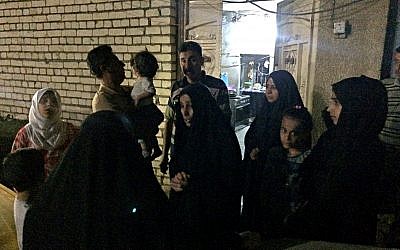
People stand in the street after feeling aftershocks from an earthquake in Baghdad, Iraq, November 12, 2017. (AP Photo/Hadi Mizban)
The semi-official ILNA news agency said at least 14 provinces in Iran had been affected by the earthquake.
Officials announced that schools in Kermanshah and Ilam provinces would be closed Monday because of the tremor.
Iranian state TV also said Iraqi officials reported at least six people dead inside Iraq, along with more than 50 people injured in Sulaymaniyah province and about 150 in the city of Khanaquin.
Advertisement
Iran sits on many major fault lines and is prone to near-daily quakes. In 2003, a magnitude 6.6 earthquake flattened the historic city of Bam, killing 26,000 people.
As a multimedia journalist, my job is to take the quality, fact-based journalism produced by The Times of Israel newsroom and make it accessible across every platform — from Instagram posts to podcasts to short-form videos.
This is how many, especially young people, consume news these days. But misinformation is rampant on social media. Our team at ToI produces accurate, responsible short-form reporting on Israel and the Jewish world.
If you believe in the importance of factual social media journalism, please consider joining our reader support group, The Times of Israel Community. Your financial support is essential to sustain responsible multimedia reporting.
We’re really pleased that you’ve read X Times of Israel articles in the past month.
That’s why we started the Times of Israel - to provide discerning readers like you with must-read coverage of Israel and the Jewish world.
So now we have a request. Unlike other news outlets, we haven’t put up a paywall. But as the journalism we do is costly, we invite readers for whom The Times of Israel has become important to help support our work by joining The Times of Israel Community.
For as little as $6 a month you can help support our quality journalism while enjoying The Times of Israel AD-FREE, as well as accessing exclusive content available only to Times of Israel Community members.
Thank you, David Horovitz, Founding Editor of The Times of Israel


 Add ToI as a Preferred Source on Google