

Prelude to a parley?
Arab columnists try to explain why Assad used chemical weapons and why Russia still supports him
 Add ToI as a Preferred Source on Google
Elhanan Miller is the former Arab affairs reporter for The Times of Israel
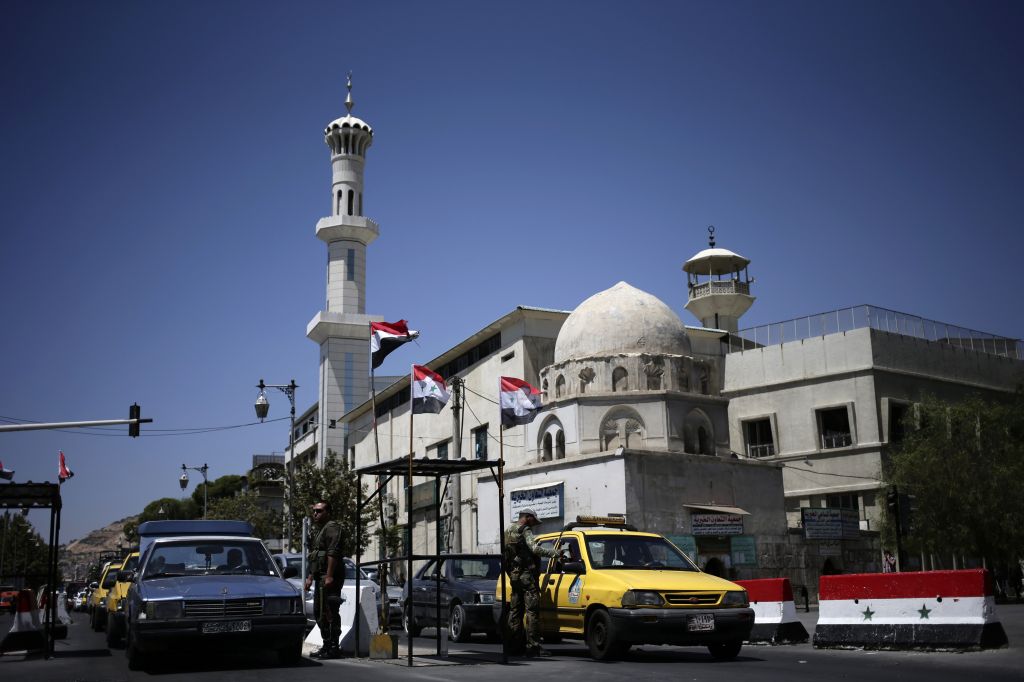
News of an impending American strike on Syria leads the front pages of Arab newspapers Wednesday, with some regarding it as a necessary prelude to a political conference on Syria’s future.
“The ‘looming’ strike on Syria lays the ground for ‘Geneva II,'” reads the headline of Saudi-owned daily A-Sharq Al-Awsat, featuring a photo of a Free Syrian Army fighter in an alleyway in old Aleppo Tuesday.
Opposition sources tell the daily that they were requested by the US to deliver a “target bank” for a military strike. A source in the US State department added that the goal of the American attack is not regime change but merely a retaliation for the use of chemical weapons.
Meanwhile, a “senior Syrian oppositionist” tells A-Sharq Al-Awsat that an agreement has been reached with a number of allied states to support an American strike in return for the opposition’s willingness to partake in a political summit in Geneva. The American strike, he said, was intended to bring a defeated Assad to the negotiating table and have him resign at the end of the process.
“International and Arab umbrella to punish Assad,” reads the headline of London-based daily Al-Hayat, featuring a graphic of strategic targets in and around Damascus, as well as the buildup of Western forces in the eastern Mediterranean and in the Red Sea.
“It seemed yesterday that the military preparations and the legal justifications were completed, and the world was just waiting for the countdown to a ‘painful strike’ against the Syrian regime to punish President Bashar Assad for his use of chemical weapons, amid a broad international and Arab umbrella,” reads the article.
London-based daily Al-Quds Al-Arabi leads with Syria’s statement that it is prepared to defend itself against an American strike, reporting rumors that the attack will take place on Thursday.
The daily dedicates its editorial on Wednesday to the Russian backing of the Assad regime, asserting that Assad would not use chemical weapons were it not for a Russian assurance of protection in the UN Security Council.
“Russia considers all Islamic nations with a Sunni majority that surround it potential enemies. It believes the only way to deal with them is the one used by it in Chechnya, the state which dared declare its wish for independence from Moscow: subordination with fire and iron. This doctrine was only strengthened with the start of the Syrian revolution, taking the form of an alliance with the Syrian and Iranian regimes.”
“The boss of the Kremlin doesn’t understand that in their struggle against tyranny, the nations lift the banner of religious and national identity as a form of independence from the occupier. This reflects a thirst for identity and social justice and political liberation.”
“Why did the regime use chemical weapons?” asks Syrian opposition leader Michel Kilo in an op-ed in A-Sharq Al-Awsat Wednesday.
“There is a simple and direct answer to this question, namely that criminality is the essence and spirit of the Assad regime which ruled Syria using an equation that stated quite honestly: I will either rule you or I will kill you. Today, since Assad is no longer capable of ruling them, he is killing them,” writes Kilo.
If Assad succeeded in anything, writes Al-Hayat columnist Elias Harfoush, it is in changing the thinking of the Obama administration regarding the Syrian conflict and about military intervention in it.
“We face a new Obama that we did not know, neither during his first term nor during the first year of his second term. Obama was hesitant to involve his forces in any military action overseas … what has changed in the past few days, causing Obama to resort to force to punish the Syrian regime?”
“It was impossible for the United States to maintain its hesitant position given the international atmosphere and the pressure exerted on it. It had to confront the conflict in Syria which reached such a level of violence, and a regime which showed such disregard for the lives of its citizens,” writes Harfoush.





The Times of Israel Community.