

Social piano experiment has Jerusalem passersby keyed up
Cadenza Piano lets anyone tickle the ivories on Jaffa Street, as VC gurus pitch capital on coming together through music
 Add ToI as a Preferred Source on Google
Jessica Steinberg, The Times of Israel's culture and lifestyles editor, covers the Sabra scene from south to north and back to the center
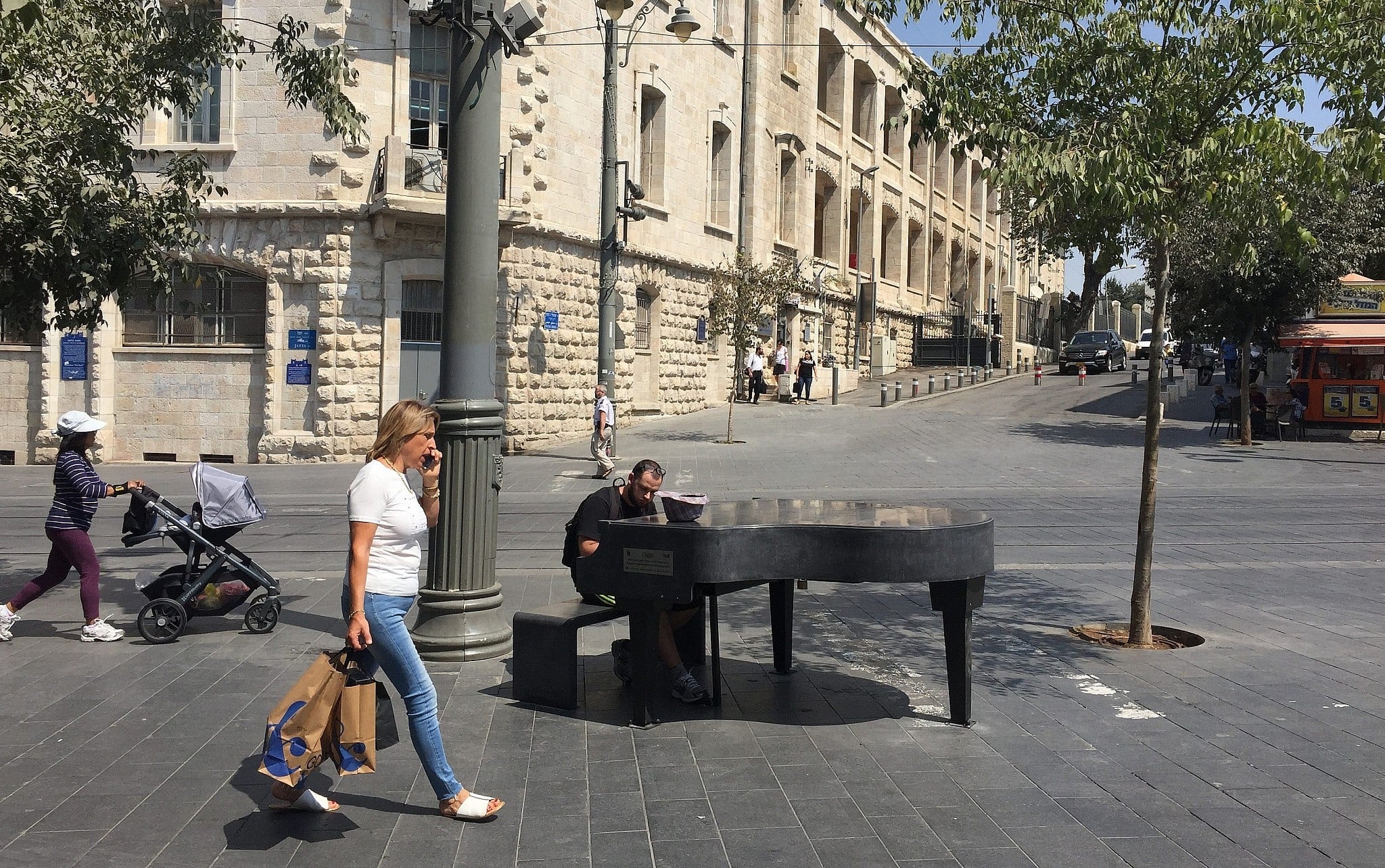
It was a Tuesday morning in September, and a small crowd had gathered around the grand piano on Jaffa Road, listening to a medley of jazz improvisations performed by a guy who plunked his battered fedora hat on top of the piano.
His audience included an Arab street cleaner standing under a nearby tree, an older gentleman swinging his leg in tune, an ultra-Orthodox teenager twirling his sidecurls and an Arab woman in traditional dress leaning over the piano, requesting the theme song from “Love Story,” a request that was later granted.
Unlikely as it may seem, it was a fairly typical scene for the second month of the Jerusalem piano experiment of Cadenza Piano, a company created by two Israeli entrepreneurs who wanted to see the effect of the musical instrument in a public space.
Cadenza is named for improvised passages played or sung with gusto. This particular Cadenza is available for impromptu performances from 10 o’clock each morning until 11 o’clock each night. It is shut down for the 25-hour period of Shabbat, in order to avoid offending Orthodox practice.
“People get off the train, stop, play on their way to work, and then move on,” said Evelyn Rubin, a former venture capitalist who runs Cadenza with founder Dan Kaufman, professor of entrepreneurship at Sapir College.
“He thinks about public spaces,” said Rubin of Kaufman, describing a project he arranged on his own suburban street, where he convinced neighbors to pitch in for a ping-pong table and benches. “He’s all about being an active participant in the public sphere.”
Rubin also knows a few things about encouraging entrepreneurship and startups. A Canadian by birth, she started working in Jerusalem’s venture capital scene more than 20 years ago, with veteran investor Shlomo Kalish at Jerusalem Global. She then worked with Knesset member Erel Margalit (Zionist Union) at Jerusalem Venture Partners, worked as an advisor at Temech, a Haredi women’s platform for employment and entrepreneurship run by the Joint Distribution Committee, and spent four years at OurCrowd, an equity crowdfunding platform run by another veteran entrepreneur, Jon Medved.
Rubin was looking for a change when she taught entrepreneurship for Kaufman at Sapir and heard about his piano venture.
“I needed something for my soul,” said Rubin, who hopes to sell the treated concrete-encased instruments to municipalities and institutions around the world. “My job is to sell pianos.”
This first Cadenza piano is a trial run, launched by Eden, the Jerusalem municipality’s development company, for a period of three months, until the end of November.
The instrument is a high-quality electric piano that they eventually hope to run on solar power, but, for now, it is set by a timer to turn on in the morning, and off at night
Kaufman and Rubin decided on the intersection of Jaffa Road and Shlomzion Hamalka Street, where the light rail passes frequently and pedestrians constantly cross the broad street, heading to offices, shops, cafes, and errands.
There are daytime and nighttime patterns to the impromptu performances, said Rubin, but while she frequently checks in, she rarely interferes in the scenes taking place around the instrument, preferring instead to let things happen as they will.
“There are incredible things that have happened here,” she said, recalling when two Palestinians played “Hatikvah,” Israel’s national anthem, or when Adam Ippolito, a former pianist for John Lennon, happened by during a visit to Israel and stopped to play.
The piano is one of three public music projects currently in downtown Jerusalem, together with orchestra chairs on Hillel Street and a giant radio sitting on the pedestrian sidewalk of Ben Yehuda Street.
This Cadenza, however, is all about the grand stretch of the piano keyboard and the random passersby who sit down to play. Or listen.
“It exposes people to pianos,” said Rubin, who spent 10 years learning to play as a child and is now considering trying it again. “Jerusalem is an intense city, but this brings something to the wider mix.”







The Times of Israel Community.