

Soldier burial bill faces mounting opposition
Jewish Home party turns against initiative to bury Jewish and non-Jewish troops alongside each other; IDF set to present its position
 Add ToI as a Preferred Source on Google
Haviv Rettig Gur is The Times of Israel's senior analyst.
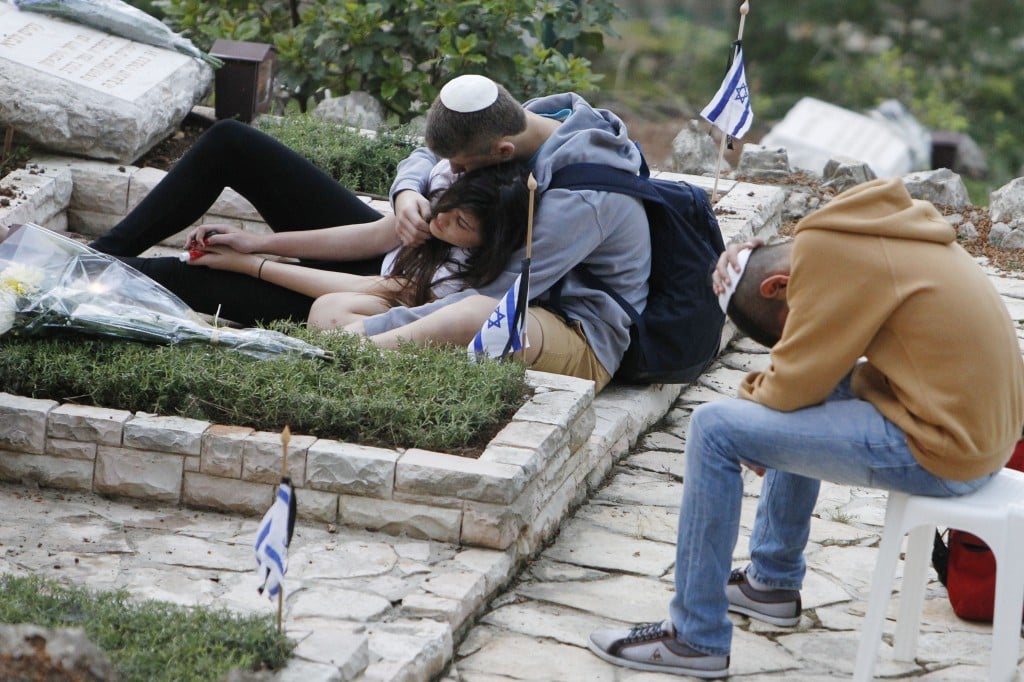
A bill that would mandate the burial of Jewish and non-Jewish soldiers alongside each other in Israel’s military cemeteries is facing growing opposition from within the coalition.
The legislation, sponsored by MK Elazar Stern (Hatnua), an observant Jew and former IDF major-general, seeks to correct a “warped situation” in which soldiers “who fight shoulder to shoulder” are subjected to different burial treatment if they fall, according to former IDF chief of staff MK Shaul Mofaz (Kadima), who is a cosigner on the bill.
Stern’s bill does not deal with all non-Jewish soldiers, but only with those who are eligible for immigration under the Law of Return — that is, non-Jewish family members of Jews, chiefly from the former Soviet Union. It states that “any soldier who dies, including a soldier eligible for rights under Article 4(a) of the Law of Return, and whose relatives choose to bury him in a military cemetery, shall be buried in the plot and row, and directly alongside, the soldiers already buried in that plot.”
While the bill initially enjoyed a huge number of cosponsors — 26 MKs when it was proposed last week — it has seen a growing groundswell of opposition, chiefly from religiously observant groups.
One MK, the Jewish Home party’s Shuli Mualem, signed onto the bill last week but has since withdrawn her name and support.
A source in the party insisted Stern was trying to solve a problem that didn’t exist.
“The situation today is fine. The non-Jewish soldiers are not outside the fence; they’re not buried in unkempt plots,” the source insisted. “They’re buried in adjacent plots that are identical.”
Several Jewish Home officials recalled a recent meeting in the Defense Ministry during which ministry representatives showed two photographs of the different plots on Mount Herzl and asked MKs to identify which contained the remains of Jewish soldiers, and which those of non-Jews. The MKs could not tell the difference, the officials claimed.
“Nobody doubts the [non-Jewish] soldiers’ sacrifice,” a Jewish Home official said Wednesday, echoing comments last week (Hebrew) by Deputy Religious Services Minister Eli Ben Dahan, also of Jewish Home.
“But halachically, you can’t bury them together,” the official added.
A few families of fallen soldiers have also expressed opposition to the bill.
David Einhorn, father of Yonatan who was killed in the Second Lebanon War in August, 2006, warned that “I won’t bury my son Yonatan” against the strictures of Jewish law.
The families of fallen soldiers “respect and cherish the sacrifice of the [non-Jewish] soldiers,” but if the bill passes into law, “it will lead to the opposite situation from today, with a ‘general’ plot for everybody and a separate side-plot for religious soldiers” whose families seek to bury their fallen in keeping with halacha, Einhorn told Army Radio on Sunday.
“Let them bury separately; that’s their decision,” MK Amram Mitzna (Hatnua) said this week in response to some families’ threats that they will exhume their children and rebury them in Jewish plots. Like Stern, Mitzna is a retired IDF major-general.
“I’m bothered by the fact that, in recent years, the Jewish religion has been interpreted as one that divides, that separates — in schools, in buses, and now in cemeteries,” Mitzna said. “The military cemeteries are filled with warriors who fought and died alongside one another. There is no halachic reason to oppose this [bill],” he added.
The military has yet to express an opinion on the bill, but that may change soon. The Public Council for Commemoration of Fallen Soldiers in the Defense Ministry was holding meetings on the issue, and is expected to present its formal view Thursday afternoon.
According to sources familiar with the issue, Defense Minister Moshe Ya’alon opposes the bill, as does the military rabbinate.
The proposal came in response to the uproar that ensued after IDF Chief of Staff Lt.-Gen. Benny Gantz mistakenly passed over the grave of Yevgeny Tolotzki, a young soldier who died in basic training on February 17, during an April Memorial Day ceremony meant to honor the IDF’s most recent fallen soldier. Gantz failed to notice Tolotzki’s grave, which was located in a non-Jewish plot in the Mount Herzl Military Cemetery, and placed a ceremonial Israeli flag on the grave of another soldier in the Jewish plot.
The IDF apologized for the misstep and promised to correct its procedures to ensure it did not recur.
At the time, Stern called on the chief of staff to immediately “find an appropriate way to repair the damage.”
On Thursday, Stern offered his response to the criticism that his bill stands in violation of Jewish law.
In a letter to MKs, obtained Thursday by The Times of Israel (read the Hebrew original here), Stern offers a series of Jewish textual sources suggesting that the burial of Jews and non-Jews together could be permissible.
“I am trying to present to you, members of Knesset, a different Judaism, a Judaism that does not hate the stranger, but brings him closer through an understanding of his uniqueness and [spiritual] stature,” Stern wrote.
One of the sources he offered in the letter was from the Talmud’s Tractate Gittin, folio 61 (link in Hebrew), which “offers a number of laws we are instructed to follow in dealing with non-Jews,” he explained. “Our rabbis taught,” the Talmudic passage reads, “we support the non-Jewish poor with the Jewish poor, visit the non-Jewish sick with the Jewish sick, and bury the non-Jewish dead with the Jewish dead, for the sake of peace.”
“This house,” Stern wrote the MKs, “which represents the entire people and must listen and hear the entire people, must understand that it is impossible in the shared world of the military… to separate soldiers after their deaths. Only those who don’t understand the meaning of the state and its army can oppose this bill.”
Meanwhile, efforts are underway to contain the political fallout from the contentious disagreement between coalition partners. A new forum was established this week aimed at ironing out differences related to religious issues within the coalition before they turn into media battles.
According to a report in the Hebrew daily Maariv, the forum, made up of Education Minister Shai Piron (Yesh Atid), Deputy Transportation Minister Tzipi Hotovely (Likud), Ben Dahan and Stern, has met twice in the past week.
The burial bill is expected to be raised in the Ministerial Committee for Legislation on Sunday, a key step in which a bill stands a chance of gaining the government’s support for its passage in the Knesset. The bill was supposed to come up in the committee last week, but the IDF requested a week’s stay to study the issue.
Ron Friedman contributed to this report.





- Israel Inside
- Russian-speaking Jews
- Elazar Stern
- Ministerial Committee for Legislation
- Benny Gantz
- Yevgeny Tolotzki
- IDF Memorials
- Jewish cemeteries
- Shaul Mofaz
- Mount Herzl
- Eli Ben Dahan
- Defense Ministry
- Public Council for Commemoration of Fallen Soldiers
- Moshe Ya'alon
- Shai Piron
- Tzipi Hotovely
- Israeli Memorial Day
- military cemeteries
The Times of Israel Community.