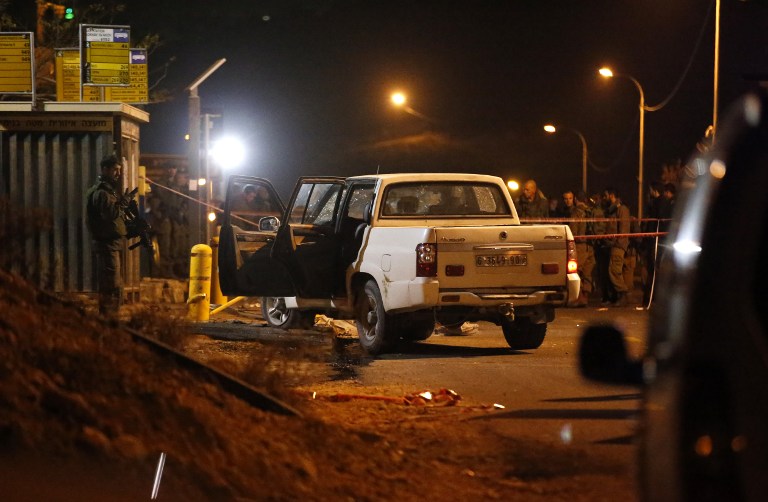
Israeli police at the scene of a terror attack in Jerusalem Sunday, Jan. 8, 2017. A Palestinian rammed his truck into a group of Israeli soldiers, killing four and wounding 16 others (AP Photo/Mahmoud Illean)
Five Israelis were killed in January by Palestinian terrorists, making the month the deadliest since June 2016, according to Israel’s security service.
The Shin Bet recorded a total of 100 attacks in January, which left 16 wounded, according to its monthly report published earlier this week.
Four of the victims were killed in Jerusalem on Jan. 8 when the assailant drove his truck into a crowd of soldiers. One man was killed the previous week in Haifa.
Of the attacks documented last month, 81 involved the hurling of firebombs. December 2016 had seen 98 attacks.
Israeli forensic policemen and security forces inspect the site where a Palestinian man drove at a bus stop in an attempted car-ramming attack before being shot dead, near the West Bank settlement of Adam, east of the West Bank city of Ramallah, on January 25, 2017. (AFP/Ahmad Gharabli)
Separately, on Thursday, Palestinians accused a driver they claim is an Israeli settler of deliberately hitting a Palestinian man with his car at the entrance to the West Bank town of Beit Ummar, near Hebron.
Get The Times of Israel's Daily Editionby email and never miss our top stories
Rafat Muhammad Shihdeh Abu Arrar Masalmeh, 36, was struck while approaching the parked car of his brother on the shoulder of the road, according to a report by the Palestinian Ma’an news agency. The report did not specify his condition or name the driver.
The report quoted a man described as a “local activist” of saying the settler hit Masalmeh deliberately and then fled the scene.
According to the report, Israeli police later questioned the driver, who reportedly said he hit Masalmeh by accident.
Advertisement
We can't do this work alone.
The war with Iran has been draining for all of us in Israel. But when I heard about a high casualty incident – ballistic missile impacts in Arad and Dimona that left nearly 200 people wounded – I drank a cup of coffee, packed a bag, and headed south.
There, I spoke with Shilgit, the head of an after-school program for underprivileged youth. Standing outside her destroyed center, Shilgit said it was a miracle that no children were hurt and spoke about the community coming together in the hours since.
As a Times of Israel reporter, I’m committed to telling stories of resilience like Shilgit’s. But my colleagues and I can't do this alone. If you value work like this,please consider joining our reader support group, The Times of Israel Community. Your financial support is essential to keep real human reporting like this going.
We’re really pleased that you’ve read X Times of Israel articles in the past month.
That’s why we started the Times of Israel - to provide discerning readers like you with must-read coverage of Israel and the Jewish world.
So now we have a request. Unlike other news outlets, we haven’t put up a paywall. But as the journalism we do is costly, we invite readers for whom The Times of Israel has become important to help support our work by joining The Times of Israel Community.
For as little as $6 a month you can help support our quality journalism while enjoying The Times of Israel AD-FREE, as well as accessing exclusive content available only to Times of Israel Community members.
Thank you, David Horovitz, Founding Editor of The Times of Israel