

Testing reportedly shows Islamic State used mustard gas on Kurds
Samples from attack in Syria two weeks ago confirm use of nerve agent or precursor, officials say
 Add ToI as a Preferred Source on Google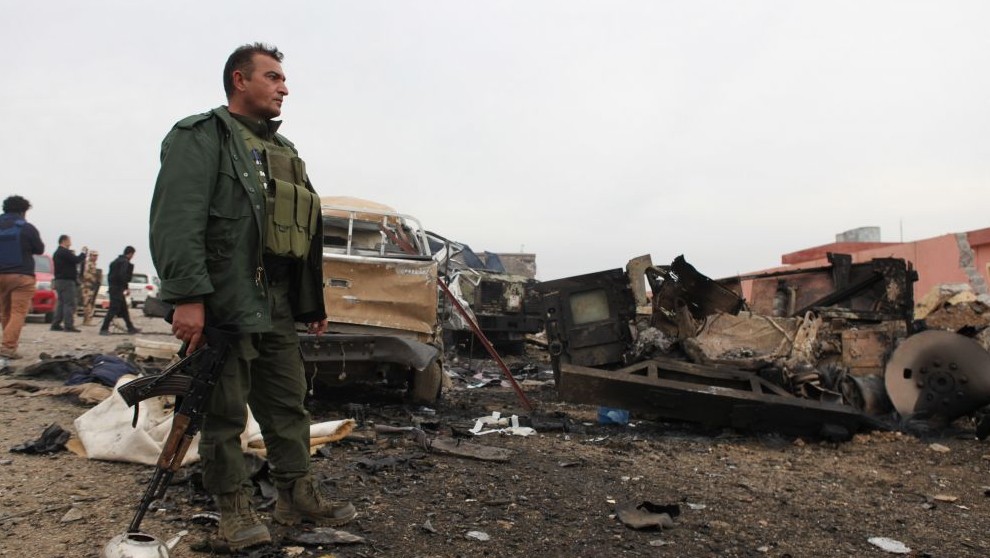
Testing has reportedly confirmed that Islamic State militants used the mustard gas nerve agent against Kurdish troops in Syria in recent weeks, according to US officials.
Unnamed officials speaking to CNN over the weekend said samples analyzed from an attack several weeks ago showed signs of mustard gas, though it was not clear how much was used or at what concentration.
Fears grew late last week that Islamic State fighters were in possession of the chemical weapon after the German defense ministry reported a chemical attack on Kurdish troops training in northern Iraq last week, though they were unable to determine what agent was used.
Samples from an attack last week outside Makhmour, Iraq, near the Kurdish capital of Irbil, were also sent for testing, according to CNN.
A US official told the Washington Post the Obama administration was not surprised by the reports of the chemical attack in Makhmour, given the results of the testing.
“We find the allegations of mustard use there [in Iraq] to be plausible because of information we already had — that they certainly had it in their possession, and used it in the past,” the official said.
The tests were done after Kurdish fighters complained of being attacked by chemical arms in Hasakeh, Syria, earlier two weeks ago, according to CNN.
An official told CNN on Friday that initial testing seemed to show the agent used on the attack in Syria was a precursor and thus had likely not come from a leftover stockpile belonging to the regime of Syrian President Bashar Assad.
On Thursday, a US official speaking to the Wall Street Journal had said it was possible the regime of Syrian President Bashar Assad had not destroyed all its stockpiles of mustard gas, which had then ended up in the possession of the Islamic State.
Syria agreed to get rid of all its chemical weapons stockpiles in 2013 after the US threatened airstrikes following an attack on a suburb of Damascus that left over a thousand people dead by some counts.
However, international inspectors never confirmed that all mustard gas was destroyed, according to the Wall Street Journal report.
Kurdish peshmerga fighters have complained of being targeted with chemical arms several times since January, when a car bomb with chlorine was reportedly used.
The Conflict Armament Research group and Sahan Research group said last month that the Islamic State group had also targeted peshmerga with a projectile filled with an unknown chemical agent on June 21 or 22.
The chemical used had characteristics and clinical effects “consistent with a chlorine chemical agent,” the groups said.
The organizations said they had also documented two such attacks against Kurdish fighters from the People’s Protection Units in Syria’s northeastern Hasakeh province on June 28.
It said that upon impact, the projectiles had released a yellow gas “with a strong smell of rotten onions.”
There were no deaths but troops exposed to it had experienced burning of the throat, eyes and nose, severe headaches, muscle pain, impaired concentration and mobility, and vomiting.
AFP contributed to this report







The Times of Israel Community.