

The Beersheba dead
An IDF soldier, an Israeli Arab and an Eritrean man are the focus of the Hebrew press’s coverage
 Add ToI as a Preferred Source on Google
Ilan Ben Zion is an AFP reporter and a former news editor at The Times of Israel.
The terror attack on Beersheba’s bus station centers on three characters, whose stories fill the front pages of the Hebrew newspapers on Tuesday as authorities and reporters alike try to decipher what went down in Sunday night’s incident.
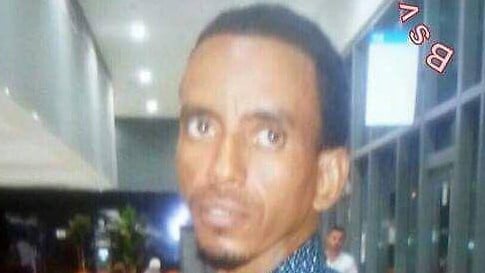
The first figure is the attacker, identified by police on Tuesday as a 21-year-old Israeli Arab man named Muhanad Alukabi, a Bedouin from near the town of Hura, just east of Beersheba. He slipped past security with a pistol and knife, stabbed a soldier and opened fire, killing one and injuring 11. The second is the soldier, Sgt. Omri Levy, 19, who was killed in the attack and laid to rest on Monday afternoon. The third, Haftom Zarhum, 29, is an Eritrean who was mistaken for an assailant by Israeli security forces, shot, then brutally beaten by bystanders. He later died of his injuries.
Alukabi’s father denied he was involved, claiming he was executed, Israel Hayom reports. “Everyone blames him for killing and nobody knows the truth,” he told reporters. Alukabi’s uncle, however, condemned the attack, saying, “We’re a tribe of good people and faithful to the state. Many of us served in the IDF for many years. We’re Israelis in every respect and want peace already. This unfortunate incident won’t break us.” A resident of the town tells Haaretz that they have no trust in the Hebrew media: “You’ll probably present us as attackers and terrorists, but we’re not. We’re people who want to life in honor and hope but not despair.”
In Yedioth Ahronoth, Yossi Yehoshua writes that the number of terrorists in recent weeks with Israeli ID cards has gone up to 22, 19 from East Jerusalem and three from Israel proper. “All of them without a criminal record, all of them received inspiration from social media, and all of them made the decision at the last moment, so that it was impossible to stop them,” he says. He nonetheless warns against sweeping generalizations against Israeli Arabs “of the sort uttered by politicians in these days.”
“The absolute majority of Israeli Arabs do not take part in terrorist acts, and it’s inaccurate to compare them to residents of East Jerusalem who rush to protect Al-Aqsa,” he writes.
The death of Zarhum, an innocent man, evokes the ire of the press and authorities alike. Haaretz reports that the police will investigate the “suspected lynching” of the Eritrean man. It reports that security camera footage shows that after he was shot, several bystanders, including an IDF soldier, beat him with a bench and kicked him repeatedly in the head. The chief of the police’s southern command said that even if he were a terrorist, such behavior is unacceptable.
Israel Hayom reports that the Eritrean government condemned Zarhum’s death saying, “This tragic incident is a painful reminder of the covert suppression in Israel of tens of thousands of Eritreans.” Needless to say, the comment coming from one of the world’s most repressive regimes, from which tens of thousands of Eritreans sought refuge in Israel, may have been meant as a tongue-in-cheek remark by the paper.
Aeyal Gross writes in Haaretz that Zarhum’s death “didn’t happen in a vacuum” but is a direct consequence of the police’s neglect of the rules of engagement. He says that like another recent incident in the East Jerusalem neighborhood of Issawiya, police opening fire on a suspect “didn’t appear to be a necessary action aimed at preventing a stabbing and saving lives, but an alternative to arresting a suspect who didn’t represent a present threat.”
“The lynching [of Zarhum] is the continuation also of the incitement against asylum seekers, who were branded by the Israeli government as criminals who must be jailed without trial,” he argues. He says the difference in treatment by police of Jewish suspects — like the attacker at the Gay Pride Parade in Jerusalem this summer — and Zarhum and Arab terror suspects, cannot be ignored.
Dan Margalit writes in his Israel Hayom column that Zarhum’s death was an “unfortunate turn of events” and a “mishap,” but nonetheless advocates the shooting dead of terrorists at the scene of an attack. “The passersby, who were obviously still overwhelmed by the attack, behaved savagely and lynched him,” he writes, but cautions that “in an effort to avoid these unintended consequences, law enforcement’s response to future attacks might be compromised.”
“The ongoing debate over the conduct of first responders could lead to a situation in which a police officer decides to stand down his weapon even as a knife-wielding terrorist runs toward his next victim,” Margalit says. Instead, he argues, the lesson learned from the Beersheba attack is that “terrorists who are in the midst of perpetrating their act should be shot at on the spot, without any second-guessing or philosophical deliberations.”
Lastly, Sgt. Levi, who Yedioth Ahronoth reports was laid to rest alongside his father, who died three years ago from a heart attack at 46. “The eldest son, Omri, immediately stepped into his shoes, leading and uniting the family,” the paper reports. Israel Hayom and Yedioth Ahronoth both accompany their coverage of the Golani soldier’s death with photos of floral memorials placed on his grave.







The Times of Israel Community.