

Top scientist praises draft of Paris climate pact
Greenpeace hails accord as turning point, while activists protesting in French capital brand it ‘unacceptable’
 Add ToI as a Preferred Source on Google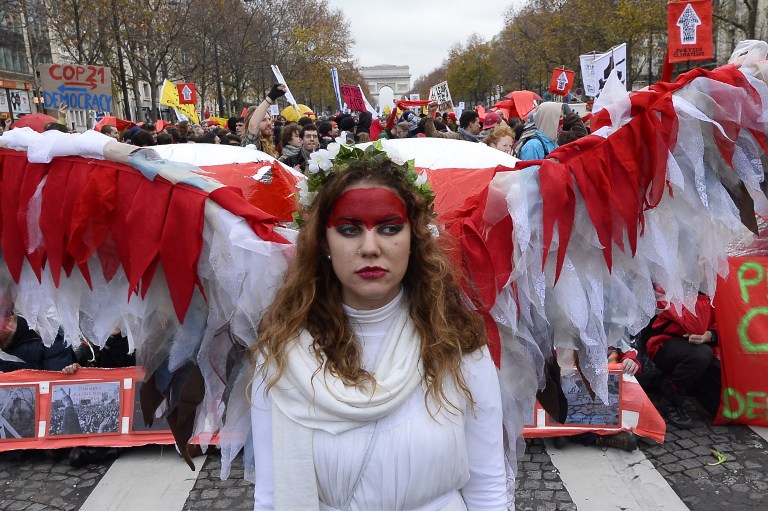
LE BOURGET, France — A top climate scientist who was critical of draft negotiation texts on a universal accord to combat climate change presented Saturday in Paris has praised the final draft as being consistent with science.
The draft accord sets a global goal of peaking global greenhouse gas emissions “as soon as possible.” It also calls for achieving a balance between man-made emissions and the Earth’s ability to absorb them by the second half of this century.
John Schellnhuber, director of Germany’s Potsdam Institute for Climate Research, said that “if agreed and implemented, this means bringing down greenhouse-gas emissions to net zero within a few decades.”
He said the accord “is in line with the scientific evidence we presented of what would have to be done to limit climate risks such as weather extremes and sea-level rise. To stabilize our climate, CO2 emissions have to peak well before 2030 and should be eliminated as soon as possible after 2050.”
He added that “governments can indeed write history today, so future generations will remember the Paris summit for centuries to come.”
Delegates are studying the accord, which may be adopted later Saturday.
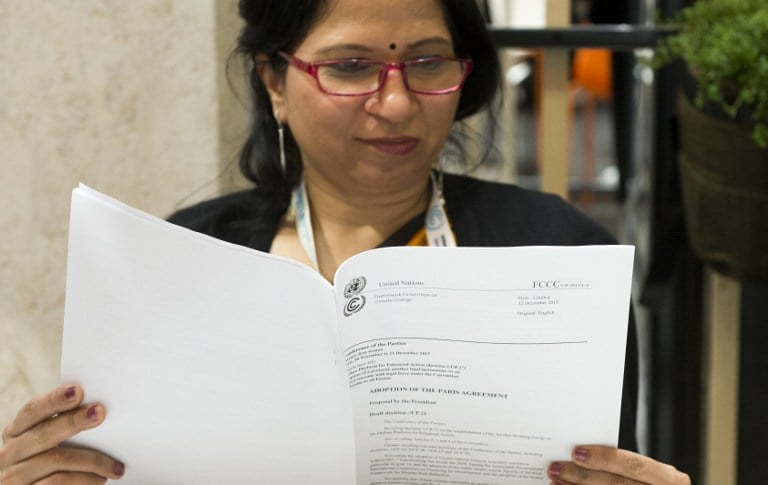
The wording of the final draft removed disputed concepts like “climate neutrality” or “emissions neutrality,” which had appeared in earlier versions but were met with opposition from countries including China.
The draft agreement included a section on “loss and damage,” an issue pushed by small island nations and other vulnerable countries who wanted the deal to recognize that there are some impacts of climate change that they cannot adapt to.
However, an adjoining decision linked to the agreement said the loss and damage article “does not involve or provide a basis for any liability or compensation” — a key demand of the United States.
Another article of the draft agreement said wealthy nations should continue to provide financial support for poor nations to cope with climate change.
It also said “other parties are encouraged to provide or continue to provide such support voluntarily.” This is a new concept in the climate talks, suggesting the most advanced developing countries should also pitch in.
‘The wrong side of history’
The accord would deal a big blow to the fossil fuel industry, Greenpeace and other prominent environment groups said Saturday.
“The wheel of climate action turns slowly, but in Paris it has turned. This deal puts the fossil fuel industry on the wrong side of history,” Greenpeace International executive director Kumi Naidoo said.
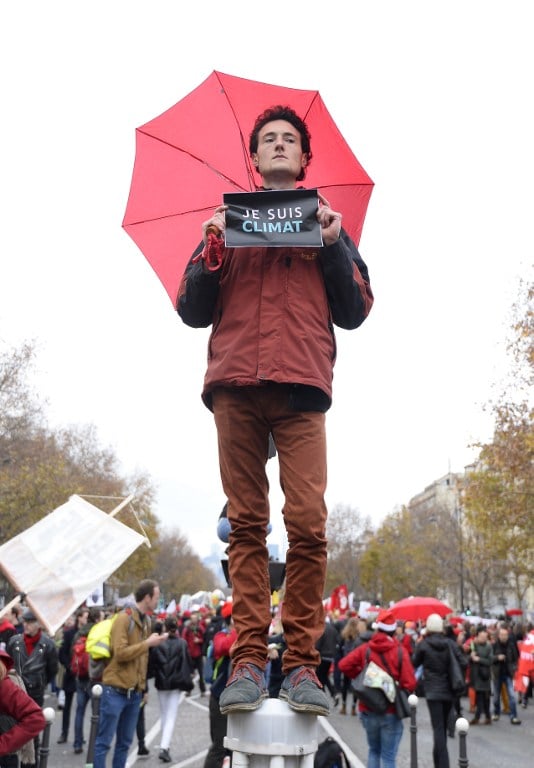
While the draft won praise from Schellnhuber and Greenpeace, other activists gathered near the Eiffel Tower on Saturday were already denouncing the potential accord as insufficient to protect the planet.
Protesters from environmental and human rights groups had gathered in the French capital to call attention to populations threatened by rising seas and increasing droughts and floods.
Thomas Coutrot of advocacy group Attac said the accord is an optical illusion that “masks” a lack of serious policy changes like abandoning oil altogether.
“This accord is unacceptable,” he said. He called for declaring “a state of climate emergency.”
Guillaume Durin of Alternatiba said, “we are convinced the agreement won’t be enough.”
AFP contributed to this report




The Times of Israel Community.