

Trump team suggests plan not entirely set in stone, but core aspects seem to be
US officials have indicated they are willing to alter components of proposal and ready to weigh Palestinian counteroffer — but key territorial allocations appear non-negotiable

 Add ToI as a Preferred Source on Google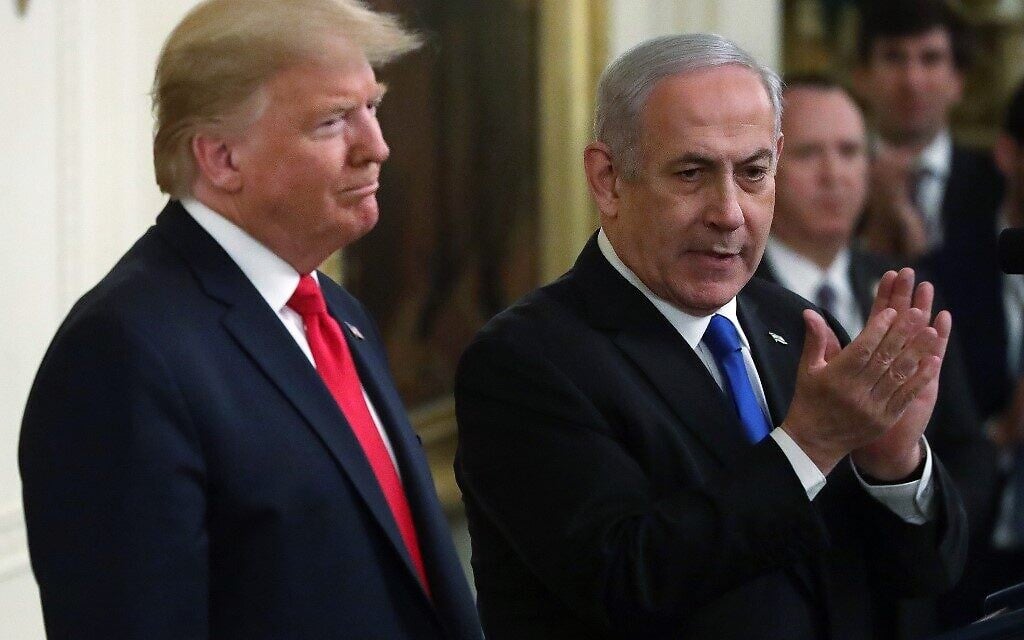
WASHINGTON — The Trump administration is insisting that the contours of its peace plan are not fully set in stone, The Times of Israel confirmed Thursday, allowing for the Palestinians to propose alternatives that would enable a negotiating process with Jerusalem.
Even after US President Donald Trump unveiled his long-awaited peace plan Tuesday, White House officials have indicated that aspects of the plan are a blueprint that could be altered through the process of direct talks between the sides.
But key territorial elements of the plan seem to tell a different story, and would appear to be non-negotiable: with 30 percent of the West Bank — notably including all Jewish settlements and the Jordan Valley area — allocated to Israel under any scenario.
The Trump team’s plan provides for an eventual Palestinian state in some 70% of the West Bank, minus the Jordan Valley and a network of enclaves carved out to include all of Israel’s settlements and slivers of land connecting them.
It offers the Palestinians a capital in Arab neighborhoods and partial neighborhoods on the outskirts of Jerusalem that lie on the far side of Israel’s West Bank security barrier.
The proposal appears to have been tailored to accommodate the expected Palestinian rejection of the plan, imposing a four-year settlement freeze in areas allocated for that future Palestinian state to allow the PA time to consider coming to the table.
That state’s establishment is predicated on several conditions long demanded by Netanyahu, including demilitarization, the recognition of Israel as a Jewish state and ongoing Israeli overall security control in the West Bank.
The Palestinian Authority, which cut off ties with the Trump White House in 2017 after it announced it would move the US embassy to Jerusalem, indeed rejected the offer emphatically.
“No, no and no to the ‘Deal of the Century,’” said PA President Mahmoud Abbas. “Jerusalem is not for sale. All of our rights are not for sale or bartering.” The Palestinian people, he vowed, will send the US plan to “the dustbin of history.”
US Secretary of State Mike Pompeo on Wednesday urged the Palestinian leadership to come up with a “counteroffer” to the plan that could win Israeli support.
Asked about the Palestinian reaction to the proposal by Israel’s Channel 13, Pompeo said he hoped they would consider and evaluate it, and then come to the table. “I hope they’ll take it seriously,” he said. “I hope they’ll then present a counteroffer if what’s presented isn’t acceptable. That’s how this ought to move forward, and I hope that they’ll do that. We’ll see.”
The plan’s architect, Trump son-in-law and senior adviser Jared Kushner, has also suggested that Palestinians should propose changes they would like to reach a final accord.
“Palestinians may have issues with aspects of this plan,” he wrote in a CNN op-ed. “But to address them, they should identify the areas they would like to improve and agree to negotiate with Israel. Failure to do so would be to miss an opportunity which may never come again.”
Despite the fact that plan gives the PA some time to consider its position, the territorial component of the plan affords them no such courtesies — in the 30% of the West Bank earmarked for Israel.
US Ambassador to Israel David Friedman indicated as much when he told reporters on Tuesday that Israel was free to annex the settlements right away in agreement with the plan — before backtracking Wednesday, saying Jerusalem would need the approval of an Israeli-American committee.
Kushner then said that the US would not green-light such a move until after the March 2 elections at the earliest.
Prime Minister Benjamin Netanyahu had intended to begin the annexation process this coming week, before Kushner intervened. He told reporters shortly after the White House event that he would bring the annexation of the Jordan Valley and all West Bank settlements for a vote in Sunday’s cabinet meeting, but was later forced to walk back that pledge due to Kushner’s statements.
But any confusion on the timing of potential annexation — and the situation has no doubt been confused — does not appear to invalidate the fact that Washington is open to unilateral Israeli steps even prior to any comprehensive Palestinian engagement with the proposal.
This core issue, it would then seem, is not one the White House would consider opening up for discussion.






The Times of Israel Community.