

Trump to make case for Jewish voters to back 2020 bid
US president to speak at meeting of Republican Jewish Coalition, which is preparing to spend millions on his campaign; speech comes weeks after he suggested Democrats ‘hate’ Jews
 Add ToI as a Preferred Source on Google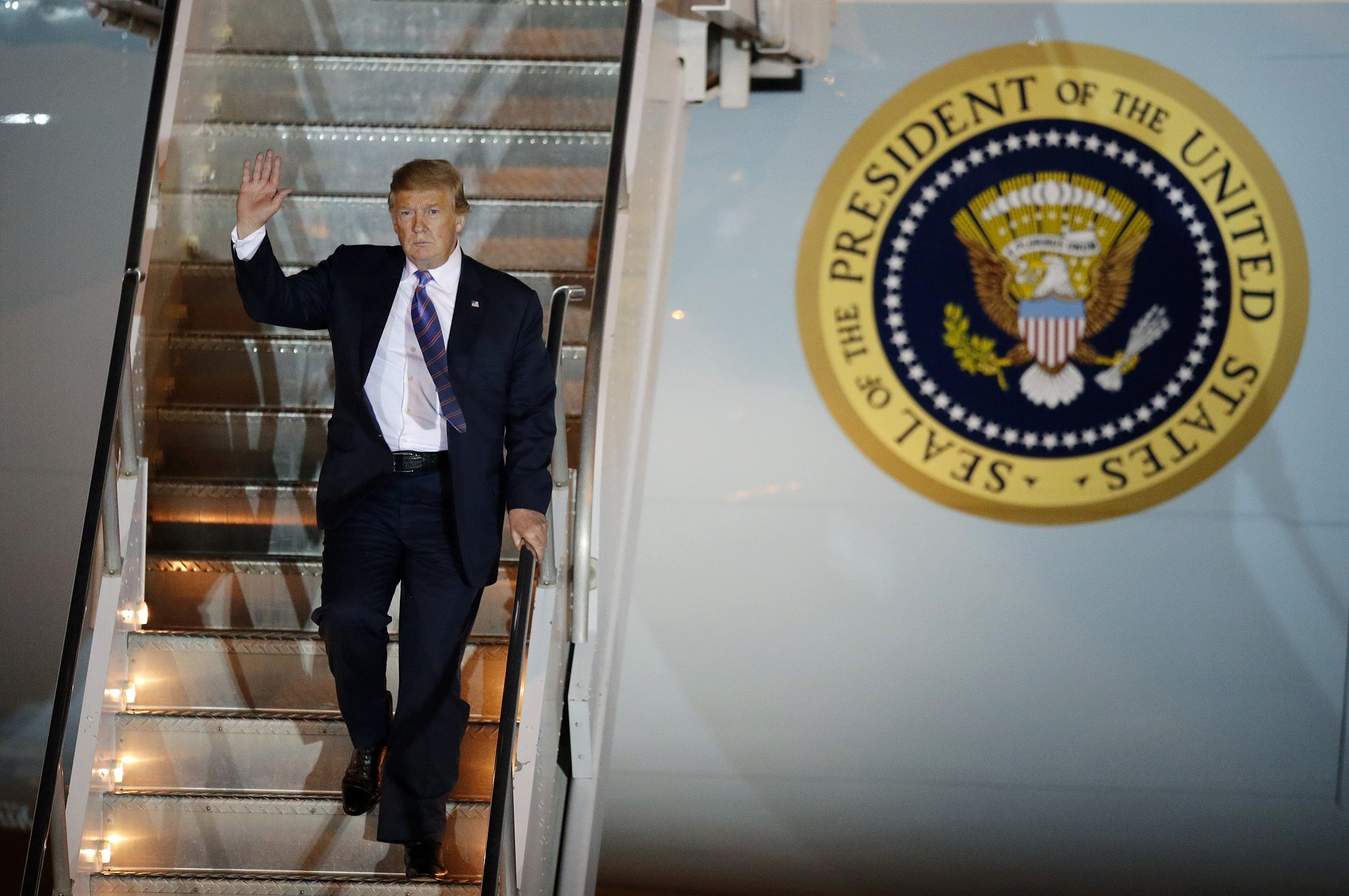
US President Donald Trump is trying to make the case for Jewish voters to back his re-election, as he takes a victory lap with Republican donors in Las Vegas.
Trump was scheduled to speak Saturday at the annual meeting of the Republican Jewish Coalition, which supported his 2016 campaign and is preparing to spend millions on his 2020 effort.
Jewish voters in the United States have traditionally sided heavily with Democrats, but Republicans are hoping to narrow the gap next year, in part as Trump cites actions that he says show he’s more pro-Israel.
Trump’s speech comes weeks after he suggested Democrats “hate” Jews. His remark came as Democrats engaged in an internal fight over how to respond to comments by Representative Ilhan Omar of Minnesota, that were criticized by some as anti-Semitic.
Before Trump’s appearance, people assembling for the event carried signs with “We are Jews for Trump” and “Trump” written in Hebrew. Dozens of men and several women wore red yarmulkes with “Trump” in white.
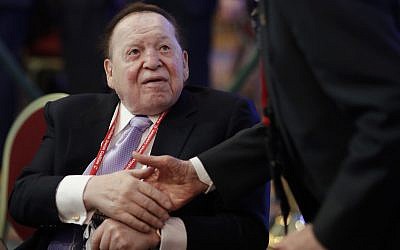
The president will make his speech at a resort owned by billionaire Sheldon Adelson, CBS News reported. Adelson has close ties to both Trump and Prime Minister Benjamin Netanyahu.
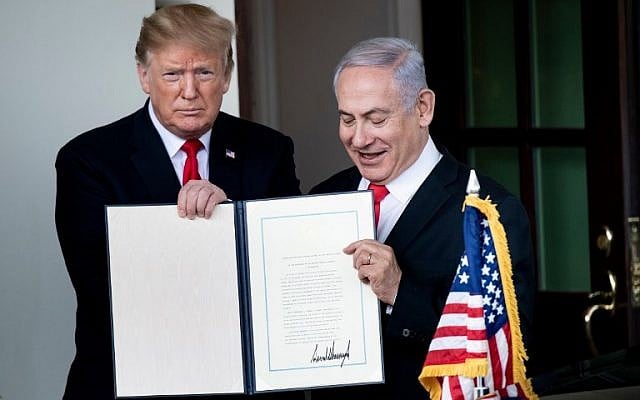
As president, Trump has made a number of policy moves seen as popular among Israel-focused voters, most recently by reversing US policy and recognizing Israeli sovereignty over the Golan Heights. Israel captured the strategic plateau from Syria in the 1967 Six Day War and in 1981 effectively annexed the area, in a move never recognized by the international community, which considers the Golan Heights to be occupied Syrian territory.
He also recognized Jerusalem as Israel’s capital and moved the US embassy there from Tel Aviv; eliminated hundreds of millions of dollars in aid to the Palestinians and closed their representative office in Washington; and has been largely silent in opposing Israeli settlement activity in the West Bank, in what the Palestinians see as the core of a future state.
Views from the press riser! #TrumpAtRJC pic.twitter.com/2aISWVKg1c
— RJC (@RJC) April 6, 2019
Trump withdrew from the landmark 2015 Iran nuclear deal, which Netanyahu had fiercely opposed, and re-imposed stringent new sanctions on the country that Israel regards as an existential threat. Trump is closely aligned with Netanyahu, who’s seeking to return power in Tuesday’s national election.
Trump also pulled the US out of several UN organizations, the UN Human Rights Council and UNESCO, citing anti-Israel bias in their agendas.
But Trump was slow to condemn white supremacists who marched violently in Charlottesville, Virginia, in 2017. The previous year, he circulated an image of a six-pointed star alongside a photo of Hillary Clinton, a pile of money and the words “most corrupt candidate ever.”
And he told the Republican Jewish Coalition in 2015 that he didn’t expect to earn their support because he wouldn’t take their money. “You want to control your politicians, that’s fine,” he said at the time. Ultimately, the group and many of its donors backed Trump.
According to AP Votecast, a survey of more than 115,000 midterm voters and 3,500 Jewish voters nationwide, voters who identified as Jewish broke for Democrats over Republicans by a wide margin, 72 percent to 26 percent, in 2016.
Over the past decade, Jewish voters have shown stability in their partisanship, according to data from Pew Research Center. Jewish voters identify with or lean toward the Democratic Party over the Republican Party by a roughly 2-1 ratio.







The Times of Israel Community.