

What is the biblical holiday of Purim, and why do Israelis link it to Khamenei’s death?
Joint Israel-US strikes on the Iranian regime are taking place just as Jews are set to mark a festival commemorating another war against a Persian official who sought their destruction
 Add ToI as a Preferred Source on Google
Rossella Tercatin is The Times of Israel's archaeology and religions reporter.

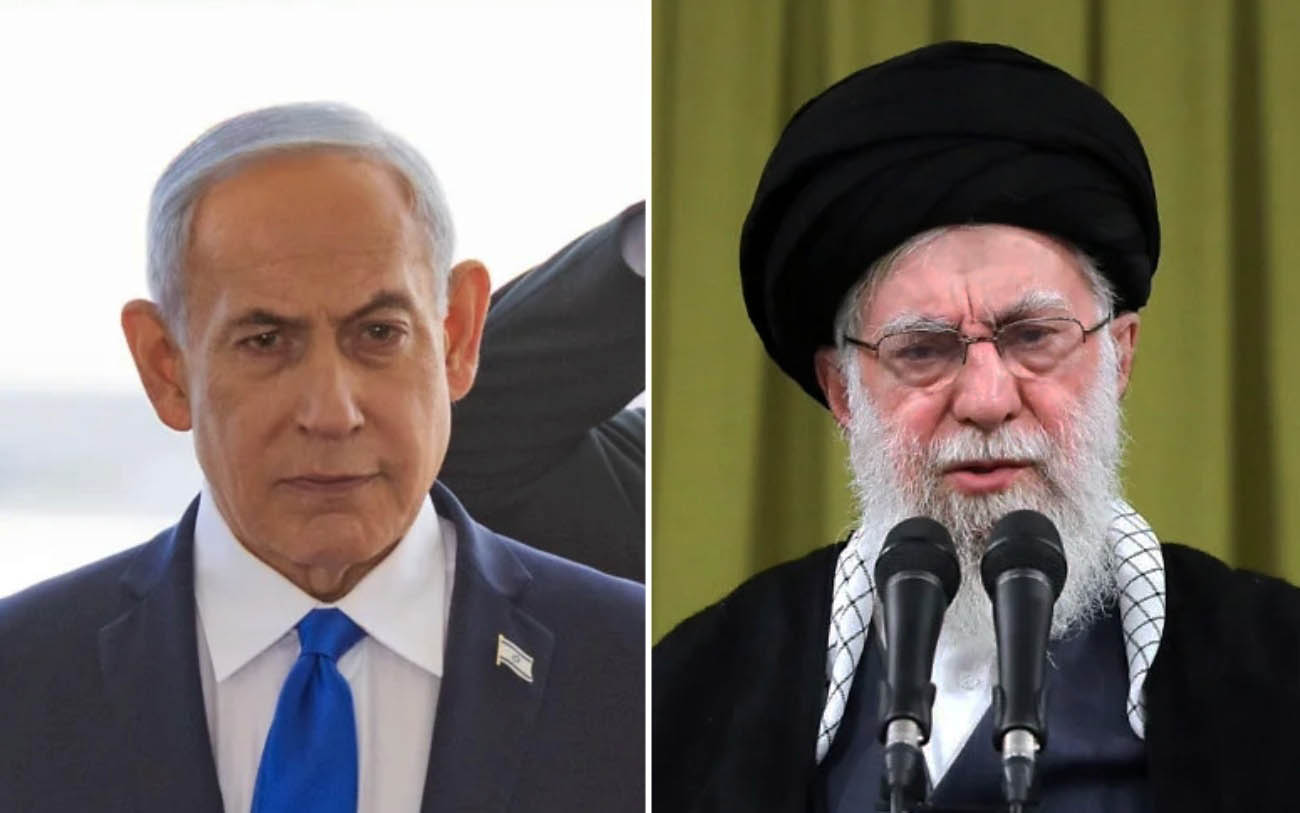
Saturday morning, just over an hour after Israel and the United States began airstrikes against the Iranian regime, Prime Minister Benjamin Netanyahu addressed Israel and the world in a video statement.
In his speech, Netanyahu noted that the confrontation with Ayatollah Ali Khamenei and his supporters was taking place as Jews prepared to mark the anniversary of another war fought against an official from ancient Persia.
“My brothers and sisters, in two days we will celebrate the holiday of Purim,” he said. “Two and a half thousand years ago, in ancient Persia, a tyrant rose against us with the very same goal: to destroy our people completely. But Mordechai the Jew and Queen Esther, through their courage and resourcefulness, saved our people. In those days of Purim, the lot fell, and the wicked Haman fell with it.”
“Today as well, on Purim, the lot has fallen, and the evil regime’s end will also come,” he added.
Netanyahu was not the only one who mentioned Purim in remarks tied to the latest conflict.
Avigdor Liberman, the head of the opposition party Yisrael Beytenu, drew a direct comparison between the biblical figure Haman and Iran’s supreme leader, Khamenei.
Chief Rabbis Kalman Ber and David Yosef also addressed the Israeli public in a letter recommending increased prayer and fasting for a favorable outcome in the war.
“We witness the steadfastness of the Air Force pilots, the IDF soldiers, and all other security personnel,” they wrote. “And just as we merited in the days of Purim to be saved after fasting and crying out [to God]… so too now it is incumbent upon the public to increase fasting and prayers.”
What is Purim?
Purim is the only rabbinically instituted festival whose story has its own volume in the biblical canon — the Book of Esther.
The story is set in Shushan, the capital of the Persian Empire, where many Jews lived after being taken into exile by the Babylonians, who destroyed Jerusalem and the First Temple in 586 BCE.
Most historians identify the Persian king Ahasuerus mentioned in the Bible as Xerxes I and place the story during his reign (485-465 BCE).
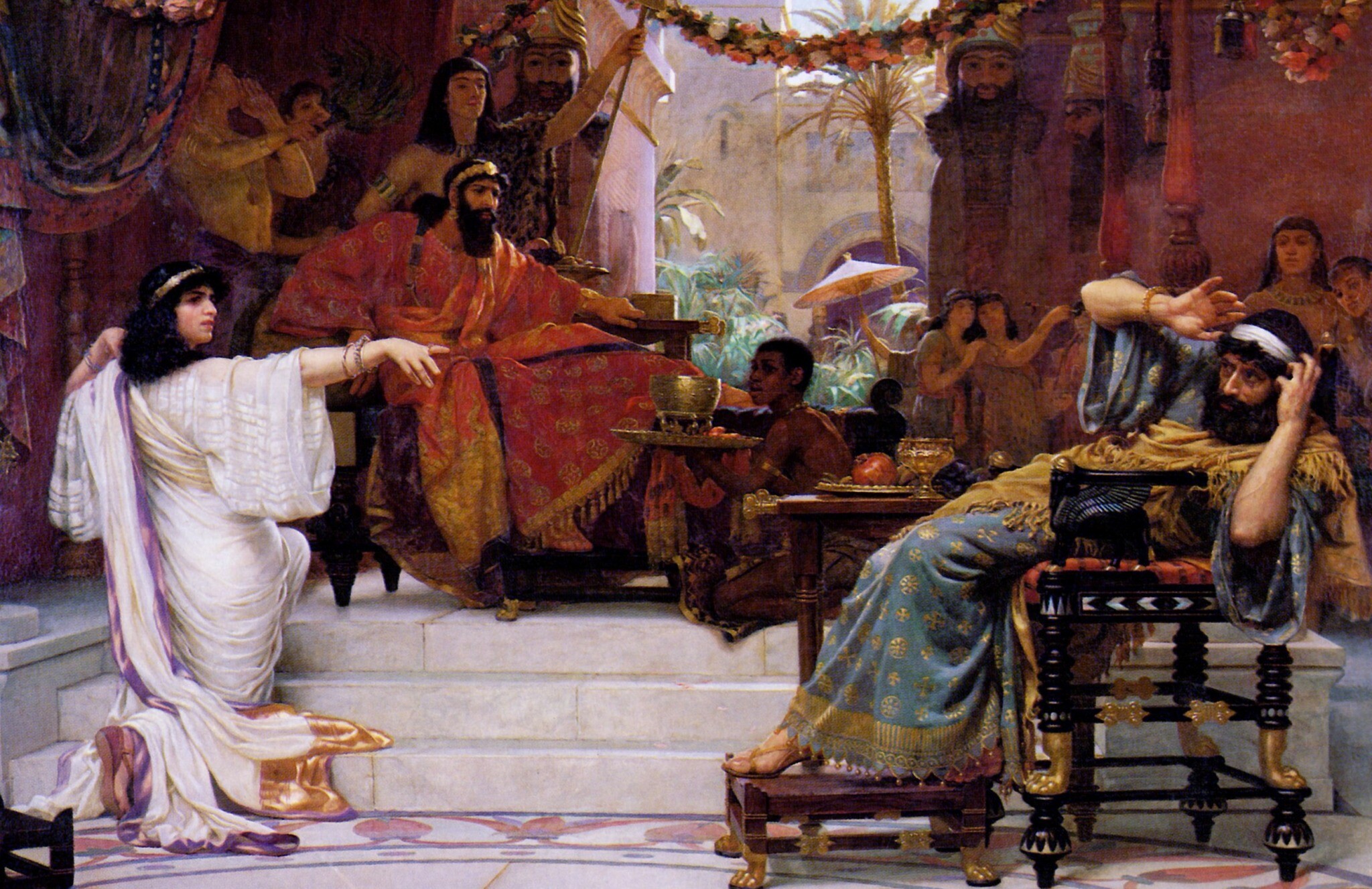
In the story, Esther, a young Jewish woman, is chosen by the king as his queen while hiding her Jewish identity. Meanwhile, one of Ahasuerus’s closest officials and confidants crosses paths with Esther’s uncle Mordechai. Enraged that Mordechai does not show him what he deems sufficient deference, Haman persuades the king to order the obliteration of the Jewish people across his empire.
His plot is exposed when Esther, risking her life, reveals her true identity to the king. Ahasuerus then allows the Jews to fight back against their enemies on the very day Haman hoped to massacre them, the 13th day of the Hebrew month of Adar, which this year falls on Monday. Granted the ability to stand up for themselves, the Jews rout their enemies in a resounding victory.
Purim is celebrated on the day following the battles, the 14th of Adar, except in Jerusalem and a handful of ancient “walled cities,” which mark the holiday a day later to remember how Jews in Shushan fought for an extra day before celebrating.
Since 1979, after the Islamic Revolution turned Iran into a theocratic regime that publicly declared its intention to destroy Israel, the story of Purim has often been used by Israeli leaders as a cautionary tale.

When on Saturday night, authorities confirmed Khamenei’s death in an Israeli strike earlier in the day, some doubled down on biblical comparisons, as the operation also took place on the Sabbath before Purim, which holds added importance in Jewish culture.
Remember not to forget archnemesis Amalek
The Sabbath before Purim is known as Shabbat Zachor (from the Hebrew word meaning “remember”). It is a day marked by an additional Torah reading of the verses that command the Jewish people not to forget the evil perpetrated against them by Amalek during their wandering in the desert:
“Remember what Amalek did to you on your journey, after you left Egypt — how, undeterred by fear of God, he surprised you on the march, when you were famished and weary, and cut down all the stragglers in your rear. Therefore… you shall blot out the memory of Amalek from under heaven. Do not forget!” (Deuteronomy 25:17-19, JPS).
In biblical, rabbinical, and modern Jewish literature and rhetoric, the figure of Amalek has come to embody the archenemy of the Jewish people in every generation. In the Book of Esther, Haman is described as the Agagite, or a descendant of King Agag, himself a descendant of Amalek and the king of the Amalekites at the time of the first Israelite king Saul, several hundred years before the story of Purim.
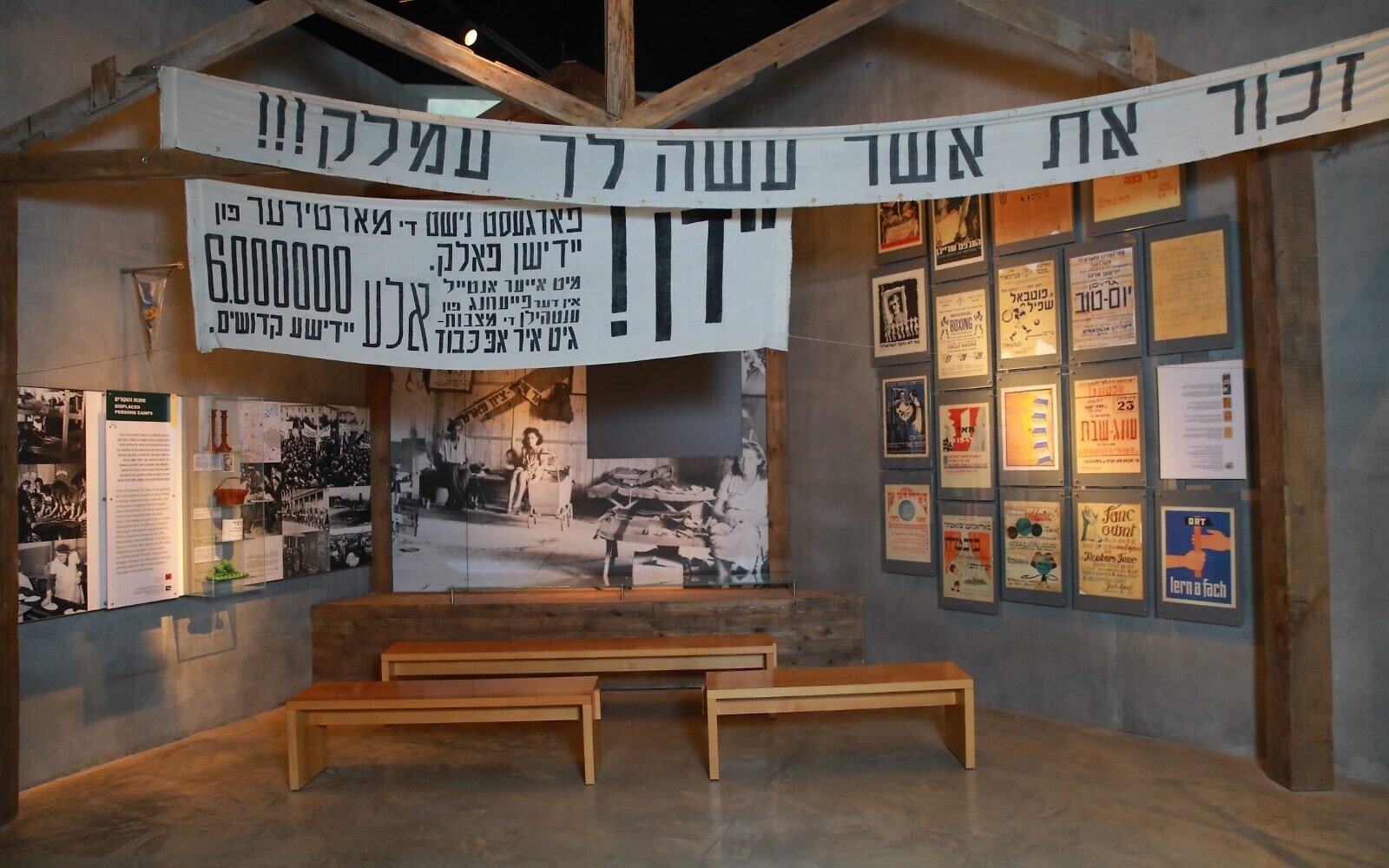
On Saturday night, the verses were tweeted by far-right National Security Minister Itamar Ben-Gvir in a warning against “anyone who tries to raise their head here in Israel,” who, he said, “will find themselves facing a determined, forceful, and uncompromising police force.”
Especially since the devastating October 7, 2023, Hamas invasion, Israeli leaders have often spoken of the country’s enemies in terms of Amalek.
Netanyahu himself quoted the biblical story, among other times, in the speech he gave as the emergency unity government, formed in the immediate aftermath of October 7, was sworn in on October 13, 2023.
“I have always said and reiterated every time there was a terrorist attack or a murder perpetrated by Hamas or one of the other [terrorist] organizations — I said this when the family was murdered in their car or a bus was blown up — this individual case teaches a general rule. If they could, they would murder all of us,” Netanyahu said.
“Today, against the enemy, with the ancient command ‘Remember what Amalek did to you’ ringing in our ears, today we are uniting forces in order to ensure the eternity of Israel,” he added.

A few months later, the comments were picked up by critics of Israel as proof that the country intended to commit genocide against the people of Gaza, due to the biblical commandment for the people of Israel to wipe out the nation of Amalek, including women and children. Netanyahu felt compelled to clarify that this was not what he intended, but rather that he wanted to emphasize the scope of the horrors perpetrated by Hamas on October 7.
A modern Purim?
In the case of the war in Iran, not only did Netanyahu refrain from mentioning Amalek, but he was also very clear in emphasizing that Israel does not consider the Iranian people an enemy, casting Israel as their ally in fighting against the regime.
“Our joint action will create the conditions for the brave Iranian people to take their destiny into their own hands,” Netanyahu said Saturday, referring to the Israeli-American attack.
“The time has come for all parts of the Iranian people — the Persians, the Kurds, the Azeris, the Baloch, and the Ahwazi — to cast off the yoke of tyranny and bring about a free and peace-seeking Iran,” he added.

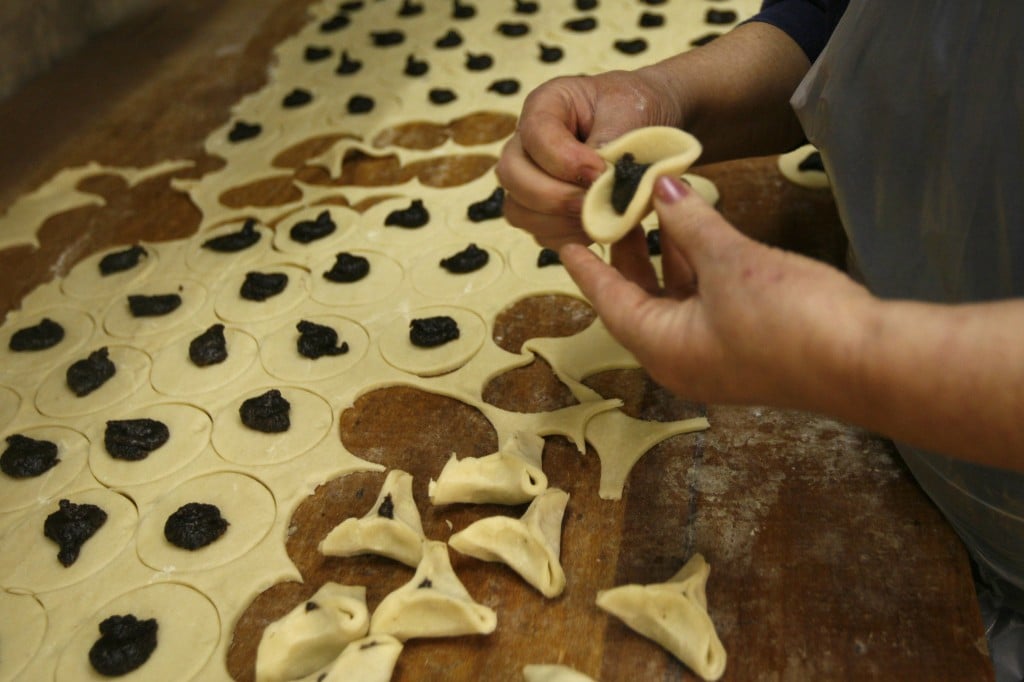
As the news about Khamenei’s death emerged that night, many Israelis celebrated, with pictures and footage on Israeli news outlets showing people dancing and singing, with others poking some fun at the new developments, for example suggesting baking “oznei Khamenei” — a spin on the traditional cookies baked for Purim, known as hamantaschen, or Haman’s pockets, in Yiddish, and oznei Haman, or Haman’s ears, in Hebrew.
Several Jewish groups abroad, such as the American Jewish Committee and the Conference of Presidents of Major American Jewish Organizations, also expressed their support for Khamenei’s elimination.
“Tomorrow, no kindergarten, no costumes, no [Purim] play at the nearby auditorium, and no parties in the upcoming days,” Daniela Fubini, a resident of the southern community of Kochav Michael, wrote on Facebook. “At the same time, one day we will be able to tell [my son] Matan that when he was little, we experienced a modern version of the Purim story and this era’s version of Haman died badly.”
“The villains in the end always lose,” she further wrote. “This villain might have possibly caused irreparable damage in Iran and in Israel, but in the end: bye-bye.”










The Times of Israel Community.