

Whatever became of the national interest?
Netanyahu and Mofaz really did have a rare opportunity to correct a historic inequality on conscription. Predictably, they blew it

 Add ToI as a Preferred Source on Google
David Horovitz is the founding editor of The Times of Israel. He is the author of "Still Life with Bombers" (2004) and "A Little Too Close to God" (2000), and co-author of "Shalom Friend: The Life and Legacy of Yitzhak Rabin" (1996). He previously edited The Jerusalem Post (2004-2011) and The Jerusalem Report (1998-2004).
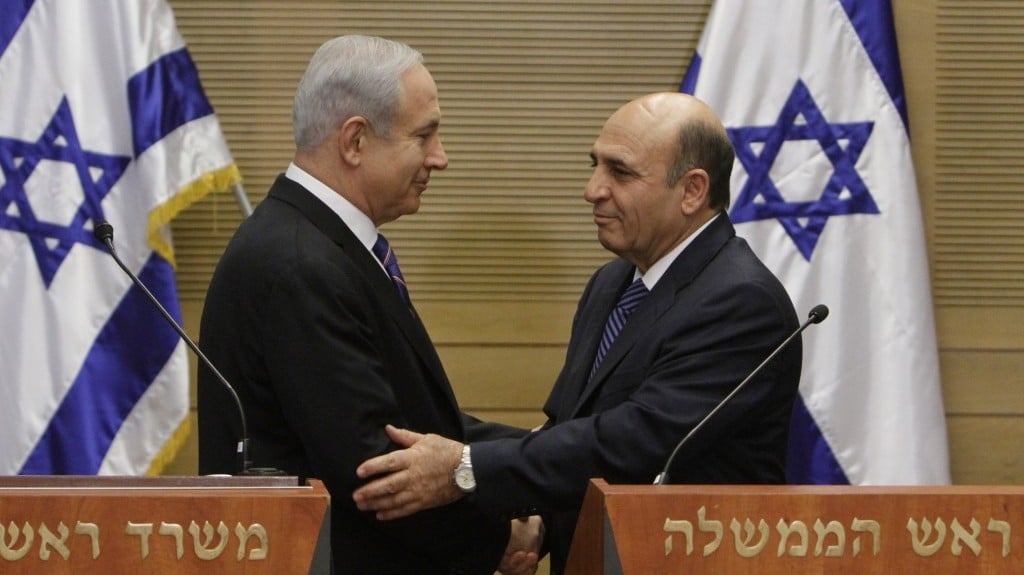
Ten weeks. That’s how long the “historic” partnership between Benjamin Netanyahu’s Likud and Shaul Mofaz’s Kadima held together. One of the biggest coalitions in Israeli political history has turned out to be the shortest-lived.
Only 70 days ago, they shook hands, even embraced, and talked up an alliance conceived for the good of the nation. Their coalition brought “hope for all of Israel,” said Netanyahu. Theirs was a partnership “that puts the national interest at center stage,” said Mofaz.
Together, they asserted, they and their 90-plus Knesset supporters were going to ensure that ultra-Orthodox and Arab Israelis carried their share of the national service burden, and that we finally got an accountable election system. Wonderful news, but Mofaz had still more. He had some creative ideas to get the Palestinians back to the negotiating table. And if that wasn’t enough, he would bring added expertise to the struggle to thwart Iran’s nuclear ambition.
It sounded too good to be true, and it was too good to be true. The allies are back in their opposing camps again — Mofaz accusing Netanyahu of “siding with the draft-dodgers,” and Netanyahu deriding Mofaz for bolting for narrow political reasons just as a “significant change” on conscripting the ultra-Orthodox was about to be finalized.
In the end, in the worst Israeli partisan political tradition, perceived self-interest prevailed over all the highfalutin rhetoric about the good of the state.
Mofaz, with the spectacular ill-timing that has become his hallmark, opted to abandon the coalition two full weeks before the deadline expired on legislating a replacement to the cancelled Tal Law on ultra-Orthodox service. He plainly felt Kadima was being humiliated by Netanyahu in the negotiations on universal conscription, and feared the impact on Kadima’s electoral prospects.
The sense of grievance was understandable; the prime minister did unilaterally dismantle the Kadima-led Plesner Committee that was drafting the new law two weeks ago. But Mofaz created Kadima’s political impotence within the coalition in the first place, by agreeing to a partnership with the Likud in which only he of Kadima’s leaders became a cabinet minister. That meant the largest party in the Knesset had no leverage over the prime minister. And now, by failing to wait out the conscription negotiations until the end of the month, he has shown his own bad faith, which will cost him dearly with the Israeli public come election day.
Netanyahu, in resisting some of Plesner’s recommendations — on the pace of ultra-Orthodox conscription, and the punishments for those who skip it — even after the Likud had approved them, made a straightforward political choice. Kadima will dwindle drastically in the next elections, perhaps disappear altogether, he reasoned. The ultra-Orthodox parties will not. There was a limit to the extent he was prepared to alienate them. And Mofaz sought to push him beyond it.
The whole episode may not do Netanyahu too much good either. But it did have the effect he sought of staving off elections, and yielded the added bonus of further weakening Kadima. If, improbably, he can yet get some kind of legislative proposal on more equitable conscription through the Knesset before his next meeting with the voters, he will have no great cause for regret.
Ironically underpinning the rapid rise and fall of the Likud-Kadima coalition is the fact that, just as Netanyahu and Mofaz claimed when unveiling their partnership on May 8, it really did represent a historic opportunity. It offered the leaders of the country’s two biggest parties a rare chance to correct an unfair and untenable inequality in Israeli society — to engineer a workable compromise that would require ultra-Orthodox and the Arab Israelis to share in the responsibility for this country’s well-being, and to give them a greater sense of stake and partnership in the Israeli national enterprise.
Foolishly, selfishly, and predictably, they blew it.








The Times of Israel Community.