

Will Israel refuse the Druze?
The question of whether Jerusalem should get involved to help the besieged community in Syria — and how — proves a real doozy
 Add ToI as a Preferred Source on Google
Joshua Davidovich is The Times of Israel's Deputy Editor
There are times when front page choices leave readers and newsstand passersby scratching their heads. Like Wednesday’s front page on the New York Post, for instance, or Israel’s own Yedioth Ahronoth on the same day.
While the country’s other newspapers are focused on a looming humanitarian crisis facing Syria’s Druze community and what Israel plans to do about it, or the swirling culture war as artists and politicians clash over state support for controversial works, Yedioth devotes nearly its whole front page to the US Food and Drug Administration’s decision to blacklist trans fats, illustrated with a picture of that most American of foods, cheese burekas.
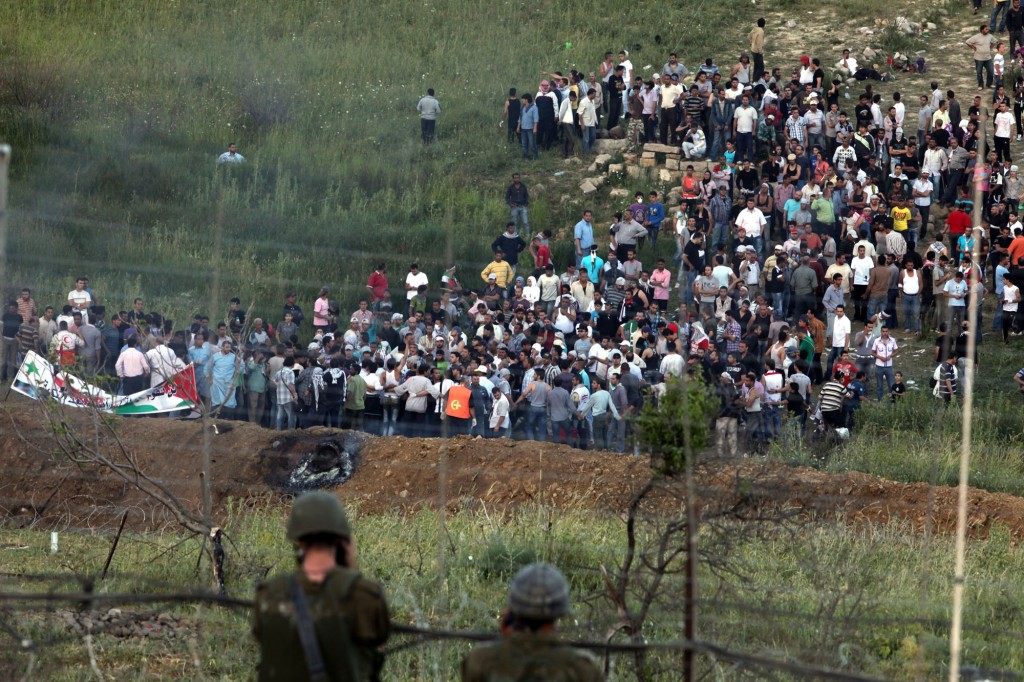
The FDA’s war on greasy Mediterranean food, though it receives prime real estate in Yedioth, pales next to the recent attention being given in the Israeli press to the civil war in Syria, where the advance of jihadist rebels on Druze areas of southern Syria and the heavy fighting on Israel’s doorstep on the Golan Heights have sparked fresh worries.
Israel Hayom’s ominous headline, “Civil war comes to the Hermon,” is accompanied by an equally ominous picture of large dark clouds – supposedly smoke from the battles — heading for the town of Majdal Shams, on the slopes of the mountain that straddles the border between Israel and Syria. The paper notes that battles within earshot of Israel are nothing new, but the new front of the Hermon “presents new strategic challenges, as well as the Druze dilemma.”
That dilemma, of whether Israel should let in Druze refugees should they stream to the border, or otherwise enter a conflict it has mostly stayed away from, has been the focus of much of the press’s attention on Syria in recent days.
Commentator Dan Margalit doesn’t offer any answers, but does seem to argue that the issue should be seen not through humanitarian lenses but rather those of political expediency, in the hopes of placating Israel’s own Syrian Druze minority living on the Golan.
“If the Druze refugees do indeed come, will we keep them from entering an enclave created for them in the Israeli Golan Heights? But who says Israel is ready for that? However, if they don’t let them in – how bad will tensions get with the Druze community in Israel?” he asks.
It seems though a decision has already been made, with Haaretz reporting that IDF chief Gadi Eisenkot hinted that he won’t let the Syrian Druze be slaughtered, though the army is preparing to stop an influx of Syrian refugees from making it into Israel, and at the very most allow a small number into an encampment on the border.
“The IDF plans to form a front line along the border while the Israel Police deal with any refugees that manage to slip through the border,” the paper reports, adding that officials have reinforced the fence since a 2011 incident which saw several people cross the fence into Israel. “In the wake of that incident, the Israel Police is preparing to take action in Israeli Druze villages to prevent any refugees from taking shelter among family members on the Israeli side of the border.”
Yedioth reports that Israel may also be exploring other options to help the Druze community, including leaning on the US to make a humanitarian effort on their behalf. In addition, they may try dealing with the rebels threatening the Druze, by offering butter for them to silence their guns.
“They can take advantage of the unofficial ties – forged in the last few years, if foreign reports are correct – with rebels in Syria and request in exchange for humanitarian aid that Israeli reportedly provides that they don’t harm the Golan Druze, as well as pressure the US to to do the same and provide direct humanitarian aid,” the paper writes, seemingly missing the fact that the rebels threatening the Druze are Islamists that Israel is not linked up with. “If there is no option and the situation devolves into a humanitarian disaster, it will be impossible to discount the option of Jerusalem deciding on pinpoint airstrikes to end the massacre. And then to immediately stop. The dilemma is clear: They have to help the refugees, but they can’t get caught in the Syrian mud.”
It’s too late to offer the same advice to Israel’s cultural community, which is caught in the muck of trying to thwart Likud Minister Miri Regev’s use of the bully pulpit without coming across like a bunch of cud-gobbling brutes.
After the arts community was forced to step back because some attacks on Regev and her ilk went too far, papers indicate that she may be making efforts to reach some sort of détente with artists in her sniper sights.
Yedioth reports that Regev and the Jerusalem Cinametheque came to a deal to not screen a controversial biopic on Yitzhak Rabin assassin Yigal Amir at an upcoming film festival, though the movie will still be judged for the competition. And Haaretz says that Culture Ministry officials met with the management of the Al-Midan theater, which is under fire for a play based on the life of a terrorist who killed an Israeli soldier, reporting that the meeting was described as “good.”
Despite that, Regev ordered funding for the theater cut, after management could not say where some of its other money came from.
“Former terrorists are sitting there and speaking via this play,” Yedioth reports Regev told a group of terror victims. “We found a hole of a million shekels there. I don’t know where the money is going. There is a limit. There is here a connection between terrorists and the theater and we need to check it out.”
Haaretz isn’t about to let Regev run amok unimpeded, though, comparing her moves to Soviet-style censorship but also taking aim at those who would make peace with her.
“The questions about [al-Midan’s] ‘sources of financing’ are nothing more than a crude hint at the possibility that the theater is taking money from illegitimate sources, perhaps even enemies of Israel,” the broadsheet’s lead editorial reads. “Or in other words, this is treason against the state. As for the claim that Al-Midan is a political theater, it’s ridiculous in the best case, and mainly demonstrates the Stalinist spirit that has taken over the Culture Ministry.”






The Times of Israel Community.