

N, Na, Nay to Uman: What the press is saying on August 26
Ukraine’s president gives Netanyahu a way to avert virus risk posed by mass pilgrimage to rabbi’s gravesite, which premier declines so as not to upset Haredi coalition partners
 Add ToI as a Preferred Source on Google
Jacob Magid is The Times of Israel's US bureau chief
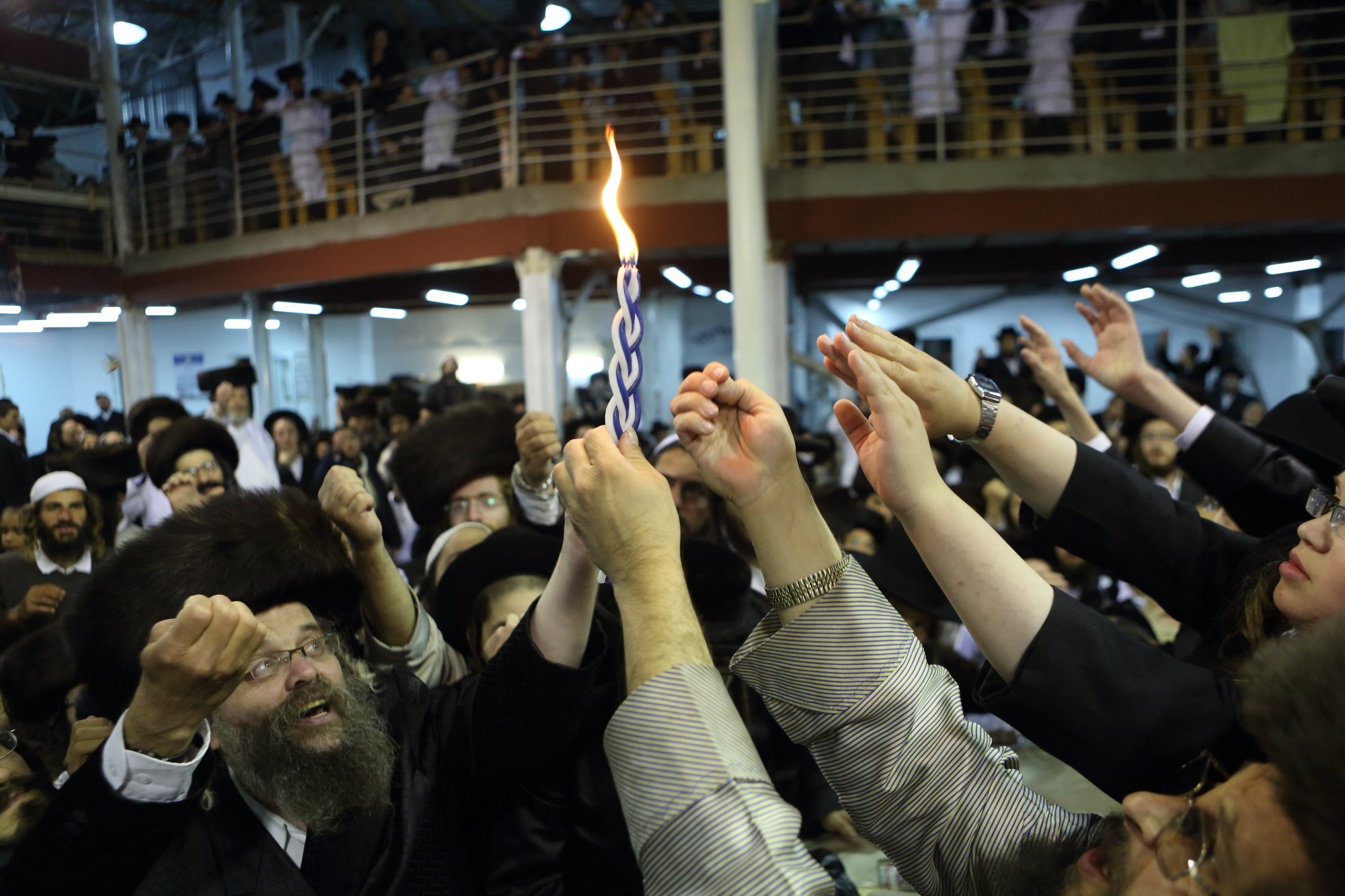
1. No Pilgrims’ Progress: With the threat of elections pushed off for another 120 days, what appeared to be a relatively marginal issue led most of the evening broadcasts, pushed to the front thanks to the political clout of those raising it.
- At issue is the annual Rosh Hashanah pilgrimage of tens of thousands of Haredi Jews to the gravesite of Rabbi Nachman of Bratslav in Uman. Host country Ukraine’s President Volodymyr Zelensky announces that Kyiv will “significantly limit” the gathering due to what his office says was a request from Prime Minister Benjamin Netanyahu’s office. But almost immediately, the premier’s spokeswoman issues a statement to several major outlets clarifying that he had made no such plea.
- “Why run away from what could be a significant victory in the fight against the coronavirus pandemic?” asks Channel 12’s Yair Cherki, answering that Netanyahu has been facing immense pressure from the leaders of the Haredi Shas and United Torah Judaism parties to allow the flights to Uman to take off without a hitch, no matter the risk they pose to the effort to curb the pandemic.
- The Kan public broadcaster reports that with several thousand Israelis already in the country, Ukraine isn’t waiting until a few days before the holiday and has begun barring Haredi tourists at the border. Twelve passengers who were “unable to prove the purpose for their visit” were ordered to get back on the next flight to Israel.
- Chief Rabbi of Kiev Moshe Asman tells the network’s Avika Weiss that either only several thousand tourists will be allowed in for the pilgrimage in the end or there will simply be a broad ban on all entry ahead of the Rosh Hashanah holiday. Asman claims the mayor of Uman has been using the issue to advance his political brand, coming out aggressively against allowing any ultra-Orthodox visitors into his town.
- In Haaretz, Haredi columnist Yisrael Cohen goes after Israel’s coronavirus czar Ronni Gamzu for penning a public letter to Zelensky, pleading for him not to allow this year’s Uman pilgrimage to go forward. Cohen argues that Gamzu had no right to make such an official request that is typically reserved for heads of state. Moreover, he argues that Gamzu has not shown similar concern regarding the throngs of anti-Netanyahu protesters that have packed the streets outside the premier’s official Jerusalem residents on a more than weekly basis. “For us, the sanctity of Rosh Hashanah prayer on the tomb of the righteous is no less important than the ‘sacred’ democratic right to demonstrate and protest,” Cohen writes.
2. Dial Hezbollah for info: Israelis in several towns along the Lebanon border were ordered to remain in their homes late last night after the IDF warned that an ongoing security incident was taking place.
- Channel 13 reports that the “security incident” was an infiltration attempt, but provides no additional information. This is likely because the army managed to go the entire night without updating the public as to what exactly was happening. Some of the communities were told that they could return to their routines, but no explanation was given.
- Media outlets sufficed with pictures of flares the IDF fired into the sky around the northern Galilee as soldiers searched the area to ensure no one had breached the border after troops reportedly heard gunshots at an outpost along the frontier.
https://twitter.com/LunaSafwan/status/1298360730371186691?s=20
- Frustrated by the lack of transparency after hours of radio silence from the IDF, The Times of Israel military correspondent Judah Ari Gross tweets, “Will Israelis yet again have to turn to Hezbollah to find out what’s going on?”
- “Thousands of hikers in the Galilee are going through a hellish night. Residents of the border communities do not know what is happening. I just don’t understand what the army is doing. Don’t you think it would be appropriate to update the citizens of Israel as to what is happening?” writes Channel 12’s Nir Dvori, who doesn’t appear used to being kept out of the loop on such matters.
- It took over seven hours for the IDF to issue a statement saying its aircraft had hit several Hezbollah observation posts along Israel’s northern border after shots were fired from Lebanon toward its soldiers.
3. Trouble in Gaza City: Just as one might have thought the pressure cooker that is the Gaza Strip would be able to cool down to a simmer with the entrance of the Qatari envoy and his $30 million in handouts, the coastal enclave is forced to deal with its first two cases of community coronavirus spread.
- The two women confirmed to have the virus are in addition to the four identified a day earlier. “If there are already infections turning up without a clear source, that could indicate large numbers of cases which have so far gone under the radar,” writes ToI’s Aaron Boxerman. “Question which still needs to be answered: how long were the four diagnosed with coronavirus yesterday wandering around the Strip before they were identified and isolated? The future of the battle against COVID-19 in Gaza may depend on it.”
- “For years, the situation has been going from bad to worse,” Mkhaimar Abusada, a political scientist at Al Azhar University in Gaza City tells The New York Times. “If we need to shut down for several weeks, I’m worried we could be heading for a disaster.”
- “When there’s a war, I usually know where it’s safe to go,” says Sobhi Khazendar, 27. “The virus is different. It can be anywhere and everywhere. I have no idea how I can avoid it.”
- While Hamas has placed the coastal enclave under a 48-hour lockdown, the Associated Press reports that hundreds gathered for the funeral procession of four Palestinian Islamic Jihad fighters who were killed in an apparent work accident.
- Ynet’s Elior Levy reports that while Qatari envoy Mohammad al-Emadi has entered the Strip with the millions in handouts for Gaza’s needy, he will not be distributing it immediately until he is able to get assurances from Hamas that the group will direct its fighters to cease lofting dozens of arson balloons into Israel on a daily basis.
- Footage of al-Emadi entering Gaza through the Erez crossing is posted on social media showing a completely pitch-black Strip. The coastal enclave is getting only three to four hours of electricity per day after becoming used to more than three times that amount. The electricity shortages are a result of Israel stopping fuel imports in response to the violence, which led a Gaza power plant to shut down.
VIDEO showing the arrival of Qatari envoy with the aid money in Gaza. pic.twitter.com/KEpq9VtK4s
— FJ (@Natsecjeff) August 25, 2020
4. He only understands force: With Netanyahu agreeing to compromise legislation that saw the deadline for passing the annual budget pushed off for another 120 days, one might have assumed that the political infighting taking place inside the coalition would have subsided.
- Instead, Ynet’s Amichai Attali argues that the delay will simply give Likud and Blue and White the opportunity to begin the mud-slinging before the campaign could officially kick off in 120 days when the parties again fail to reach an agreement to avoid elections.
- “An emergency government to address the economy and the coronavirus — this was the mandate for which all members of the government broke their promises to voters by teaming up with one another. The ungovernable nightmare will now last until December, when in fact elections [now] would have forced politicians to remove their masks [and show the public who they really are],” Attali writes.
- Channel 12’s Daphna Liel reports that despite the temporary ceasefire that the compromise legislation was supposed to have granted the parties, Netanyahu’s staff once again removed any mention of Blue and White chairman Benny Gantz from a press release regarding government grants for Israelis that the defense minister had been involved in ensuring. “Let’s just say that Blue and White didn’t fall off their chairs in surprise at the conduct, but it definitely didn’t contribute to clearing the air between the sides,” she says.
- But the bad blood isn’t just between Likud and Blue and White, but within Likud as well. Kan’s Michael Shemesh reports that Finance Minister Israel Katz requested that some of Transportation Minister Miri Regev’s powers be transferred to his office and was met with fervent opposition. “She does not know me. She shouldn’t play such games with me,” Shemesh quotes Katz as having said behind closed doors.
- Haaretz’s editorial asserts that what Gantz can learn from the budget standoff with Netanyahu is that the Likud leader “only understands force” and that while it took him until the very last minute, the prime minister effectively walked back his demand for a one-year budget — which would have been a violation of the coalition deal — by agreeing to the compromise legislation.
- “In the months leading up to the next crisis, Gantz is better off sticking to this approach. No more futile dreams of cooperation, joining hands and healthy working relationships, but rather coming to terms with Netanyahu being a bad coalition partner, who needs to be closely watched. The last few days have clearly shown that Netanyahu depends on Gantz no less than Gantz depends on Netanyahu,” Haaretz writes.
5. Nonstop peace-making: US officials announce that the first commercial flight between Israel and the United Arab Emirates is scheduled for next week, carrying American and Israeli delegations to Abu Dhabi after the two countries agreed to normalize relations.
- In CNN, global affairs analyst Aaron David Miller delves into what the Trump administration is up to with its latest Middle East policy pushes. “The objective was not to enlist the Arab states to leverage Israel into making concessions to the Palestinians. Instead, it was designed to demonstrate that the Arab world would leave the latter behind if they didn’t agree to make concessions and sign up to more reasonable terms with Israel.”
- “The big prize is Saudi Arabia. If Riyadh, as custodian of the holy sites of Mecca and Medina, lends its hardline Islamic legitimacy and authority to normalizing relations with Israel, the tactical shift underway might well become strategic, leading to a transformation in Arab attitudes toward Israel, breaking apart the Arab consensus in support of Palestinians and freeing each Arab state to decide on its own what to do about relations with Israel,” he writes.
- US Secretary of State Mike Pompeo used his visit to the region, which was scheduled to promote further normalization agreements between Israel and its Arab neighbors, to tape a speech for the Republican National Convention from the roof of the King David Hotel in Jerusalem.
- “Casting aside his own advice to American diplomats and bulldozing a long tradition of secretary of state non-partisanship, Mike Pompeo plunged into the heart of the US 2020 presidential race Tuesday with a speech from Jerusalem supporting Donald Trump’s reelection,” AP’s Matthew Lee writes.
- “In an apparent nod to concerns about the appearance, which congressional Democrats allege is in violation of the Hatch Act prohibiting executive branch employees from partisan activity, Pompeo did not attack Trump’s opponent, former Vice President Joe Biden, by name or even mention the Democratic party. He limited his remarks to a defense of Trump and the policies of the administration — something all secretaries of state do, albeit not at their party conventions,” he adds.








The Times of Israel Community.