

DC synagogue does double duty as ‘Shutdown Central’
Furloughed federal employees find community, political puns and an endless ‘The West Wing’ loop at downtown Washington shul
 Add ToI as a Preferred Source on Google
Rebecca Shimoni Stoil is the Times of Israel's Washington correspondent.
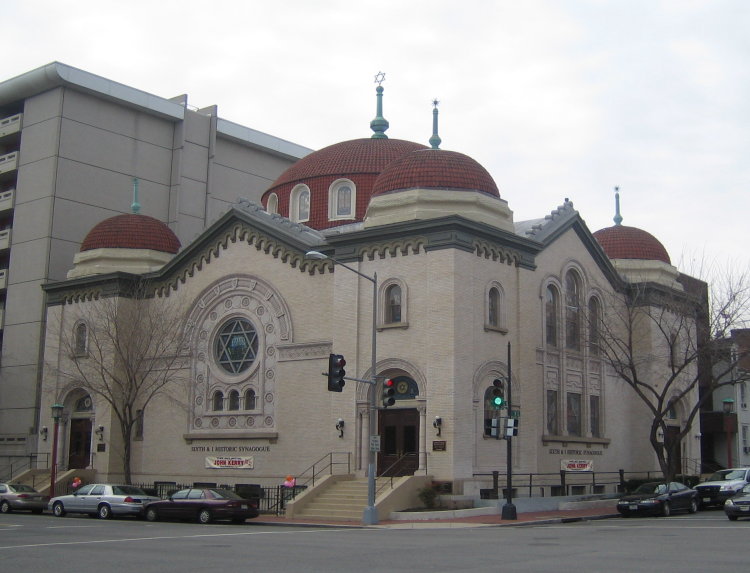
WASHINGTON — The fourth floor of Washington, DC’s historic Sixth and I Synagogue hums with quiet conversation, with the clacking of knitting needles, the pock-pock of ping-pong rivalries, and behind it all, the dulcet tones of The West Wing’s Rob Lowe, Martin Sheen and Allison Janney.
It is the middle of the business day, and a group of mostly young professionals are slouched in overstuffed sofas facing the giant television screen. Occasionally, they snack on tangerines labeled as John Boehner, Scott Brown-ie bites and Cracker Jack Lews. The National Zoo – which sits miles to the northwest with its gates closed – is symbolized by a giant tub of animal crackers.
Nobody wants to be here.
“I’d much rather be doing my job,” shrugs one furloughed federal employee with a wry smile.
This is the Sixth and I Synagogue’s Shutdown Central – an air-conditioned, pun-filled atmosphere designed as a safe haven for furloughed federal workers. During business as usual, the restored synagogue hosts Sabbath services, concerts and Jewish programming. But on Monday, hours before the government shut down, Executive Director Esther Safran Foer suggested that the building, largely unused during daytime hours, could be a useful resource during a shutdown.
“A lot of people who participate in our services and programs are federal employees. They may not be essential to the government but they are essential to us,” said Hannah Orenstein, the synagogue’s communications director.
“People are incredibly grateful – our director was pure heart when she came up with this. It is an incredibly frustrating time. You can’t work and you can’t go anywhere and you’re not really sure what to do with your time,” she explained. “Here, we’re trying to build a sense of community. That way, if the shutdown drags on, something positive could be made out of very negative and uncertain times for our country.”
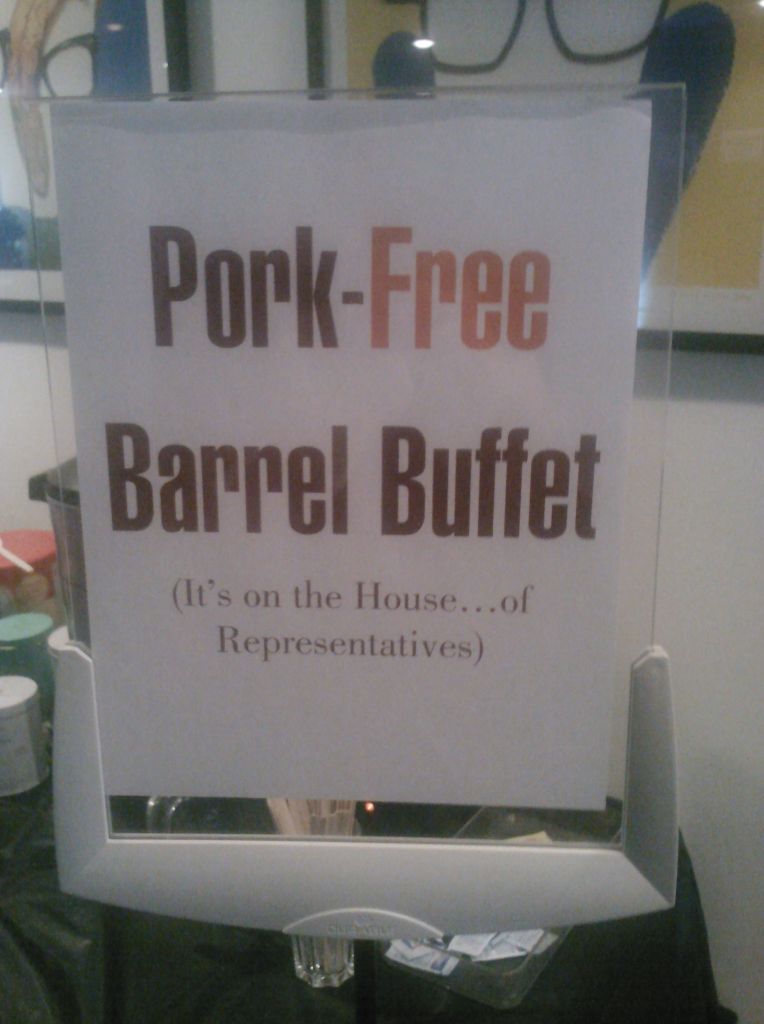
The political puns posted all around the room (“pork-free barrel buffet – it’s on the House…of Representatives” reads a sign by the snack bar) are part of a Sixth and I tradition, Orenstein admits.
Back in the room, two young women click their knitting needles as they talk shop – or lack thereof.
“Most of us went into public service because we wanted to help people. We’re lawyers and other professionals – we could have gotten higher paying jobs in the public sector,” one person on the sofa explains. The federal employees are reticent about being quoted on record, or even being filmed from behind, and so most spoke about the shutdown on the condition of anonymity.
The loop of The West Wing has stopped.
“Can we just skip to season five, episode eight?” asks one knitter.
“It’s the shutdown episode,” explains a person sitting next to her. “I mean, we don’t have to work chronologically, do we?”
Conversation switches to the impact of the shutdown.

“My dry cleaner has no business. When people work, they wear suits,” one out-of-service fed said. The other furloughees began to list all of the service-sector employees whose income was suddenly curtailed.
Jennifer Rhorer is one furloughed federal employee who is happy to go on the record. She is passionate about her work as a statistician for the Department of Agriculture, and says that she is one of the lucky ones who can make it through a relatively protracted shutdown.
Rhorer says that she is pessimistic that Congress and the White House will reach an agreement any time soon.
“When the government almost shut down in spring 2011, it was different. The Congresspeople were talking. This time there was nothing, no closed-door meetings, and there is no room for compromise.”
Rhorer’s parents are Catholics, and her father is a longtime Republican voter. He has taken to calling up his representative, who is one of the “Kamikazes” who support maintaining the shutdown to quash Obamacare, on a daily basis. Rhorer’s family are spread out in core Republican states, and she says that they are becoming aware of the human costs of government shutdown.
Rhorer is worried about her data sets. There is no way, she says, to recreate the information that should have been gathered during the shutdown.
“I love my job and I have a lot of pride in the work I do,” she says when asked about how the label “non-essential employee” sits with her obvious dedication to her work. “I completely understand why they’d say that, but I have a strong work ethic and I am proud of what I do. Mostly, I am really happy for the general public to not have any idea how much I do.”
The furloughed statistician sits and embroiders for hours. It is her secondary hobby; her first choice is her volunteer work at the National Zoo. But even her time-demanding volunteer commitment has fallen victim to the shutdown.
On the sofas at the synagogue, the furloughed workers are as fearful as they are frustrated.
“I’m worried that if this keeps going, people might think that they’re doing okay without us,” one admits. “And they will think it justifies reducing the federal government.”
A second fears the uncertainty of the time frame, and a third is concerned about a loss of benefits that may never be repaid. All have stories of co-workers who are worse off – who were caught mid-relocation, or weeks before anticipated retirement, or must pay their children’s preschool while uncertain as to when the next paycheck will come.
According to Orenstein, what was initially designed as a free coffee spot for penny-wise furloughees has turned into more of a support group. It has also brought new interest to the synagogue.
“We definitely saw new faces the first day – people who had never been here before and were not regulars,” she says. “It is always exciting to see that – we have a pretty strong e-mail list but this has gone beyond any list. We have hosted a number of events and we have gotten a lot of response for them, but we have never done anything that has gotten such a response internationally.”
The synagogue says that it is expecting an increased turnout if the shutdown continues. “The shutdown is felt in the way that a natural disaster is felt in other places. We’re glad to be part of that shared experience,” explains Orenstein.
Sixth and I is the first community institution to open a “shutdown central”, but there are other opportunities for furloughed feds.
Out-of-work federal employees can stretch their food budget while stuck at home. A number of well-known DC eateries are offering free sandwiches for the duration – with the presentation of a government ID. Alexandria’s already politically tinged Pork Barrel BBQ has added a catch to its free meal deal – every government worker is welcomed except members of Congress. Cupcakes, empanadas, burgers and gourmet chocolate all can be found at free or discounted rates.
The bars have been – possibly predictably – enjoying unusually high weekday volumes. One downtown establishment will offer government employees a free screwdriver starting at noon, and each ensuing pick-me-up is priced at a furlough-friendly rate. A second will give federal workers free cups of coffee – but Congresspeople will pay double to compensate.
Federal employees can go to free knitting classes in Alexandria, Virginia or a free movie in Greenbelt, Maryland. And they can shop, provided they believe that their reserves will hold out until the end of the shutdown. Downtown and suburban stores reported higher-than-usual traffic – but not necessarily more purchases.
On Friday afternoon, with the Sabbath a few hours away, the Sixth and I cohort start leaving, even as a ping-pong game re-starts. Democrat and Republican leaders’ faces adorn the red and blue-coded paddles. Nancy Pelosi’s face is frozen in a grimace as it smacks the white ball.
“Hope I don’t see you Monday,” one calls out to the room before leaving. With knowing smiles, the other federal workers agree, but have already resigned themselves to a few more days at ‘Shutdown Central’.









The Times of Israel Community.