

Funny, you don’t sound American
Tel Aviv’s Standup Factory lets Hebrew-speaking comedians up their game by trying out their routines in English
 Add ToI as a Preferred Source on Google
Jessica Steinberg, The Times of Israel's culture and lifestyles editor, covers the Sabra scene from south to north and back to the center
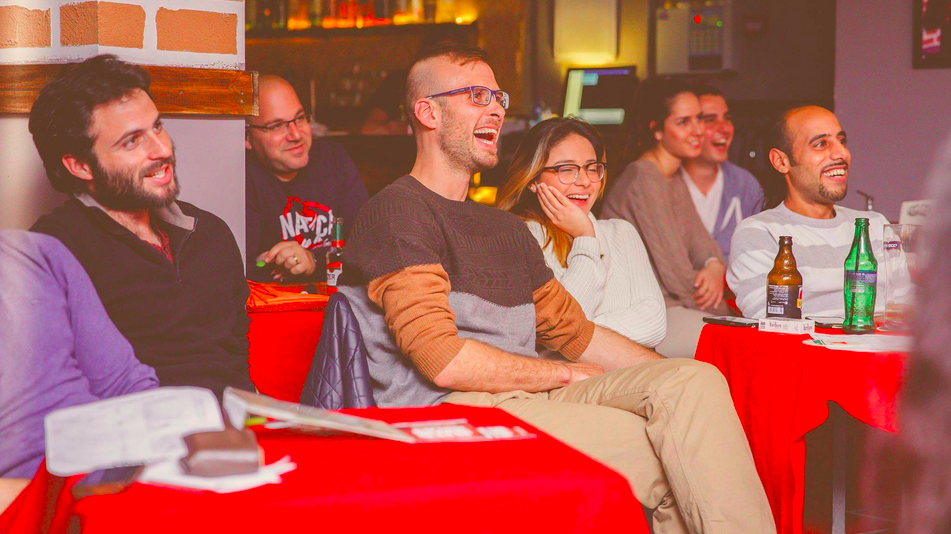
It’s not easy being a stand-up comic, or standupist, as they’re known in Hebrew. That nail-biting worry about whether a particular punchline will sail, or fall flat. Will the audience play along, or sit in silence? Now try doing it in a different language.
Each week, a bunch of Hebrew-speaking comedians try to make their audiences laugh in English at the Standup Factory on south Tel Aviv. Opened by comedian Erez Birenboim last September, the venue is meant to be the answer to the lack of real comedy clubs in Israel, a club “that feels like home,” said Birenboim. “It’s a stand-up club of standupists.”
Birenboim’s fellow comics helped him renovate the place, putting in the floors, sound system, even the bathrooms. Now the club has 10 shows each week, with several English-language acts throughout the year. That was a must for Birenboim.
When Birenboim began doing stand-up work about 10 years ago, he watched American comedians online “obsessively,” he said.
“We would sit around, crying from laughter,” he said. “To be able to do stand-up in English? That’s the goal. In Hebrew, you know, comedy is still in diapers. It’s a small group of comedians around here.”
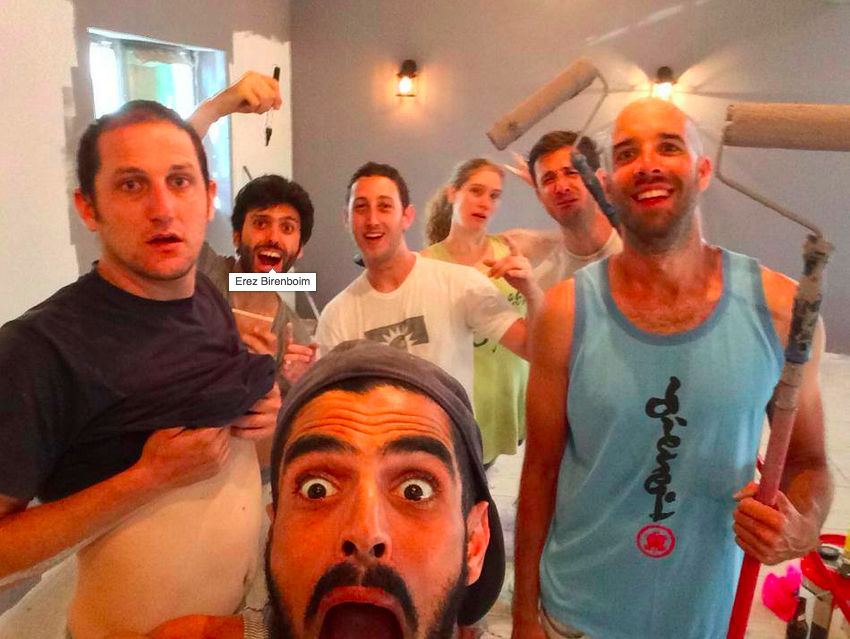
At the Standup Factory, Hebrew-speaking comics work on their routines in English to local English speakers.
“They’re our guinea pigs,” joked Yohay Sponder, a Standup Factory regular.
As Birenboim sees it, American stand-up is the standard, but Israeli audiences are tough customers.
“Israelis don’t have patience to wait for the punchline,” he said. “If it’s not funny, they’ll say so. If the punchline doesn’t come they start talking. You have to be on every minute.”
Of course, this is more of a challenge when attempting to joke in a second language.
“It’s really hard,” said Sponder, who has been doing stand-up for the last decade. “The goal is to get to the comfort zone in another language.”
When he does his routine in English, it adds a certain pressure, he said. The attempt to become fluent — and funny — in another language makes him feel like a beginner again.
“There’s extreme excitement when you’re onstage even for five minutes,” he said. “It’s all new again. You’re not in your comfort zone and you have to pay attention to everything you say, the timing and the comedy rules, and you still have to be understandable.”
Sponder, dressed in his uniform of jeans and a black T-shirt, had a small cheat sheet in his hand for his 15 minutes onstage on a recent Wednesday night at the Standup Factory. He riffed on his usual subjects: global politics, couples and religion, with a few well-placed jokes about his English.
When performing abroad, Sponder usually gets his first laugh at the expense of his Hebrew accent, to which he often responds with a “Fuck you,” then letting the audience know he learned his English from watching Dora the Explorer and porn.
If the audience doesn’t react, he’s not always sure if it’s because he’s not funny or if it’s due to his use of the language, said Sponder.
“Americans can get self-conscious because of my language,” he said.
But it doesn’t stop him from using it as a prop.
There’s the joke about celebrating his birthday in the States, where they kept on yelling, “Go Yochai,” to which he responds, “Why do you want me to go? It’s my fucking birthday.”
And then there’s the roster of quips about couples and sex, how women never want sex as much as men.
“When I went to the States, I translated 35 minutes of couplehood material,” he said. “It worked really well, because apparently girls abroad behave like here. They’re naggers, too. And they fall asleep in front of the TV, just like here.”
Bada boom!
But Sponder doesn’t worry about his grammatical mistakes, as long as the comedy is funny and the audience understands the joke.
“People say American humor is different, but I’m focusing on who I am,” he said. “It’s self-humor, and the things I’ve been through.”
That’s a theme for most comics, and the Israeli comics are no exception.
Yossi Tarablus, who often jokes about his own life, which includes his wife and two young children, loves the simplicity of stage comedy.
“I bring my life to the stage,” he said. “They’re my actual stories, the things that happen on the street, the things that piss me off.”
That can include the cost of diapers, the challenges of a second child or any attempts at intimacy as a couple with young kids.
In English, however, there’s the extra layer of comedy courtesy of being culturally inadequate, said Tarablus.
“You can get away with more culturally incorrect stuff,” he said. “I call it the Borat factor,” referring to the Sacha Baron Cohen comedy about the American misadventures of a Kazakh reporter who always ends up offending someone.
Some of the Hebrew-speaking Israeli comics use Hebrew as another layer of comedy, throwing in a word or term in Hebrew, sometimes even an entire sentence. It may be their crutch, but it also becomes an opportunity to laugh, as they play the hapless foreigner.
That’s a typical twist with Shahar Hason, one of the country’s best-known comics, who’s as comfortable live on TV as he is on the small, square stage of the Standup Factory doing his routine in English.
And when he can’t make himself understood, he’ll say it in Hebrew, with a grin, which makes everyone laugh even harder.
https://youtu.be/PGBAkyXANf8
“It can be hard to find the right word, but you can’t get hung up on that,” said Sponder.
Sponder knows he needs to improve his spoken English, and get funnier in his second language. But for now, he makes his sometimes broken English work for him. “I like you American people,” he told an audience in Ventura, California. They laughed.
And after a riff about how much women like to talk, he says, “You like to do sex, guys?”
Despite the bad grammar, they know exactly what he means.
“You have to go with whatever happens onstage,” he said. “If most of the people in the audience are Israeli, I won’t use American slang, and if a punchline doesn’t work, it could be I’ll need to repeat the punchline in Hebrew.”
At the Standup Factory, the English-speaking audience is also the main audience for native English speakers like Benji Lovitt and Molly Livingstone who shared the stage with Sponder, Tarablus and Hason on this particular Wednesday night.
“My ideal audience is native English speakers,” said Lovitt, who often works with American groups in Israel. Hummus, cultural differences and his ongoing efforts to learn Hebrew play a large role in Lovitt’s routine. But he’s also become a connector among the cadre of local comics, bringing fellow English speakers and comedians to the club.
Will he ever perform in Hebrew? Probably not.
“I think about Hebrew all the time, and I can talk about my relationship with Hebrew forever,” he said. “But it’s more important for me to do it in English.”
Ditto for Livingstone, who riffed on Israeli-made mapquest app Waze, her full last name now that she’s married to a half Yemenite, and the fact that no one can pronounce her name, Molly, in Hebrew.
They’re all Israeli subjects, although Anglo in approach.
Still, said Lovitt, the fact that a Tel Aviv club can host weekly comedy nights in English shows the changing face of Israel and Tel Aviv. There are more English-speaking immigrants in Tel Aviv than in the past, and the club has barely scratched the surface of its potential English-speaking audience.
It’s all good news for Birenboim, who knew his club would get a good response because Israelis love stand-up.
“There’s no school or group that doesn’t invite a comedian for some holiday, and there are lots of holidays here,” he deadpanned. “I was even once invited to perform at a Holocaust Day ceremony.”
But even Birenboim was surprised by how many Israeli stand-up artists wanted to try performing in English.
“The tourists come, the foreigners and the Israelis, and they’re all laughing at a twenty-minute routine in English,” he said. “We used to think, who could do it? But there’s a lot who can.”
The next English-language shows at the Standup Factory will be on Wednesday, March 25 and April 29. Check the club’s website for more dates and information. Standup Factory, Shvil Hameretz 5, Tel Aviv.









The Times of Israel Community.