

Looking for Israel in Geneva
The Jewish State is not in the P5+1, and Iran seems to think it’s unconnected, but press accounts point to Jerusalem having skin in the game
 Add ToI as a Preferred Source on Google
Joshua Davidovich is The Times of Israel's Deputy Editor
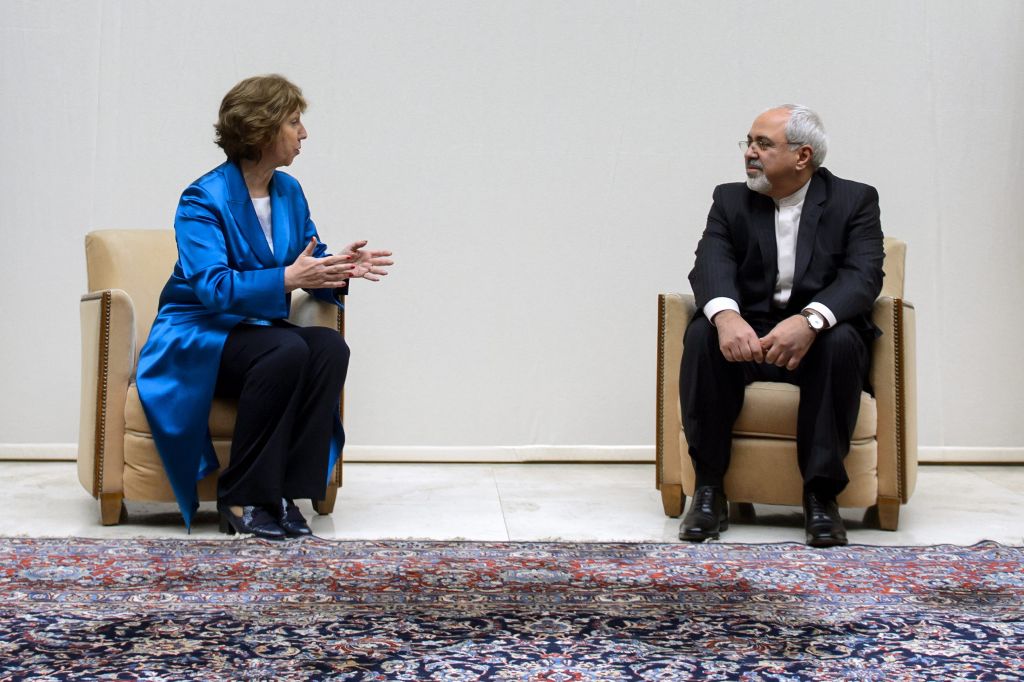
The end of nuclear talks in Geneva is front page fodder across the board in Israel’s Hebrew-language press Thursday, though each paper has a different take on the negotiations and their upbeat closing statement.
Israel Hayom leads off with the reactions (US happy, Israel skeptical), Maariv blasts off with the nut of the deal (fewer sanctions = less enrichment), Yedioth Ahronoth start things with its not quite an interview with Iran Deputy Foreign Minister Abbas Araqchi (“the nuclear talks have nothing to with Israel”) and Negative Nancy Haaretz reports off the bat that things are actually not going that swimmingly.
The paper’s Barak Ravid, dispatched to Geneva, cites US officials who say that despite the progress made, there is still a long way to go in terms of the easing of sanctions.
“There were still fundamental disputes between the sides, particularly with regard to the degree and type of sanctions relief the Iranians would receive in return for their proposal, the Americans said,” the paper reports.
Yedioth’s Lior Zilberstein, also enjoying the Swiss sunshine, snags a one-on-one with Abbas Araqchi. And by one on one, she means she caught him in the lobby of his hotel and, refusing to identify herself as Israeli, asked if the talks could lead to an improvement in relations with Israel. His answer: Israel has nothing to do with the talks. It can lead to a lot of things but it all depends.
A few minutes later, she details, she approached him again and, identifying herself as Israeli, asked for an interview. His unsurprising answer: You know I can’t do that.
Later, she writes, she found out that her scoop became big news in Iran, where Araqchi was lauded for refusing to speak to her. Actually, Araqchi did talk Wednesday to Israel Radio, whose correspondent insisted the deputy FM knew full well that he was addressing a representative of the Zionist entity.
Araqchi may think Israel has nothing to do with the talks, but Maariv reports that in the coming days a Western delegation will visit Israel to update Jerusalem on the goings-on in Geneva.
Emily Landau, from Tel Aviv University’s INSS think-tank, writes in the paper that from what we know of Iran’s tactics, offering gimcracks for gold, little has changed since the Ahmadinejad days. “The right way to see these talks is through the prism of the art of haggling,” she writes. “As long as there is no indication that Iran changed its nuclear program, or a decision to end its military nuclear drive, we need to look at each step as a bargaining tactic toward the international community. It’s reasonable to assume that the main goal for Iran is to end the painful sanctions. It is seeking the minimum amount of concessions on the nuclear issue and the maximum easing of the sanctions.”
Israel Hayom has the unshocking Israeli response, courtesy of an unnamed diplomatic official in Jerusalem. “Iran will be judged by its actions and not its presentations,” the source is quoted saying. “Until concrete steps are taken to prove that Iran is dismantling its military nuclear program, the international community should continue sanctions. Iran continues to violate the decisions of the UN Security Council, including the resolution which calls on it to suspend fully and permanently all uranium enrichment activities, the reprocessing of fissile material, and all heavy water-related activities.”
‘The occupation by another name’
Maariv, which has been following peace talks with the Palestinians with unmatched zeal, reports on an Israeli proposal to lease the Jordan Valley for 20 years so the army can maintain a buffer zone between a future Palestinian state and Jordan, but to nobody’s astonishment, the Palestinians rejected the offer out of hand.
“We cannot agree to that,” Hanan Ashrawi, a member of Fatah central committee, tells Maariv. “From our view it’s just the occupation by another name, which wants to rule over us again and control our lives. We won’t accept that in any form.”
The paper also reports, for the gabillionth time, that the talks are at a dead end.
Israel Hayom has the exciting news that after over 100 days with no Bank of Israel governor, and nobody noticing, Prime Minister Benjamin Netanyahu and Finance Minister Yair Lapid have sat down to pick one and will do so by Sunday. The paper reports on the three candidates: Zvi Eckstein (Lapid’s choice), Victor Medina (Netanyahu’s choice) and Mario Belcher. Notably missing from the list is acting governor Karnit Flug, whom Netanyahu has refused to appoint.
In Haaretz, Ari Shavit makes the oft-heard call of Ariel for Natanz, in other words, Israel should freeze settlements to pave the way for Iran freezing its centrifuges. “When Israel was in distress a decade ago, it did something: the disengagement from Gaza. To head off the threat of tightening international isolation, Israel initiated a daring step that changed everything and rescued the country. Now the trouble is doubled and redoubled, and therefore the actions must be double and quadruple. The truth that Netanyahu repeated time after time in his speech is not enough. The justice he claims time after time behind closed doors is also not enough. An ambitious initiative of ‘freeze-freeze’ is needed. A complete freeze of construction in the settlements beyond the Green Line, and a complete freeze of the centrifuges spinning; a freeze of the Israeli settlement enterprise, and a freeze of the Iranian nuclear program. Each of these suspensions is required in its own area. Each of these suspensions is essential to distance the darkening red line. But the combination of the two is a winning combination.”









The Times of Israel Community.